
Estimated reading time: 3 minutes
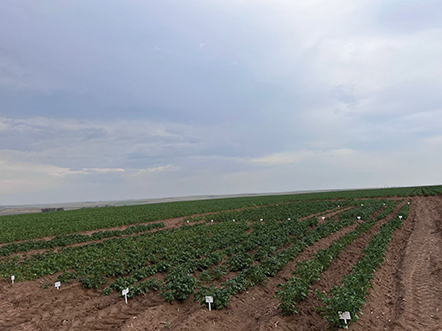
The Mpumalanga trial was planted on 30 October last year. This was the first cultivar trial planted in Mpumalanga in a while. Mpumalanga produces approximately 3.4% of South Africa’s potatoes and the bulk of it is exported to Mozambique. The most prominent cultivar grown in the region is Mondial.
Mpumalanga has very warm summers and cold winters, and experiences its highest rainfall during the month of December (approximately 200 mm of rain is received). The warm season in the region lasts for approximately three and a half months from December to March, with an average daily high of 25°C reported in 2024.
Trial design
The trial was planted in a randomised block design with three replications per cultivar. The main cultivars planted were Moonlight, Foxy, Mondial, K1, Lanorma, Lilly, Noya, and 55A5.
The purpose of the trial is to assess which cultivar performs the best given the climatic conditions of the region. This information can be used to guide the decision-making process of producers and allow them to make an educated decision as to which cultivar can be grown in their area.
Haulm and stem count
A haulm and stem count was conducted on 12 December last year. This entails counting the number of plants in one of the three repetitions. Ten plants are then chosen and a stem count is performed. When choosing a repetition to do a count on, it is important to check for any mechanical damage such as tractor tyre damage or areas where a pivot wheel may have affected the trial.
With regard to the stem count, research has shown a correlation between stem count and tuber numbers. With fewer stems there are fewer tubers, which can result in larger tubers. The main factor affecting the number of stems is the physiological age of the tuber.
Seed can be aged in two ways, namely chronologically or physiologically. The chronological age is the number of days which have elapsed since the tuber was harvested. The physiological age is the internal age of a tuber, which is determined by biochemical changes that take place within a tuber. While conducting the count it is important to also take note of any insect damage or the onset of blight, to name but a few characteristics.
Special thanks
Potatoes SA wishes to thank all the role-players as well as the producer, Fremax Farms, for allowing us to plant the trial on their land. Without their assistance these trials will not be possible. – Damien Da Cal, Potatoes SA
For more information, send an email to damien@potatoes.co.za.