
Estimated reading time: 9 minutes
During the 18th century, a German town decided to build a church. The first thing they did was plant trees around the proposed construction site. The reason was simple – they envisioned that their children could use these trees as rafters to complete the church.
“This is the ultimate definition of vision and that is also what our new potato producers are busy with,” Gert Bester, chairperson of Potatoes SA, said during the organisation’s 2024 Transformation Symposium held at the Birchwood Hotel in Kempton Park in February.
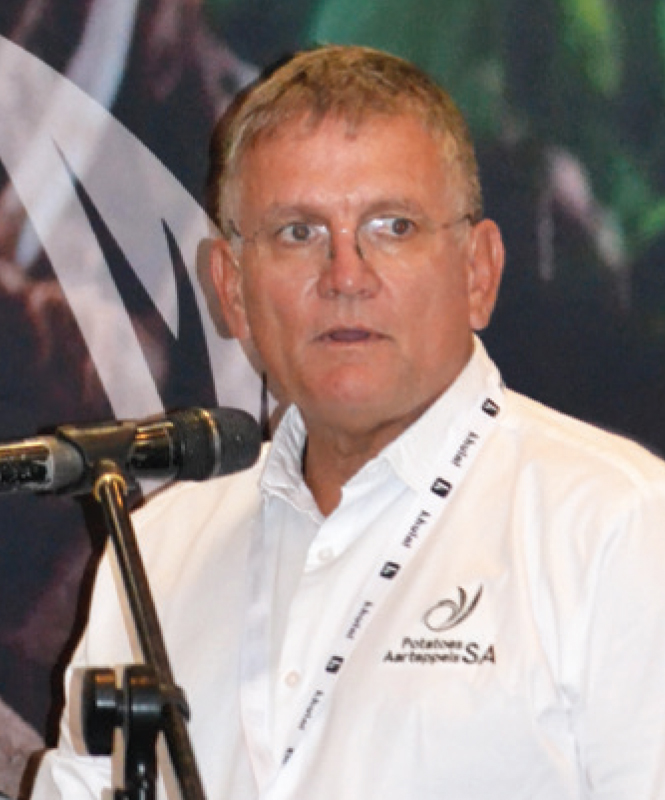
“Our new potato producers are also visionaries. They are first-generation potato producers, and they are building a legacy for their children and our country,” Bester said and addressed the producers directly: “You should never underestimate the struggle or value of the work that you are doing.”
Knowledge is power
Meshack Ndongeni, transformation chairperson of Potatoes SA, agreed with Bester that not enough reference is made to the fact that new producers are often first-generation producers.
While every achievement deserves recognition, the hardship of first-generation producers should not be forgotten. He added that it is important to honour all those who assist these producers to progress in their journey from emerging to becoming commercialised.
“Various Potatoes SA producers are helping our producers to transform, and we are thankful for the vast knowledge within the industry that is shared freely with our new producers.” However, Ndongeni added that Potatoes SA’s support is not limited to producers transitioning to commercial status. The organisation also looks out for small-scale producers who cultivated a mere 0.5 to 1 ha of land to ensure food security for their families. “We try to upskill and uplift all new potato producers.”
Ndongeni said the growth opportunities in the potato industry are endless. “I do not know why it is not the biggest crop in the country. Potatoes are wonderful and we should continue this drive to ensure that it becomes the biggest crop.”
The impact of investment
Rendani Murovhi, transformation manager of Potatoes SA, added that the future of transformation in the potato industry looks brighter than ever before. “The past decade’s work has been combined in a portfolio and we use this to attract greater investment.”
This investment has significantly empowered black producers, leading to a substantial increase in the total cultivation area under the Enterprise Development Programme (EDP). It has grown from 40 ha of potatoes planted in 2011 to over 350 ha under production in 2024 (Figure 1). Lack of funding has limited the intake of new entrants into the programme, but the support provided allows producers to expand their potato production and acquire more external funding.
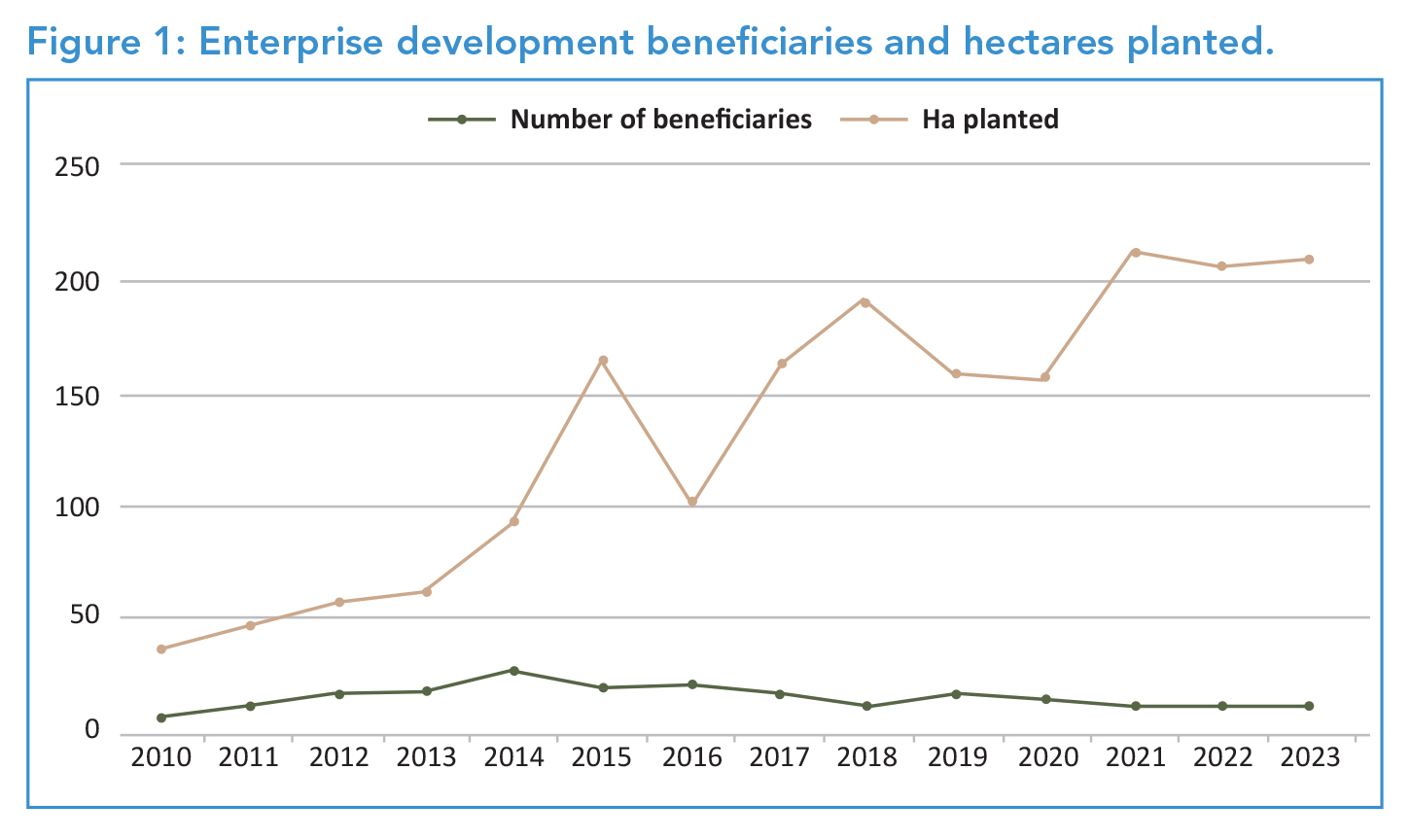
Although only over 350 ha is reported and recorded under Potatoes SA programmes, there are over 400 ha of potatoes planted by black and commercial producers, including those funded by the Department of Agriculture Land Reform and Rural Development (DALRRD).
However, Murovhi indicated that even more investors were needed to drive transformation within this agricultural subsector. “Because our funding only comes from the statutory levy, we need partners to help us fast-track the pace of transformation within the potato industry.”
Presently there are successful partnerships that include DALRRD, Agri SA and other industry role-players. While the wheel seems to be turning slowly, it is turning. She thanked the commercial potato producers who were helping Potatoes SA drive this initiative.
Managing the market
Angelo Petersen, chairperson of the National Agricultural Marketing Council (NAMC), said it is important to keep in mind that the potato industry is operating in a VUCA world (volatile, uncertain, complex, and ambiguous). “Currently it is also violent and chaotic.”
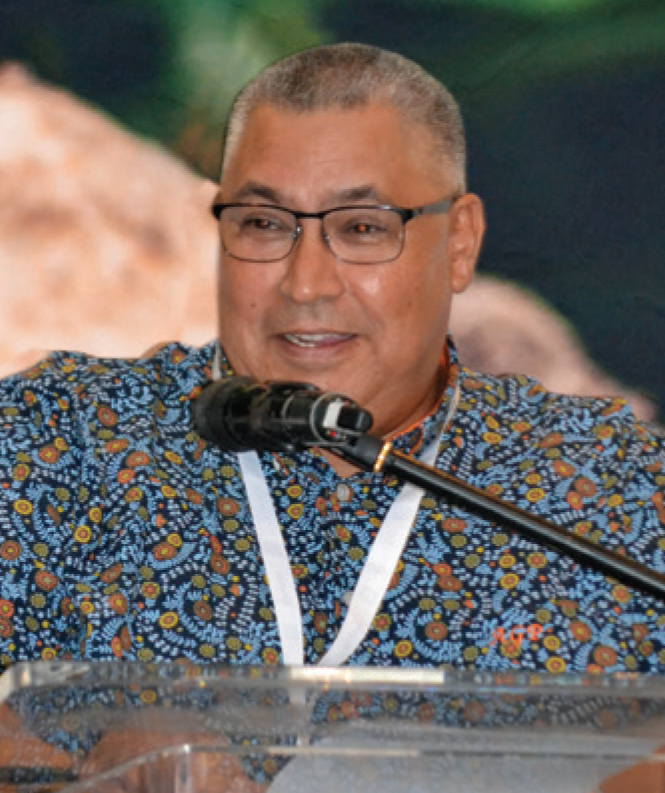
Within this context – where geopolitical conflicts are disrupting supply chains and leading to higher input costs – partnerships are crucial to enable transformation in the South African agricultural sector, Petersen said. “We need to understand that transformation goes beyond the planting and harvesting of crops. It needs to look at all aspects of farming, including the successful marketing of produce, for example.”
Petersen said transformation is expensive and therefore it is important for parties to work together to find ways to lighten this cost burden. “The culture that we need to encourage is one of innovation and knowledge exchange. This will help us to find collaborative solutions to the challenges we face.”
Infrastructure issues, such as road and port infrastructure, including loadshedding, are serious threats to South African agriculture. The latter is especially of grave concern to black producers and agribusinesses, Petersen added. “Our roads need to be fixed. If government is unable to do this, we should do it ourselves. But it must be fixed.”
Finally, the dualistic nature of the country’s agricultural sector remains concerning. “Despite a considerable investment in transformation, black producers are only producing 10% of agricultural outputs and their income is equal to this. So, we need to ask ourselves whether we are getting the best return on this investment. Should this market share not be at least 20% by now?”
Unemployment challenges
Medupi Shabangu, executive manager of learning programmes and projects at the Agricultural Sector Education Training Authority (AgriSETA), said while all sections of the Sector Education Training Authority (SETA) have spent R9 billion over the past three financial years, it is impossible to ‘outskill’ unemployment. “We need economic growth and relevant skills to combat this.” Relevant skills refer to skills that still matter within an artificial intelligence (AI) work environment.
Shabangu said it is important that newly trained individuals in the agricultural sector regard themselves as their own first employer. “We need to establish producers that will create jobs for the future.”
Karidas Tshintsholo, co-founder of the agricultural financing and input platform, Khula!, said it is important not to generically label primary producers as ‘producers’. “We’ve learned that there are at least five different types of producers.” They are:
- C1 – Extremely small-scale, garden producers.
- C2 – Small-scale producers who consume half their produce and sell the other half to market.
- C3– The so-called emerging producers that have not yet fully crossed over to commercial production.
- C4 – Commercial producers.
- C5 – Mega producers.
Tshintsholo said many producers advance from C1 to C2 or C3. However, the transition from C3 to C4 is a hurdle for many. “This means that producers can remain ‘emerging’ for their entire lives.” Usually, these producers might have 100 ha of land available, but they are restricted to only cultivating 10 ha. This limitation is primarily due to their inability to afford a larger crop owing to insufficient access to credit.
“While we often hear of money being set aside, especially for these producers, the reality is that they cannot gain access to the credit, because they do not have a title deed, credit score, or audited financial statements.” Hence they cannot access finances that have been ringfenced for them.
Partnership to fuel change
To help emerging potato producers, Khula! and Potatoes SA recently signed a memorandum of cooperation. Absa finances the deal, while Khula! ensures that there will be a buyer for the produce and that a portion of the income is used to service debt. To ensure that the borrowed money is used for the intended purpose, a part of the funding is deployed in terms of vouchers, which can then be used on the Khula! marketplace platform.
Abrie Rautenbach, head of AgriBusiness at Absa, said producers need to keep records of everything they did. By doing this, over time their cashflow model will naturally follow, and this will enable them to make better decisions.
Simone Olifant, transformation manager at Raisins South Africa, said without private sector funding her work would not be possible. “My transformation programme receives between R2 and R4 million annually from levy income, but our projects cost between R20 and R30 million. The shortfall is made up by partnerships.”

While it is wonderful to see the impact that Raisins SA could make to help with transformation, the lack of knowledgeable transformation officers is a problem for Olifant. “It is problematic that I know more than our extension officers, and I need to train them. And then, just when I’ve trained them, the department moves them to a different crop. A lot of money and time are lost in the process.”
Mentorship is key
Aldrin Lawrence, a former recipient of the EDP of the Year Award, discussed his road to success. He said mentorship was one of the most important things that every producer needs. “My first potato harvest was a big success because I followed my mentor’s instructions. And he was invaluable in introducing me to the open market.”
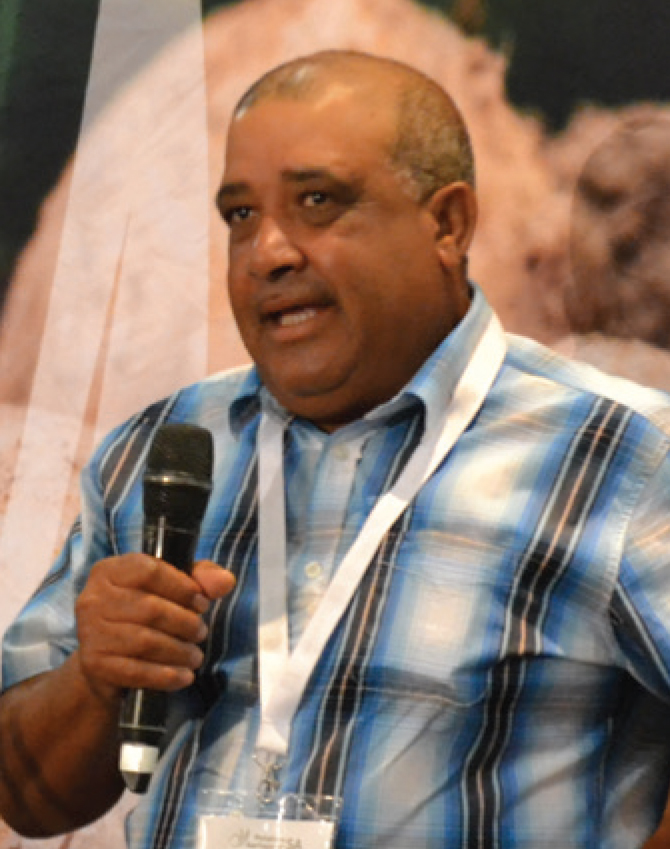
Another important thing is to keep your reputation intact, Lawrence added. “It is important to pay your debts, before doing anything else. Remember, those were the people that were willing to help you when you had nothing. Keep those relationships intact.”
Wandile Sihlobo, chief economist at Agbiz, said growth in the agricultural sector is not only important to the sector’s economy but to the country’s in general, given the high unemployment rate. “No other sector can create jobs such as the agricultural sector. This sector’s job multiplier effect is two to three times higher than any other sector’s.”
However, five issues need to be addressed for the sector to thrive: biosecurity, a broadening of international market offset points, logistics, agricultural finance and land and land release. Willie Jacobs, CEO of Potatoes SA, said ongoing, emotional discussions are crucial to making transformation work. “In the potato industry, we are a family and families work with emotion. The emotions that we need to cultivate are gratitude, kindness, passion, compassion, and love.”
For more information on the Potatoes SA Transformation Symposium, visit www.potatoes.co.za.