
Estimated reading time: 12 minutes
The potato tuber moth, Phthorimaea operculella, is originally from South America and has been a pest in South Africa on potatoes for more than 100 years. It occurs in all production regions and is especially problematic during hot years and in areas with low rainfall.
Moth larvae attack the plant foliage and tubers. The most damaging period is at the end of the season when the tubers below ground are also attacked. The potato plant is the primary host but tobacco, tomato, peppers, and eggplant are also affected. Several broadleaf weeds serve as alternative hosts. Although the potato tuber moth has several natural enemies, control is mainly chemical. Monitoring by means of pheromone traps is one way of determining the pest pressure in farmlands.
Damage to foliage
Potato tuber moth larvae are leaf miners that tunnel into the plant tissue (foliage and tubers). Mines are mainly formed in the leaves, between the two epidermal layers, but sometimes growth points are also attacked.
Larvae will not, however, tunnel down through the stems to the tubers below ground. It is important to note that Tuta leafminer (P. absoluta), also known as tomato leafminer, also occurs in potatoes. It attacks the leaves while potato leafminer damage is found on the leaves and tubers.
Leaf mines are mostly inconspicuous ‘window-like’ marks that can be recognised as those of the potato tuber moth by holding them up against the light. The damage to the above-ground parts of the plant does not necessary lead to economic losses, since moth infestations during the growing season do not usually occur in such high numbers that plants are completely stripped of foliage. If large numbers of moths do colonise a field early in the season, very small or young plants will be negatively affected.
Moth infestation of the aboveground parts of plants can put subtle stress on the plant and possibly cause wounds through which pathogens can access the plant.
Tubers below ground
When the first instar larvae reach a tuber below ground, the tuber is immediately penetrated (not necessarily at an eye), after which the larvae eat small tunnels under the skin. Older larvae will then go on to create larger and deeper tunnels. Since the first instar larvae are so small, there is usually no sign of where the larvae have penetrated the tuber.
The tunnels created under the skin will later collapse, decay and darken in colour, which gives the tuber the characteristic symptoms of potato tuber moth damage. Although above-ground infestation does not necessarily lead to losses, it plays an extremely important role in the build-up of populations, which can lead to serious crop losses later in the season. Without adequate pest control, the moth population will be extremely high at the end of the season. Thousands of moths will be flying around and continue laying eggs, while the amount of foliage and green plant matter becomes less.
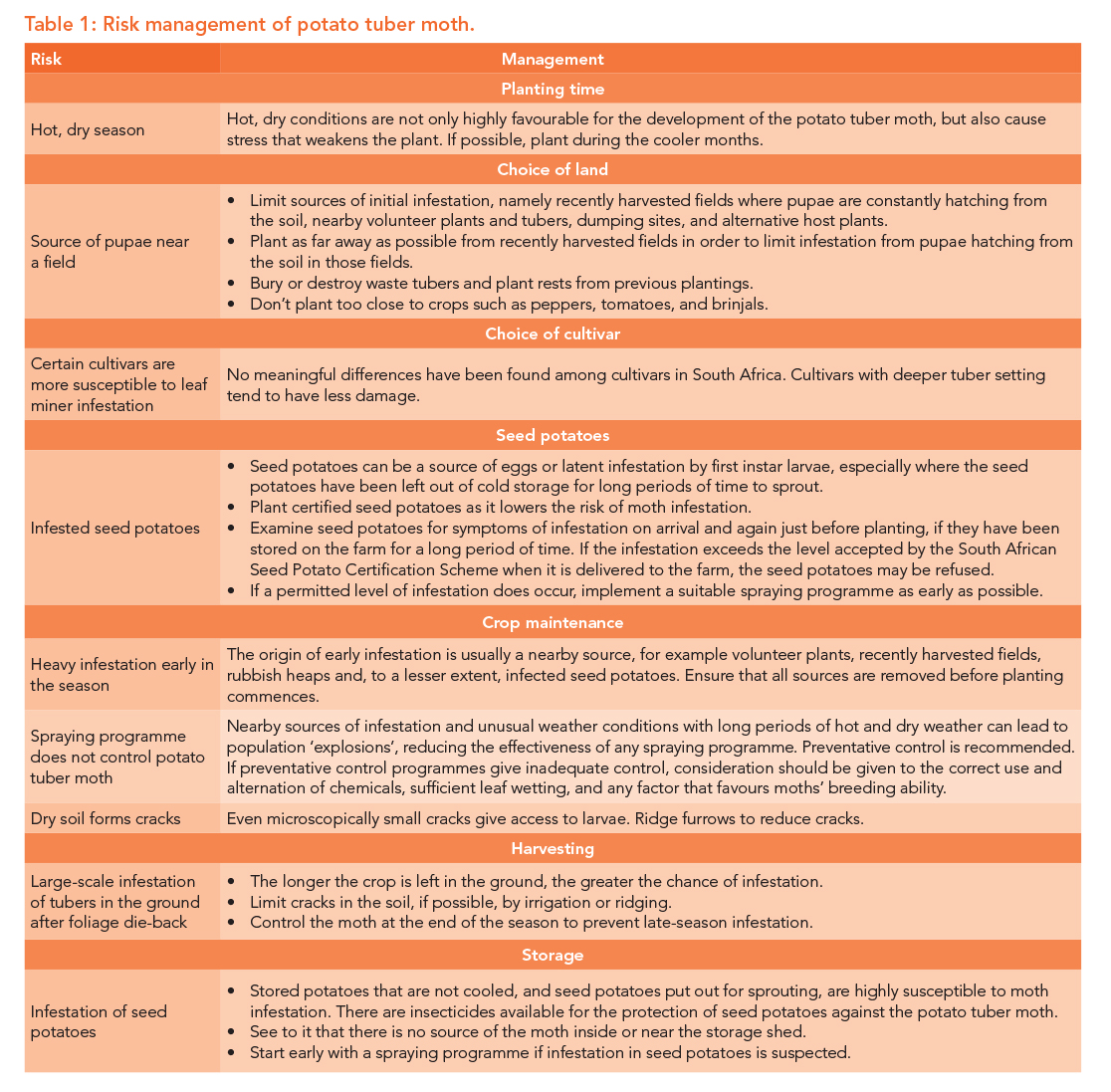
Even after foliage die-back, most moths will continue to lay eggs on dead plant matter and on the ground. This means that hundreds of thousands of first instar larvae can occur in a field and penetrate cracks in the soil while looking for food.
Enlargement of tubers prior to foliage dieback results in numerous microscopic cracks in the soil, which serve as ideal access points to the tubers. The infestation of tubers during foliage die-back can lead to serious crop losses – up to as much as 80%.
Tubers in storage
If a second or third generation is allowed to develop, the entire contents of the storage shed can be destroyed within two months. The first instar larvae penetrate the tubers mainly at the eyes, after which they tunnel under the skin. Deeper tunnels are formed in the tuber over time.
The damage symptoms differ in tubers taken from the ground compared to tubers in storage. Tubers that are attacked while in storage display fewer characteristic tunnels, but they have clearly visible excreta, mainly at the eyes.
Infestation
When moths colonise a potato field, the above-ground parts of plants are usually their first target. The moth does not always lay her eggs on the plant only, but also anywhere near the plant. The larvae will then move around until reaching the plants or the tubers below ground.
Unless potatoes are planted alongside a field that is heavily infested, the potato moth will usually enter farmlands in low numbers.
These numbers must first grow to a much larger population before the larvae will have any effect on the crop.
Four to five generations of the moth will usually breed during one season in the summer. Moths that enter storage sheds from outside, as well as infected tubers that are brought into sheds, can both lead to the infestation of tubers in storage sheds.
Life-cycle and stages
Moth and eggs: The adult potato tuber moth is 8 to 10 mm in length.
The moth is nocturnal and usually active just after sunset. The male moth locates the female through pheromones excreted by the female. Mating occurs immediately, and the female lays all her eggs within two to three days. A single female lays approximately 200 eggs on plants or on the ground beneath plants.
In warm weather, the eggs will hatch within three to five days. The moth has a lifespan of one to two weeks and it does not need to feed, but is able to live for a few days longer if it has access to liquids.
Larvae: The first instar larvae that hatch are approximately 1 mm long.
They will actively move around in search of a place where they can penetrate the plant. They mine into the leaves between the upper and lower layers of the leaf. In the process, window-like tunnels are formed. Larvae will also sometimes tunnel downward from the growth points. The larvae eat and live in this protective environment, so they are usually never observed on the plants. In hot weather the larvae will be fully grown within two weeks, but in colder conditions this process can take months.
Pupae: The final instar larvae (approximately 12 mm in length) leave the plant and move towards the ground surface (downwards from the above-ground parts of plants, and upwards if the tubers were infested), where they spin a cocoon in which they pupate. The cocoon, which is reinforced and camouflaged with sand particles, offers protection against natural enemies and is not normally visible with the naked eye. Where there is no sand available, for example in storage sheds, the larvae will use dust particles, and where there are no dust particles, cocoons are simply spun from silk in cracks and crevices.
The larva will transform into a pupa in the cocoon within two days, and after seven days the moth will emerge from the cocoon.
Effect of temperature on life cycle
Temperature plays an important role in the potato moth’s development rate. However, it is important to be aware that at no stage does the moth hibernate. All stages (eggs, larvae and pupae) will continue to develop, even in the coldest winters, with daytime temperatures above 10°C. It is only at temperatures below freezing and during long periods of temperatures above 33°C that mortality will set in.
The following guidelines apply for the duration of the lifecycle stages at temperatures between 26 and 30°C:
- Eggs – as few as three days.
- Larvae – as few as nine days.
- Pupae – as few as five days.
- Moths – one to two weeks, but with eggs being laid within four days.
The lower the temperature (below 26°C), the longer the duration of lifecycle stages. Under conditions of 26 to 30°C, a new generation can thus develop within three weeks. Under field conditions (cool nights), this usually takes four to five weeks.
Management with insecticides
More than 130 insecticides are registered for use against the potato tuber moth in South Africa. They are represented by approximately 29 active ingredients, with some being combinations of active ingredients.
The older products are mainly organophosphates, pyrethroids and carbamates.
However, several new groups have been registered and producers must now alternate between a wide range of pesticides. Alternating between different chemicals is one of the most important strategies for the prevention of immunity in insect populations.
Alternating chemicals
Make a list of the insecticides you have or which you want to use. Each insecticide (active ingredient) is classified into one of 28 resistance groups – the group should be indicated on the label.
If you are unable to identify the resistance group, download an explanatory document from the website www.irac-online.org/countries/southafrica/publications/.
This publication lists most of the active ingredients and the groups into which they are classified. The resistance groups are categorised in such a way as to give the producer an indication of which groups are interrelated regarding their effect on pests. It is therefore recommended that pesticides falling into the same group are not alternated with one another (they will have the same effect, which will accelerate the building of resistance to them).
The most common means of alternating is to use a different group of insecticides for each spray application. A method that is sometimes used is ‘block spraying’, where the same chemical (or the same group of chemicals) is used for two to three consecutive applications (at the recommended intervals), after which it is not used again for the rest of the season. Alternating in this way is recommended only for pests with a life cycle longer than the duration of the ‘block’.
For the potato tuber moth, with a life cycle of approximately four to five weeks, this means that block spraying with one particular chemical should not be done for longer than four weeks (two to three applications). The labels of some insecticides give more information on block spraying, as well as the maximum number of times the particular chemical may be used in a single season.
Poor control by producers is likely due to a combination of factors: environmental conditions (hot and dry weather), nearby sources of inoculum (rubbish heap or recently harvested field), and sub-optimal application practices. Studies are also showing a shift in sensitivity of the older modes of action.
Time of application
Most integrated pest-control programmes recommend that spraying commences as soon as certain threshold values (number of insects or symptoms of damage) are reached. The labels of some insecticides also give an indication of when spraying should commence.
The leaf mines created by the potato tuber moth larvae are not always visible or conspicuous. Moreover, there is no scientifically founded threshold value available to determine when spraying should commence.
For these reasons, and because the potato tuber moth is one of the most destructive potato pests, most producers start spraying about two weeks after emergence.
Spraying programmes
There is no standard spraying programme against the potato tuber moth. Specific regions have devised their own programmes over the years for recommendation to their clients. Such programmes are adjusted regularly as new chemical groups come onto the market.
Broad guidelines include:
- Ensure that equipment is calibrated and in good working order, and see to it that chemicals are used and alternated correctly (follow the directions on the label carefully).
- Ensure sufficient leaf wetting.
- Do not spray under unfavourable conditions, for example at the hottest time of the day and/or when there is a strong wind blowing.
- Systemic or translaminar chemicals work best when plants are still actively growing (before the second half of the season).
- If the population pressure is high, or if conditions are favourable for the moth (long periods of hot and dry weather), use the shortest spraying interval as indicated on the label.
- Target the product at the correct site. At the end of the season it is important to protect the ridges to prevent tuber damage.
Tank mixtures
The mixing of different pesticides in a single tank (including chemicals to control plant diseases) may only be done on recommendation of the relevant suppliers or manufacturers.
Some mixtures may be detrimental to plants, while some mixtures/additives must be added to the spray tank in a particular order.
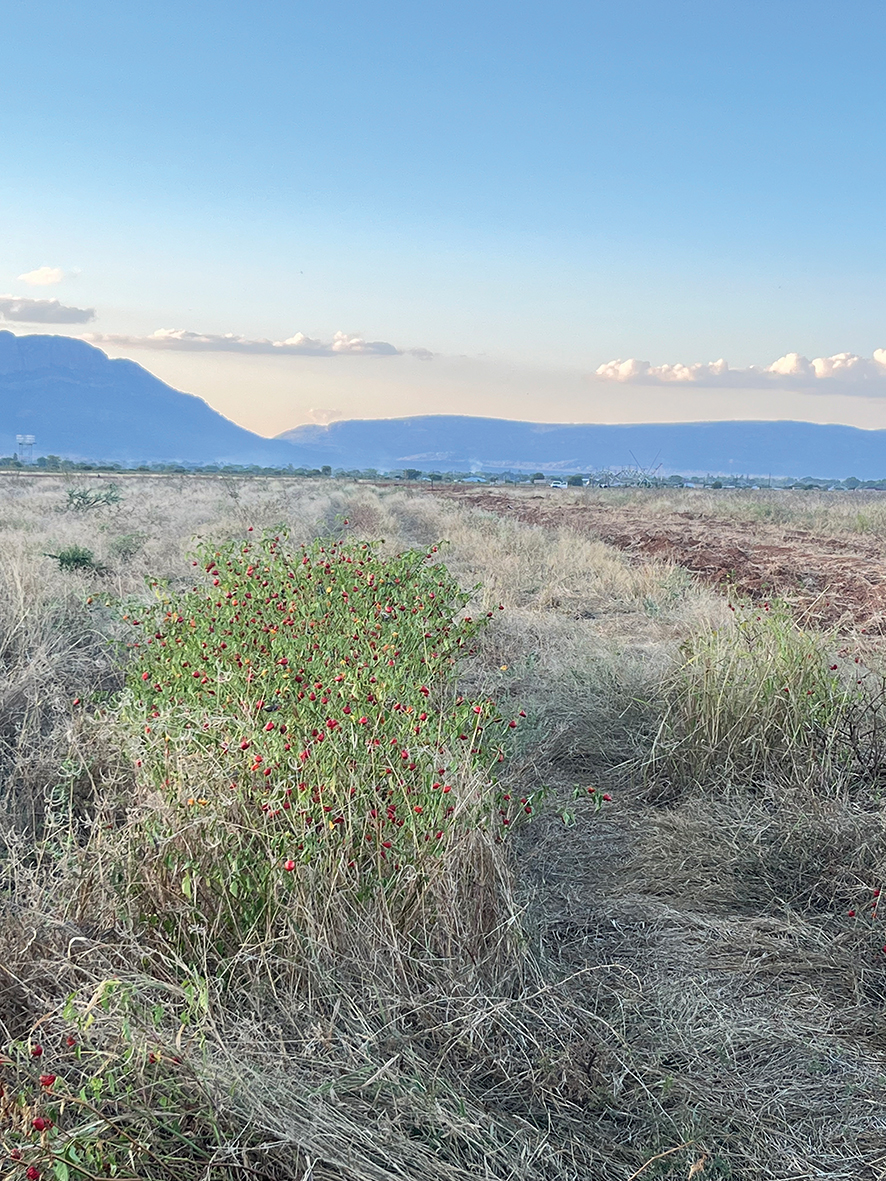
Other host plants include tobacco, tomato and eggplant. Weeds of the Solanaceae family are also susceptible. In the off-season, the potato tuber moth may survive on these crops in low numbers, but not as a major source of infestation.
Monitoring with pheromones
Pheromones are the volatile excretions of the female potato tuber moth, which attract males over long distances for purposes of mating. The pheromone is commercially available in the form of rubber capsules, for monitoring in pheromone traps. The only way to accurately determine moth numbers, or to determine whether moth numbers are rising, is through the use of pheromone traps.
Potatoes SA is conducting research on the correct use and placement of pheromone traps in farmlands. The current, untested recommendation is for the placement of one trap per quadrant of farmland (large farmlands), on top of furrows and at least 15 m in from the closest edge of the farmland. Although commercial traps and pheromone capsules are available in South Africa, most producers make their own traps.
Ridging
Regular ridging will seal cracks that are formed during the growing season and will also protect exposed tubers. Ridging is often scaled down towards the end of the season, and it is precisely then that the moth larvae burrow down to the tubers under the ground.
Sanitation is the process of reducing or eliminating sources of moth infestation. Such sources include volunteer plants and tubers that remain behind after harvesting, dump sites, infected seed, and alternative host plants. Of these, volunteer plants and tubers that remain behind in nearby fields after harvesting are the most important.
Rotation crops belonging to the Solanaceae family should not be used in a rotation programme. If possible, new fields should be located as far away as possible from recently harvested fields.
Seed potatoes
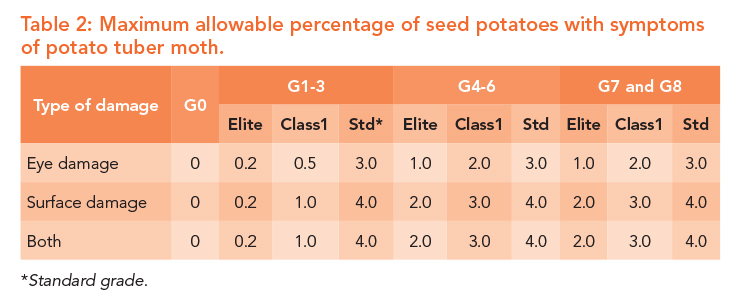
Certified seed potatoes reduce the risk of early infestation. Seed potatoes are susceptible to the potato tuber moth after certification, and especially during storage. The longer the storage period, the greater the risk. When seed potatoes are inspected on arrival at the farm, particular attention must be paid to eye damage.
Natural enemies
The potato tuber moth has several known natural enemies. These include predators that catch and eat moths, as well as tiny wasp parasitoids that infect and kill the eggs and larvae.
There are primarily two imported parasitoids, namely Copidosoma koehleri and Apanteles subandinus, which are responsible for a very high mortality rate among the potato tuber moth in South Africa. However, both these parasitoids are highly susceptible to insecticides and are usually found in very low numbers in areas where spraying programmes are followed.
Planting and harvesting schedules
A planting schedule that results in a crop that grows mainly during the cooler months of the year, will lower the risk of infestation. The longer it takes before the crop is harvested, the greater the chances of tuber infestation. – Compiled and published by Potatoes SA
For more information, visit www.potatoes.co.za.