
Estimated reading time: 5 minutes
The South African potato industry is no stranger to technological advancements. The question is, how do we move from the mindset of ‘doing it how it has always been done’ to evolving, innovating, and enabling the future of potato production?
This topic will be the central theme of the Potatoes SA Innovation Symposium on 23 and 24 July at the CSIR International Convention Centre in Pretoria. The event will serve as a platform to review the latest research, explore disruptive opportunities, and develop enablers for a more resilient potato industry.
South African potato producers operate in an increasingly complex environment. The industry faces escalating input costs and tighter legislation regulating, among others, crop protection, water use, biosecurity, and labour. The question is whether these pressures offer an opportunity to innovate or not. Can we evolve beyond reactive plans to treat symptoms with costly inputs, or rather focus on enabling healthier crops and production systems that respond to both environmental needs and consumer demands?
The status of potatoes
South Africa’s potato industry compares well with the best in the world, with over 51 000 ha planted to potatoes annually. The average South African potato yield of 49 t/ha compares favourably to that of countries such as Australia and the United States, often outperforming many European countries.
It is also important to highlight that potatoes contribute substantially to local food security as well as the informal economy via potato traders in townships and street food entrepreneurs. GG Alcock, a well-known author who writes extraordinary stories about kasi businesses in South Africa, estimates that the kota industry alone generates R12 billion per year.
With production costs averaging R240 000/ha for fields under irrigation, one understands why many potato producers are becoming more concerned about the risk associated with climate variability and demanding consumers. Break-even prices are tightening and the margin for error is shrinking.
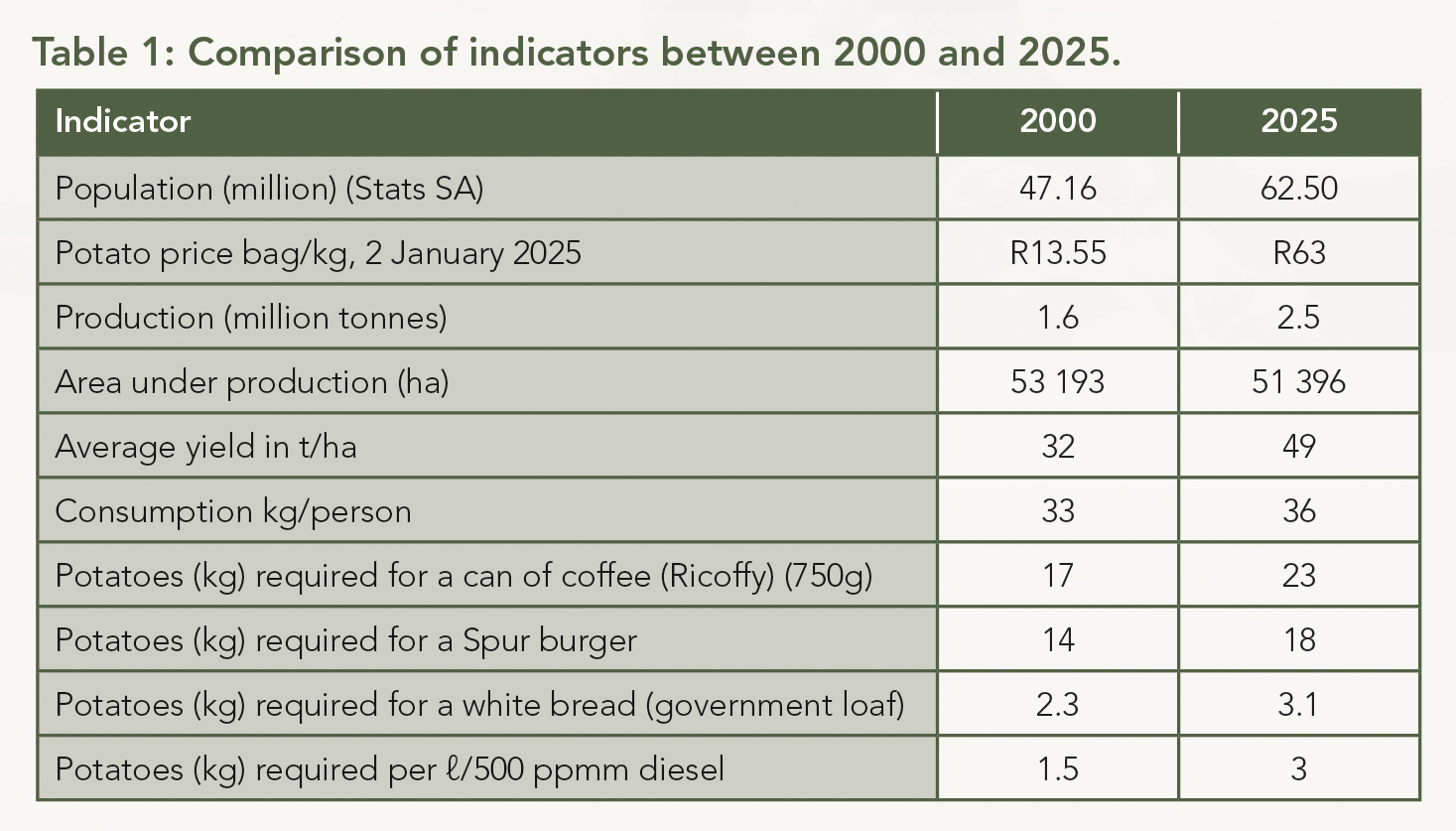
Currently, producers keep investing in marginal improvements based on promises by input suppliers. Promises of better seed, better yield, better control, better prices, or better rates keep the wheel turning. It appears to have worked as South Africa produced 1.6 million tonnes of potatoes on 53 193 ha at an average yield of 30 t/ha in 2000. Today, it produces 2.5 million tonnes on 51 396 ha at an average yield of 49 t/ha. We are indeed continuously improving.
Table 1 illustrates how yields improved while the planting area remained stable – however, the value is not necessarily improving. Per capita consumption has increased from 33 to 36 kg, while the population grew from 47 to over 62 million. But the real buying power of a potato is declining compared to basic goods such as coffee, burgers, white bread, and even diesel. Currently, potatoes offer great consumer value considering its diversity as a food source that can be included in any meal; this value is not often attributed to other basic foods.
Change is inevitable
Too often, agricultural innovation mimics existing industry trends. Input providers offer promises such as ‘grow more, waste less, save money’ when introducing new product offers. True innovation, however, lies in rethinking the model itself.
Consider a lesson from history during the 1800s when the Western Union Telegraph Company dismissed Alexander Bell’s telephone as a toy. Yet, within a few years, the telephone became the foundation of communication. The same happened in telecommunications and other industries such as photography where cameras went digital. This also applies to agriculture.
The potato sector does not have to repeat the same mistakes as other industries by overlooking new farming models, alternative supply chains, and new consumer markets simply because they do not scale the way we are used to.
Rethinking the future
According to agricultural technology thought leader, Dan Schultz, the greatest barrier to innovation in potato production is not funding or access to technology – it is the inertia of tradition. When the widely used nematicide, aldicarb, was banned in 2014, producers were forced to adjust.
Is it easier to adapt proactively than reactively? One important area that Potatoes SA’s research is proactively adapting to is ways to improve soil health.
Instead of targeting more tonnes/ha or higher cost/bag, success should be centered around resilience, equity, and relevance.
Most new ideas in agriculture do not fail because they are flawed, but because they try to succeed by replacing something else. It is time to imagine new ways of creating and capturing value by considering new possibilities, such as:
- Branded, traceable potatoes that are marketed based on sustainable practices such as soil health.
- Smart data usage to predict pest and disease outbreaks similar to ‘Waze’ for farming.
- Supply chain restructuring where growers earn royalties for unique varieties or novel practices.
- Shared risk-and-reward models between producers and input providers, driving mutual success.
Input providers
Input companies often compete by offering incremental product improvements. But producers do not switch to ‘slightly better’ results. They switch when they see a future they want to be part of.
Input providers can take the lead by avoiding benchmarking competitors and rethinking agriculture by positioning themselves as partners rather than product suppliers, by building systems that work differently and not only more efficiently, and sharing risks and rewards.
The next era of successful potato farming in South Africa will not depend on better spreadsheets or smarter drones. It will be achieved by those who dare to do something different.
2025 Innovation Symposium
The Symposium seeks to respond to these challenges and invites all stakeholders to help shape strategies that innovate for value, and not only volume. Key areas of focus include reducing input costs through smarter decision-making which includes avoiding unnecessary ‘just-in-case’ applications and increasing the perceived and actual value of potatoes by reviewing new production practices and improving consumer interest.
The 2025 Potatoes SA Innovation Symposium is not just an industry event. It is a catalyst for new thinking and a place to converse, challenge, and connect. We invite producers, researchers, suppliers, policymakers, and innovators to join us to redefine what success looks like. Join us as we evolve, innovate, and enable the future of potato farming in South Africa. – Dirk Uys, research and innovation manager, Potatoes SA
For more information, send an email to Dirk Uys at dirk@potatoes.co.za.