
Estimated reading time: 8 minutes
Pepper ringspot virus (PepRSV) has been recognised over the past five years as an emerging virus in South Africa. It is frequently present, but often without visible field symptoms. Although it first drew attention through unusual corky ringspot symptoms in potato tubers in the Northern Cape, ongoing research has shown that the virus is far more widespread than symptoms alone would suggest and can infect a wide range of other crops commonly grown in rotation with potatoes.
This article summarises current knowledge of PepRSV in South Africa, drawing on national surveys, host-range studies, and field observations. It aims to provide potato producers with a clear and practical perspective.
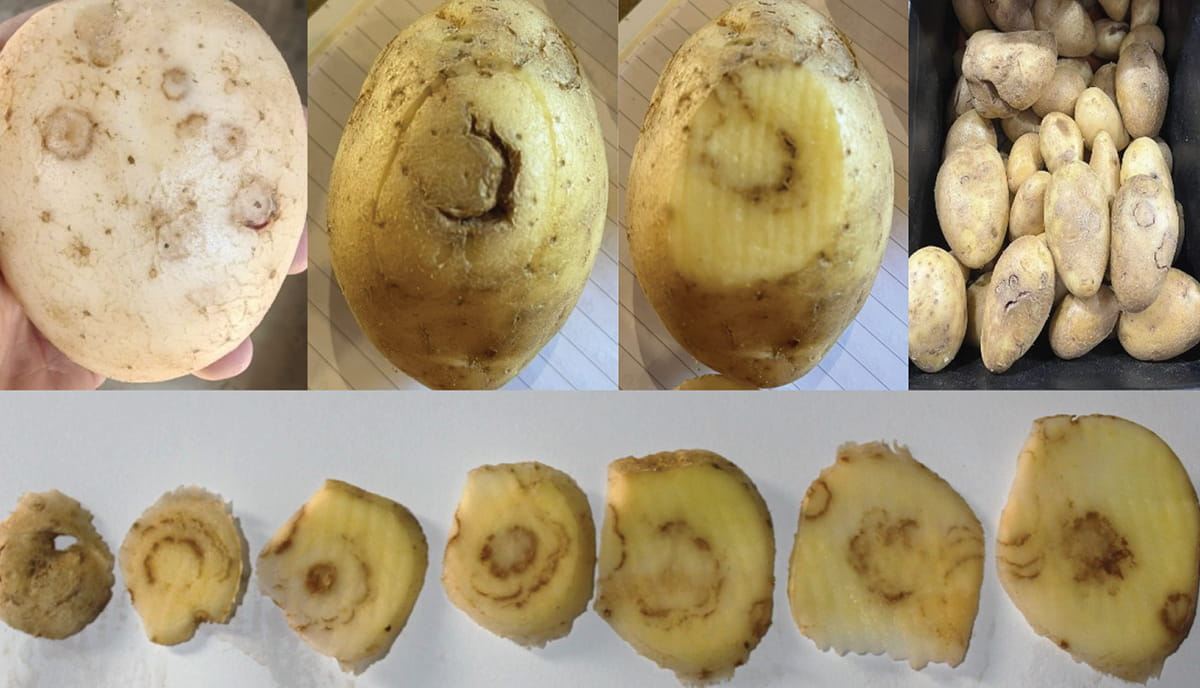
How widespread is PepRSV?
The National Department of Agriculture funded the Agricultural Research Council (ARC) to conduct a national survey to determine the geographical distribution of PepRSV in South Africa. Potato tubers were collected at regular intervals over roughly two and a half years from the Johannesburg and Cape Town fresh produce markets, and screened for PepRSV using polymerase chain reaction (PCR)-based diagnostic tests.
A total of 1 854 potato samples were screened across 32 market-day sampling events. When all results were combined, 38.7% tested positive for PepRSV, while only about 3% showed visible symptoms. Although detection levels varied between sampling dates, PepRSV was detected throughout the survey period, indicating its sustained presence in the potato supply chain.
Because each market sample could be traced back to its production area, as recorded on potato bags at the point of sale, the survey also provided insight into the geographical distribution of PepRSV. Based on sample origin data, PepRSV was detected in potatoes originating from eight of South Africa’s nine provinces. The remaining province, the Eastern Cape, was represented by only a single sample, which was insufficient to draw conclusions.
Together, these results indicate that PepRSV is widely distributed nationally, rather than confined to specific production regions. While repeated detections were observed in certain production areas over the survey period, the market-based sampling design does not allow for reliable estimates of provincial prevalence or incidence, as sample sizes varied with seasonal production and market supply patterns.
A virus that often goes unnoticed
PepRSV frequently occurs without obvious symptoms under South African field conditions. In market surveys, only approximately 3% of PepRSV-positive samples displayed typical spraing symptoms. Similarly, repeated sampling of fields with a known history of PepRSV infection has shown that potatoes in subsequent seasons can test positive for the virus despite the absence of visible tuber symptoms, while foliar symptoms are rarely observed.
This makes field detection extremely difficult and increases the likelihood that infected material may be propagated or distributed without being recognised. Comparable symptomless infections have been reported for related tobraviruses such as tobacco rattle virus (TRV), demonstrating that the absence of visible symptoms does not equate to the absence of infection.
What else can PepRSV infect?
The widespread and repeated detection of PepRSV across South Africa raised an important question: why is the virus so frequently detected in potato production systems? One possible explanation lies in the broad host range of the related tobravirus, TRV, which is known to infect hundreds of plant species worldwide.
In countries such as the United States, the Netherlands and the United Kingdom, TRV persists in potato production systems primarily because it is maintained in alternative crop and weed hosts through transmission by stubby-root nematodes of the family Trichodoridae, even where long crop rotations are practised.
To investigate whether PepRSV behaves in a similar way under South African conditions, a series of controlled pot trials was conducted over a two-year period to determine the host range of the virus.
For the initial trial, soil was collected at harvest from a commercial potato production field near Reitz in the eastern Free State, where severe corky ringspot and spraing symptoms were observed. Soil was collected at this stage to maximise the likelihood that both the nematode vector and PepRSV were present as active inoculum. Stubby-root nematodes present in the soil were morphologically identified as Nanidorus minor, the nematode species currently known to transmit PepRSV in South Africa.
The infested field soil was placed in pots and planted with a wide range of crops, including vegetables, grains, legumes, forage crops, and grasses commonly grown in rotation with potatoes (Table 1). Clean, nematode-free soil was used for control plants. After ten weeks, the roots and above-ground tissues were tested separately for PepRSV infection.
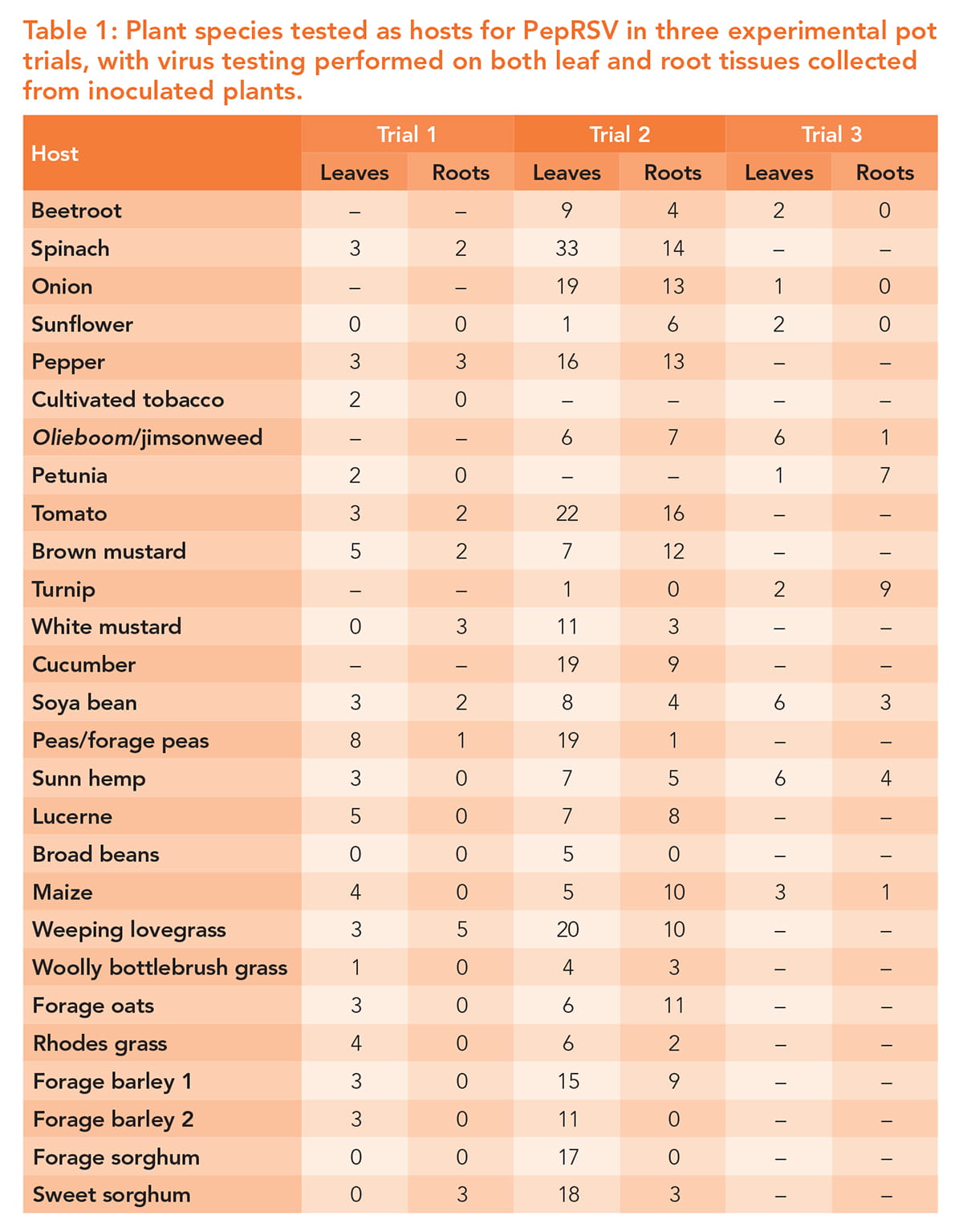
When results from all three host-range trials were combined, a consistent pattern emerged: every plant species tested was positive for PepRSV in at least one trial, either in the roots, in above-ground tissues, or in both. Importantly, many of these hosts are crops routinely used in potato rotation systems. This means PepRSV can potentially persist in the soil between potato crops via its nematode vector, even when potatoes are planted only once every four years.
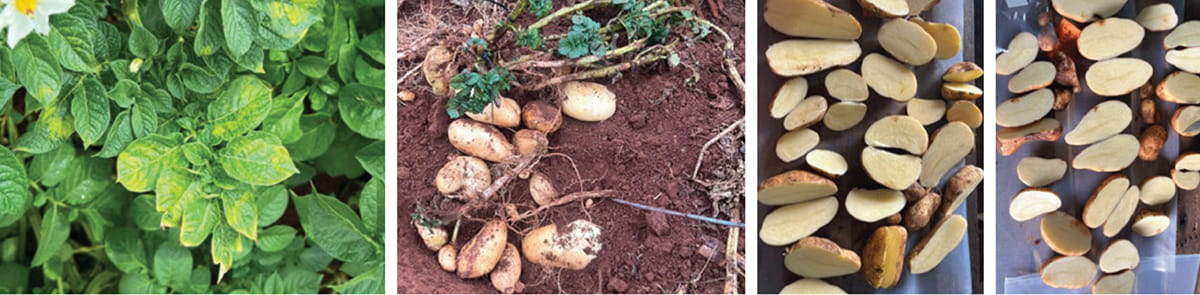
Sunflower as a host of PepRSV
PepRSV has also been confirmed in sunflowers under South African field conditions. Since 2021, the virus has been detected in sunflower crops across several production areas, including Senekal, Henneman, Ladybrand, and Sannieshof, indicating that sunflower is not merely an incidental host but is part of the broader PepRSV host range in South Africa.
Infected sunflower plants displayed distinct foliar ringspot symptoms, particularly on older leaves. These findings represent the first global report of sunflower as a natural host of PepRSV. Although symptoms are clearly visible, the impact on sunflower yield is currently unknown.
In addition to sunflower, a symptomatic weed growing beneath PepRSV-infected sunflower plants in Senekal tested positive for the virus. DNA barcoding identified the species as Arctotheca prostrata (Capeweed or Cape dandelion; Asteraceae), confirming it as a natural host of PepRSV.
The presence of the virus in a common and widespread weed species highlights the potential role of alternative hosts in its persistence. It provides a reservoir that may play a role in field-level epidemiology and the long-term maintenance of the virus within affected production systems.
The geographic overlap between sunflower- and potato-producing regions is significant, highlighting how PepRSV may be maintained within mixed-cropping landscapes. This provides further opportunities for the virus to persist in agricultural systems where potato, sunflower, and other susceptible hosts are grown in rotation or in close proximity.
The exception, not the rule
Across all studies to date, only three crops have been observed showing visible symptoms when infected with PepRSV:
- Potato: Corky ringspot and internal necrotic flecking in tubers, and occasional yellow mosaic patterns on leaves.
- Tomato: Foliar ringspots and yellow banding.
- Sunflower: Foliar ringspot symptoms.
Most other infected host plants show no obvious or consistent symptoms, and there is currently no evidence that PepRSV infection affects plant growth or yield in any of the crops studied. In potatoes, the main impact relates to internal tuber quality rather than yield loss.
Take-home messages
- PepRSV is already widespread in South Africa. It is not an isolated problem and is present in most production regions.
- Most infections are invisible. The virus is frequently present without visible field or tuber symptoms, meaning it can go unnoticed and move through production systems.
- PepRSV does not affect food safety and is unlikely to reduce yield. Where impacts occur, they are primarily related to tuber quality rather than plant growth or yield loss.
- Crop rotation alone will not eliminate PepRSV risk. The virus can persist in soils because it infects many other crops and weeds and is transmitted by members of the family Trichodoridae (stubby-root nematodes), which are likely to retain the virus over long periods.
- This is a system-level issue, not a ‘bad field’ problem. Management decisions should focus on field history, long-term field planning, nematode management, rotation choices and seed sourcing, rather than short-term reactions to isolated symptoms.
PepRSV is a widespread, mostly invisible virus that does not usually reduce yield but poses long-term risks to quality, seed systems, and trade that require informed, system-level management rather than short-term fixes. – Dr Lindy Esterhuizen, ARC-PHP
For more information, send an email to esterhuizenl@arc.agric.za