
Estimated reading time: 7 minutes
When you walk through your potato fields, picking up a handful of soil and catching that scent of fresh earth, have you ever wondered where that smell comes from and exactly what is happening in the ground beneath your feet? That fresh, earthy scent is one of the first signs that your soil is truly alive and comes from actinomycetes that resemble fungi but are classified as bacteria. While performing vital functions in the soil, they secrete a harmless gas called geosmin. This gas is released whenever it rains or when the soil is disturbed.
Soil is the foundation of the food chain, and of life and agriculture. Healthy soil produces healthy crops, stores water, filters pollution, and supports billions of microbes responsible for essential underground functions. Modern potato cultivation, however, places enormous pressure on this living system.
Healthy soil, healthy potatoes
It is widely known that potatoes are one of the most intensively managed crops in the agricultural industry. Regular and intensive tilling, monoculture, intensive fertilisation programmes, irrigation, fumigation, and harvesting processes continually disrupt the soil ecosystem. Over time, these practices deplete soil organic matter, damage soil structure, and suppress beneficial microbial communities. The result is weakened soil resilience, slower nutrient cycles, increased disease pressure, and a growing dependence on chemical inputs.
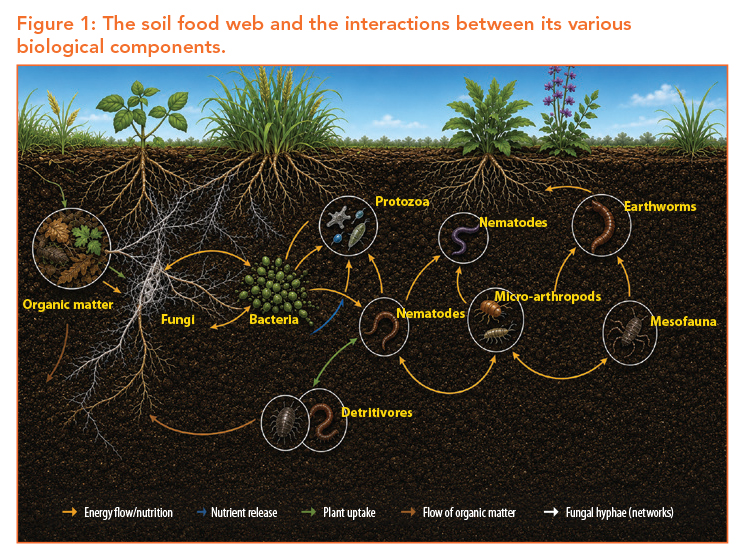
For decades, soil was regarded primarily as a physical and chemical system that had to be ‘fixed’ using fertilisers and agrochemicals. However, research confirms that soil is a living system driven by microbes such as bacteria, fungi, actinomycetes, and protozoa. A single teaspoon of healthy soil can contain billions of microbes that continually function beneath the soil surface.
These organisms form the subterranean ‘factory’ responsible for decomposition, nutrient mineralisation, water regulation, aggregate stability, and disease suppression. In healthy potato soils, active microbial communities with a wide diversity of microbes help extract nutrients such as phosphorus, nitrogen, and potassium from root exudates and dead or decaying matter. These are then released in plant-available forms that improve soil aggregation, stimulate stronger root growth, and produce antimicrobial compounds that suppress soilborne pathogens.
Potato roots also play a major role in this relationship. Potatoes release root exudates into the rhizosphere that feed soil microbes. These exudates determine which microbial communities dominate the soil, as well as the specific functions they perform during different stages of plant development.
Beneficial microbes and pathogens are locked in an ongoing subterranean battle to maintain a balance. When microbial activity and diversity decline, the soil compacts, becoming biologically inactive and even structurally unstable. This slows down nutrient cycling, increases disease pressure, and leaves the soil less resilient during drought, heat, and intensive cultivation.
Soil microbiology is important
Potato cultivation can accelerate this degradation if the soil is not carefully managed. Regular tilling is particularly harmful as it destroys fungal networks, collapses earthworm tunnels, and disrupts sensitive microbial habitats. Microbes that are adapted to deeper, oxygen-poor soil layers are suddenly exposed to oxygen and sunlight, while surface organisms are buried in oxygen-restricted environments.
In human terms, it is as if the San people were transported to the North Pole in the blink of an eye, and the Inuit to the Kalahari Desert. Both would have to make massive adjustments very quickly to survive in their new environments. These disturbances disrupt the functioning of the soil ecosystem on a grand scale.
Potato monoculture has a negative impact on microbial diversity because the soil is always exposed to the same root exudates and crop residues. Consequently, microbial communities become more specialised, creating ideal conditions for pathogens such as common scab, black scurf, Verticillium wilt, and root-knot nematodes.
Intensive fertiliser programmes and the use of aggressive agrochemicals can further suppress beneficial microbes, reducing the soil’s natural biological fertility. As the soil biology weakens, producers often attempt to maintain yields by applying more fertiliser; however, yields can still decline because the soil ecosystem no longer functions efficiently.
We have turned our soil into a drug addict that cannot get through the season without a ‘chemical fix’. Just as an addict cannot be rehabilitated overnight, we cannot expect our soil to recover within a few years from the unintended consequences of decades of indiscriminate fertiliser applications. Your soil’s cry for help can be found in observations showing that diseases in potato soils are on the rise and that chemical fertilisers have to be applied in greater quantities just to secure the same yield. But take heart, because rehabilitation is possible.
Impact of agricultural practices
Sustainable, regenerative agricultural practices are gaining momentum in potato production systems. These practices – including reduced soil disturbance, crop rotation, cover crops, crop residue retention, compost application, and biostimulants – help restore the ecological balance, stimulate microbial activity, and improve soil health. It takes nature about 2 000 years to build up a mere 6 cm of fertile topsoil, while ten tonnes of topsoil spread evenly over 1 ha is only 2.35 mm thick. Hence, we must do everything in our power to conserve our topsoil.
Rotating potatoes with grain crops, legumes, Brassicas, or lucerne stimulates a greater diversity of microbial communities. This practice helps break disease cycles by introducing different root systems and root exudates into the soil. Furthermore, cover crops, living roots, crop residue retention, and organic supplements maintain microbial activity between potato crops. This supplies nutrient-rich root exudates to soil organisms and prevents soil losses during floods.
However, sustainable and regenerative agricultural practices cannot be evaluated purely on the basis of visual observations and assumptions. Potato producers need practical tools to determine whether their management practices are really improving the soil’s health over the short and long term.
Quantifying life in the soil
Poor emergence, uneven growth, reduced tuber initiation, nutrient deficiencies, or increased disease pressure often manifest only when biological imbalances in the soil are already well advanced. However, highly sensitive microbial indicators enable producers to identify shifts in soil functions early, serving as valuable early-warning systems for sustainable potato production. After all, you cannot manage what you cannot measure.
Unlike conventional soil analyses, which offer merely a ‘snapshot in time’ of the nutrients in your soil, microbial indicators reveal whether the soil ecosystem itself is still functioning properly. Some of the most critical biological indicators determine the carbon fractions present, microbial activity, and the variety of functions performed by microbes.
Carbon source utilisation analyses help determine how efficiently microbial communities can utilise different nutrients as an energy source, providing insight into the functional capacity and adaptability of the soil ecosystem. Easily degradable carbon fractions such as root exudates, fresh crop residues, and partially decomposed organic compounds serve as an immediate energy source for microbes.
Soil rich in these easily degradable nutrients typically exhibits better microbial activity, nutrient cycling, aggregate stability, and water-holding capacity. Monitoring carbon source utilisation is particularly crucial in potato systems, as intensive cultivation accelerates the loss of organic matter.
Microbial activity assays drive nutrient cycling and measure the rate at which complex nutrients in the soil are converted into simpler elements that plant roots can absorb. Similarly, carbon cycling and the decomposition rate of crop residues are reflected here. Because easily degradable nutrients and microbial activity respond relatively quickly to changes in agricultural management, they serve as valuable indicators of the impact of regenerative practices on soil functioning.
Microbial functional diversity analyses evaluate the range of functions performed by microbial communities. Ecosystems with high microbial diversity are generally more resilient and resistant, as they can utilise a wider variety of food sources, maintain nutrient cycles under stressful conditions, and recover more rapidly from external disturbances.
Microbiology and management
It is important to note that no single microbial analysis can determine, on its own, whether a portion of soil is healthy or unhealthy. Soil microbiology is highly dynamic and is influenced by factors such as season, temperature, moisture, irrigation, cultivar, crop growth stage, and management practices. Therefore, repeated monitoring and evaluation over time are essential.
In potato production systems, soil samples are frequently collected prior to planting, during active vegetative growth or tuber bulking, and post-harvest. Many producers also sample before and after planting cover crops, applying compost, or administering biological treatments to determine whether these practices promote soil functioning and sustainable agriculture.
Consistent, long-term monitoring allows producers to identify trends rather than relying on isolated measurements. Improved microbial activity, availability of food sources, and microbial diversity typically indicate that regenerative agricultural practices are restoring soil resilience and biological fertility. In doing so, it contributes to sustainable and profitable potato production for generations to come.
We have been appointed as stewards of our soils, a responsibility we must take seriously. The reality is simple: Without healthy soil, there are no producers, no agriculture and, ultimately, no life. – Dr Johan Habig, soil microbiologist, Metson World