
The A to Z of micronutrients: Boron
Estimated reading time: 3 minutes
Boron (B) is a micronutrient critical to the growth and health of all crops. B plays a role in the movement of sucrose from leaves to roots and influences tuber bulking by improving carbohydrate transfer to tubers.
Studies show that adequate B nutrition improves root uptake of phosphorus (P) and potassium by maintaining the proper function and structure of root cell membranes. B also plays a key role in the colonisation of roots by mycorrhizal fungi, which contributes to the root uptake of P.
It is a mobile nutrient, meaning it is prone to movement within the soil. B is the second-most widespread micronutrient deficiency problem worldwide after zinc. B deficiency is highly prevalent in sandy, acidic soils with low organic matter content due to this leaching potential.
High pH soils rich in clay minerals and iron or aluminium oxides are also commonly impacted by B deficiency. Extended periods of drought impede B uptake by reducing root growth, limiting the supply of B from organic matter reserves, and depressing the diffusion and transport of B to root surfaces in the soil. Low soil temperatures can also reduce root uptake of B.
Auxin balance and growth control
Potatoes are a crop in which growers must balance top growth with tuber development to ensure good yields. The main driver of vegetative growth is nitrogen; as nitrate levels increase, plants produce more auxin, leading to faster vegetative growth at the expense of tuber development. Producers must carefully balance this nitrogen response to avoid creating problems with tuber yield and quality.
B deficiency in potatoes is more associated with rapid growth induced by growing conditions or nitrogen fertiliser than a lack of supply from the soil. The more nitrogen the plant receives, the faster it grows and the more deficient in B it becomes. This means that even in soils with adequate B levels, B deficiency in leaves during periods of rapid growth is possible.
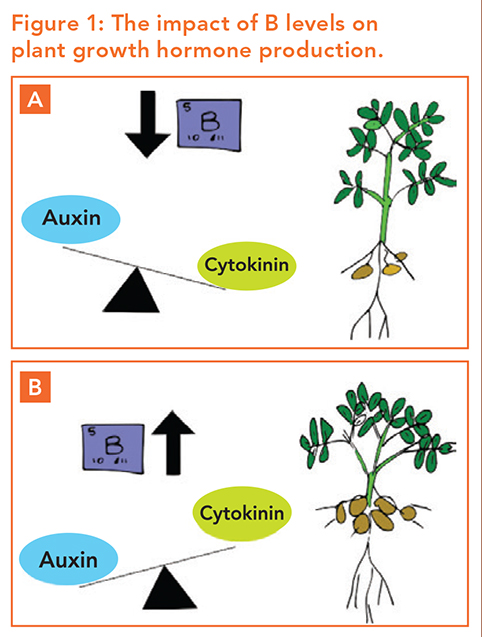
Research shows that B status has a marked effect on the relative production of plant growth hormones. Plants deficient in B produce higher levels of auxins, and lower levels of cytokinins and gibberellins (Figure 1A). As B levels increase, this relationship reverses, with auxins decreasing and cytokinins increasing (Figure 1B). Gibberellins also increase when B levels are high. This shifts the crop’s focus towards root and tuber development. B can be used to reduce auxin synthesis and slow periods of rapid vegetative growth. However, the timing and quality of B must be optimal, as there is a fine line between deficiency and toxicity.
Managing B deficiency
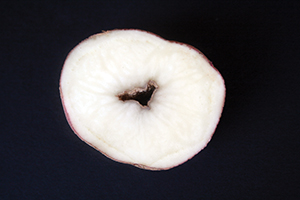
B deficiency in potatoes can cause cracking, internal brown spots and centres, hollow heart, and black spots. Growers will also observe reduced growth and yields when soil is B-deficient.
Agronomists have found that foliar and/or soil B applications, in conjunction with other nutrients such as P and calcium, greatly increase yield and potato quality. This is because B is essential for calcium transport throughout the plant. When B is applied during the early stages of the potato’s cell division process, there is better tuber uniformity. B also improves the post-harvest and frying quality of potatoes.
While B deficiency may cause quality and yield issues, so too can an excess of B. Producers should have a soil analysis conducted before planting and follow up with tissue samples from the middle of the potato plant during the growing season. – Annemarie van der Merwe, Potatoes SA