
One of the most important criteria affecting the total potato cultivation value chain is whether the plant material used is indeed the designated cultivar. At certain growth stages, it is difficult to distinguish one cultivar from the next. Because plant material is transported between plantings and farms, it may become mixed, raising questions about its identity.
For this reason, the South African potato deoxyribonucleic acid (DNA) reference collection was established at Plantovita, while CenGen developed the linked DNA fingerprint database. This collection and database will serve as a genetic reference source for the industry.
CenGen (Pty) Ltd developed the database in collaboration with Plantovita, made possible through funding from Potatoes SA. Based in Worcester, CenGen is a laboratory specialising in plant genetic research and application.
The fingerprint database currently contains data from 182 clones representing 85 cultivars. This comprehensive database offers the industry a substantial genetic reference source on which future identification and verification work can continue to build. Plantovita’s industry reference collection provided the clones. Plant material was sent to CenGen, where DNA was extracted to establish a complete DNA fingerprint database.
The DNA fingerprints of two unrelated cultivars will differ. Aspects such as disease resistance, flower colour, waxiness, starch content, and colour are largely determined by the cultivar’s DNA composition.
DNA consists of a specific combination of base pairs – A, T, G, and C – which gives a cultivar its unique characteristics. The markers used to compile the DNA fingerprint are not linked to any of the aforementioned traits; they are only used to distinguish one cultivar from another.
The gold standard
When comparing two cultivars, it is not always cost-effective to examine all base pairs (the whole genome). CenGen uses short sequence repeat (SSR) markers, which examine small sections of the genome where base-pair variation is expected. These markers are considered the gold standard for DNA fingerprint evaluations.
The Scottish Crop Research Institute selected 12 published SSR markers to genotype the potato submissions. The markers were optimised and tested at CenGen, where analyses were conducted on an automated fragment analyser, or DNA sequencer. Variation is observed in the base pair’s repeat patterns (Figure 2).
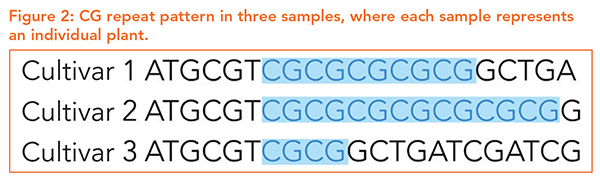
These repeat patterns are distributed throughout the genome, such as the CG repeat in Figure 2. The number of repeats can differ between cultivars. This repeat pattern is measured and named an allele call, which is evaluated visually. The total DNA fingerprint is created by combining the allele calls from the full set of markers across a clone’s genome.
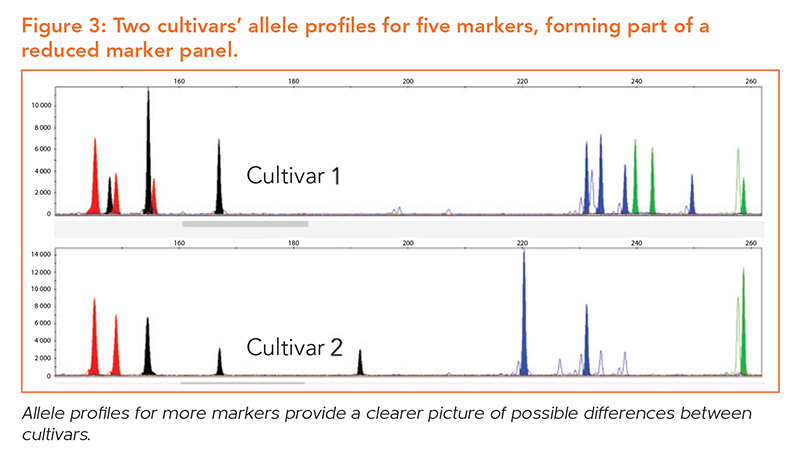
An analysis of 12 areas in the genome yields numerous allele profile combinations that collectively represent each sample’s DNA fingerprint (Figure 3). Differences in the fingerprints of two plants confirm with certainty that they are different cultivars. This project now provides a DNA fingerprint for each participating cultivar. The data can be used to compare the DNA fingerprints of other plant material.
Genetic similarities
The analyses also showed how genetically similar certain cultivars can be. For example, the cultivars Innovator and Monica Russet could not be distinguished using the SSR marker panel. This aligns with Monica Russet’s origin as a natural variant of Innovator. A variant can arise from a single base-pair mutation in the parent material, making the variant and the source genetically almost identical.
Further research is needed to develop a marker that can distinguish between these two. However, the tested marker set did distinguish the remaining submitted cultivars.
As part of the project, the test was further refined to make future DNA analyses more cost-effective. A reduced set of five markers can now be used for routine verification, without compromising on the ability to distinguish between cultivars. The full set of 12 markers will still be used to genotype new additions to the DNA reference collection.
Benefits for the industry
The DNA reference collection offers several benefits for the South African potato industry. Firstly, it provides a reliable genetic reference source against which plant material can be compared.
Cultivar identity becomes even more important as the industry grows and plant material is distributed across regions. This supports potato producers, processors and seed houses, all of whom rely on the genetic integrity of the cultivars they work with. The DNA fingerprint of each cultivar ensures the information in the reference collection is complete and valuable.
DNA analysis can be used in various practical situations. Before planting, samples can be tested to confirm that the material is indeed the cultivar that was purchased. If cultivars were mixed during multiplication, storage, sorting, or transport, DNA analysis can confirm the material’s identity.
This type of verification can provide objective answers in situations where visual field inspection identification cannot distinguish between cultivars. The larger and more comprehensive the reference collection, the more valuable and useful this technique becomes.
Procedures and arrangements
When new varieties or clones are imported, renewed or re-established, the owner or agent of the cultivar will liaise with the Potato Certification Service (PCS), which handles the sampling. This is required under the South African Potato Seed Certification Scheme (the Scheme).
Material is included in the DNA reference collection once all mandatory pathogen testing is complete. Any material not included in the Scheme following import must be submitted to PCS for testing upon placement on the variety list, or after three years of planting.
Clients wishing to make use of the DNA fingerprinting service can either work through PCS or contact CenGen directly. If a client wants to have certified material tested, PCS will be notified of the process, although they will not have access to the data. Clients working with uncertified material can also submit samples for genotyping without involving PCS.
CenGen will provide clients with sampling kits and instructions. Clients can have a minimum of six samples per project tested, including control samples. CenGen will then advise on the most appropriate controls for each situation.
Clients who do not wish to use the reference collection’s controls can contact CenGen for advice on sample quantities and the appropriate marker set. CenGen handles the cost of each project on an individual basis.
The DNA fingerprint database developed by CenGen completes the reference collection at Plantovita. Over time, this resource will support accurate cultivar identification, protect genetic purity, and improve the integrity of cultivars grown in the South African potato industry. – Carla de Beer, CenGen
Send an email to cengen@cengen.co.za or visit www.cengen.co.za for more information.