
Estimated reading time: 8 minutes
As the Potato Certification Service (PCS) celebrates 30 years of service on 14 June this year, the organisation reflects on its vital role in shaping the future of the potato industry. Established to oversee the certification of potato seed material, PCS plays an indispensable role in ensuring the availability of high-quality planting material for potato producers, and protecting the industry.
Its journey, from its roots in the 1990s to its present status, reflects both the evolution of the industry and the resilience of those who have worked to overcome its challenges. Inception of PCS The initiation of PCS in 1995 was a response to a growing need for impartiality and professionalism in certification. Before then, the Potato Producers Organisation (PPO) managed the process, but concerns over conflicts of interest prompted a shift for a dedicated body to handle the responsibility. Drs Pierre Nortjé and Neil Theron collaborated with international certification authorities to gain insights into their schemes and to ensure that South African seed potatoes met global standards.
In 1997, the then minister of agriculture made it clear that the PPO could not oversee the scheme it would soon enforce. Thus, the Independent Certification Council for Seed Potatoes (ICCSP) was established, with PCS as its appointed service provider. The ICCSP also received approval from the minister to use the government logo on its correspondence and certification labels. The Scheme was developed over time, leading to the South African Seed Potato Certification Scheme (Scheme) to be promulgated under the Plant Improvement Act, 1976 (Act 53 of 1976) in 1998. PCS did not just join the game – it rewrote the rules.
Registered as an independent, non-profit entity under South African law, PCS took on the monumental task of ensuring seed quality while navigating financial crises and staff transitions. Seed growers stepped up with loan levies to keep the fledgling organisation afloat, a testament to the value they placed on certification.
Key industry structures
The seed potato industry consists of a well-established network of committees and forums that ensure a collaborative and effective approach to the sector’s growth and sustainability. The National Seed Potato Committee (NSPC) oversees the activities of the Seed Potato Growers’ Forum, serving as the primary platform for discussing all matters related to seed potato production, from ground-level issues to strategic industry goals.
This committee works in close partnership with the Forum for Nuclear Material Providers (NUMPRO) where key stakeholders – including South African agents of internationally bred varieties and variety owners – meet annually to address essential topics such as the importation of propagation material, varietal listing, plant breeders’ rights, and the production of nuclear material.
The chairperson of NUMPRO plays an instrumental role in these discussions and, as a representative of NUMPRO, serves on the NSPC, ensuring seamless communication between nuclear material providers and broader industry stakeholders. South African Mini Tuber Producers (SAMPRO) offers a specialised platform for in vitro gene bank facilities, tissue culture propagation entities, and mini tuber producers to collaborate on technical matters related to early generation material production.
These bodies work in harmony under the guidance of a board of directors, which includes the chairpersons of the potato production regions and the managing director of PCS, ensuring a unified and effective leadership structure to drive the industry forward under the watchful eye of Adv Les Kügel, who succeeded Dr Dave Keetch as chairperson of the ICCSP after his tenure from 1998 to 2017.
In addition to these structures, the National Department of Agriculture (NDA) and the Regulated Potato Quarantine Pest Committee (RPQPC) are responsible for all quarantine pests infecting potatoes, as well as for making inputs regarding import requirements and emerging pests that may pose a threat to the South African potato industry.
Scheme amendments
The Scheme is not set in stone; it must remain current, scientifically sound, economically viable and technically justified to adapt to the evolving industry (Figure 1).
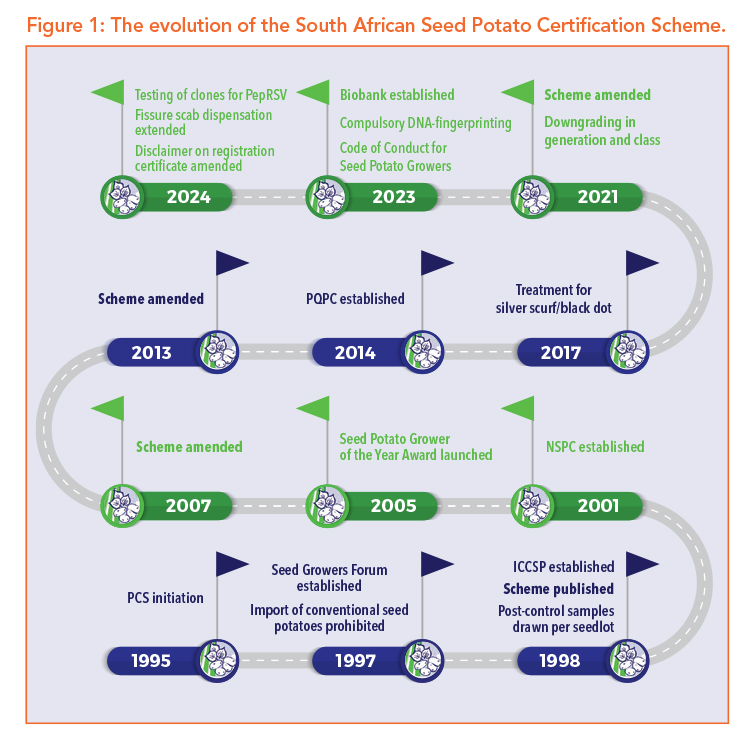
Since its publication in 1998, the Scheme has undergone several revisions to ensure its continued relevance. The protocol offers precise guidelines on the various actions and processes arising from the Scheme’s application, particularly addressing those areas not fully covered or sufficiently detailed within the Scheme itself.
Quality in every certified bag
Each year PCS plays a pivotal role in supporting South Africa’s potato industry, certifying an impressive seven million 25 kg bags of seed potatoes – fuelling 85% of commercial plantings – which are exported to countries such as Zimbabwe, Botswana, Eswatini, Lesotho, Mozambique, Namibia, Seychelles, Saint Helena, and Angola.
Spanning 10 000 to 11 000 ha across the northern, eastern, southern and western regions, PCS oversees the production of approximately three million in vitro plants and certifies ten to 11 million mini tubers as G0 seed potatoes. Certification officials conduct approximately 4 300 field inspections, draw 3 700 samples, and perform approximately 960 tuber inspections to ensure that the highest quality standards are met.
These rigorous efforts are further validated through audits by the NDA, ensuring that every bag of seed potatoes meets the gold standard of certification.
Certification is based not only on visual inspections but is supported by test results generated by the competent staff of the Potato Laboratory Service from representative samples taken from seedlots. PCS has transformed the nation’s potato industry into a global contender, ensuring every tuber tells a story of quality, resilience, and innovation.
New challenges
The global potato industry was shaken on 21 December 2023 when the National Plant Protection Organisation of South Africa (NPPOZA) notified the International Plant Protection Convention (IPPC) of the detection of pepper ringspot virus (PepRSV) in South Africa. This sent ripples through the industry alarming trade partners, and prompting several countries to close their borders to South African potatoes.
In response, PCS acted decisively, leveraging science and collaboration to safeguard the industry’s future. This included testing all imported and local potato propagating material with polymerase chain reaction (PCR), partnering with the NDA for regulatory reviews, and mitigating the risk of the virus spreading while considering its economic impact on the grower.
To navigate the challenges posed by PepRSV, PCS has undertaken a comprehensive economic impact study to understand the risks this disease presents to seed and table potato producers, the processing industry, consumers, and the sustainability of food production. By assessing the pathogen’s effects on yield, quality and pricing, this study will provide the vital data needed to accurately assign the pest’s status.
The insights gained will also serve as a foundation for potential future amendments to the Scheme. In doing so, it will protect the future of South Africa’s potato industry, helping to maintain both its growth and global competitiveness. This adaptability reflects PCS’s ethos: Change is inevitable and staying ahead requires constant evolution. PCS has consistently embraced science to tackle emerging threats.
Celebrating the growers
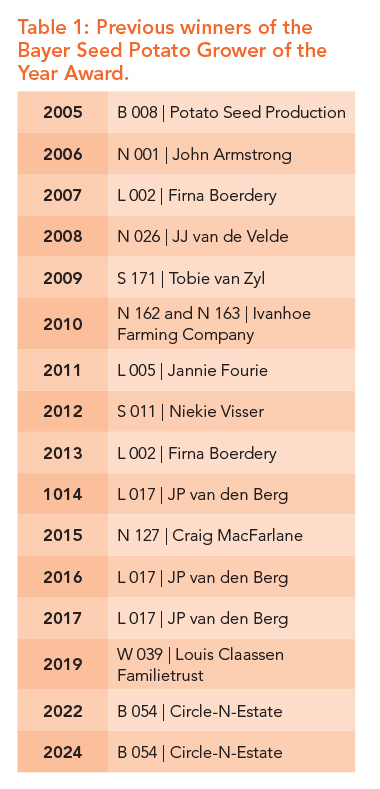
At the heart of PCS’s success are the seed potato growers. The Bayer Seed Potato Grower of the Year Award, launched in 2005, honours their dedication. To qualify for this prestigious award, growers must have planted an average of 30 ha annually for three consecutive years and have certified their seed potatoes successfully. This consistent dedication and performance set the standard for excellence in the industry, as these growers have demonstrated exceptional commitment. Since 2017, the award has been presented biennially (Table 1).
The next 30 years
As we celebrate our past successes, we know that the next PCS chapter will be even more exciting. The agricultural landscape continues to evolve, with increasing pressures from environmental concerns, the need for greater sustainability, and the drive for efficiency in production. The future of potato farming will rely on advanced research, innovation, and a keen understanding of environmental challenges, all of which will play an integral role in shaping the next generation of certified potato seed.
PCS remains at the forefront of these developments, striving to help our partners meet these new challenges while providing the highest-quality seed possible.
The next 30 years will bring about advancements in technology, but our core values of integrity, quality, and service will always remain our foundation.
A heartfelt thank you
On this momentous anniversary, I would like to take a moment to express my deepest gratitude to all the individuals and organisations that have been part of the PCS journey.
From our dedicated employees and trusted partners to the loyal growers who have relied on our services, we are truly grateful for your support and collaboration over the years.
Together, we have built something special – an organisation that stands as a symbol of quality, reliability, and dedication to the success of the potato industry. Looking forward, we are more excited than ever to continue our mission to provide quality seed assurance for the next generation of growers. Here is to another 30 years of excellence in Potato Certification Service – thank you for being a part of our story. – Dániel Möller, regional manager, Potato Certification Service, Malmesbury
For more information, email Dr Ansa van Vuuren at ansa@potatocertification.co.za or visit www.potatocertification.co.za.