
Estimated reading time: 6 minutes
Uncertainties in world food supply and demand have placed the potato in the upper echelon of recommended food security crops. Not only does this easy-to-grow crop boost household food supplies, but it is also being cultivated as a cash crop by a growing number of small-scale producers in South Africa.
The versatility of the potato is endless. It can be used as a fresh vegetable to be cooked at home and incorporated as a raw material into food products, starch, alcohol, and animal feed.
While tubers can be used for next season’s crops, we have seen that the demand has been shifting from fresh tubers to processed products such as convenience food and snacks, where new entrants into the processing sector are increasingly seeking advice on the process.
The drivers behind this trend are:
- Urbanisation.
- Rising incomes.
- Diversification of diets
- Lifestyles that leave less time to prepare fresh produce for consumption.
Potato yields in the small-scale farming sector average around ten to 20 tonnes/ha, which is far below the average yield of 47 tonnes/ha achieved by our commercial producers.
So, what are the major obstacles standing in the way?
Technical factors
- Low seed tuber multiplication rates. Technical complexity and costs associated with seed quality through successive multiplications.
- Seed tubers which are bulky and perishable.
- Potatoes with high fertiliser requirements, but low utilisation efficiency.
- Limited technical and managerial expertise.
- Disease and pests as a major constraint.
Socio-economic factors
- High production costs and lack of credit.
- Price instability due to supply and demand in fresh produce markets.
- Inefficiency of local markets when charging market and agent fees.
- Limited access to higher-value markets. Small-scale potato growers need access to profitable domestic markets, but these are mostly restricted to larger contracted producers.
- Export markets that often close to protect local producers from imports, even if a trade agreement is in place.
- Policy and institutional factors.
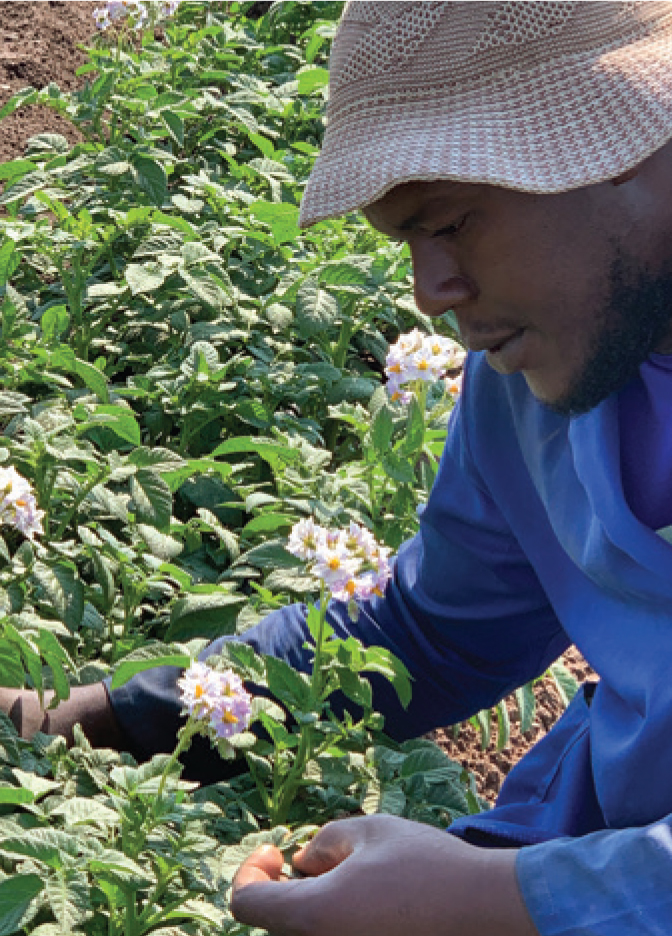
Neglect of the potato subsector
- Small-scale producers seldom receive public investment.
- In many areas, poor infrastructural facilities and poor access to markets are major challenges to the expansion of potato production and its profitability for smaller producers.
Inadequate capacity building
- Support for programmes shoring up more new varieties and scaling up existing integrated disease and insect pest management technologies and methodologies is generally inadequate due to the interest of seed houses to supply their protected varieties rather than open varieties.
- Programmes to upgrade the skills of potato growers need to be matched by government efforts to create, monitor, and enforce regulations on pesticide use and the spread of pesticide or fertiliser residues into water supplies – all of which are major constraints to the sustainability of potato production systems.
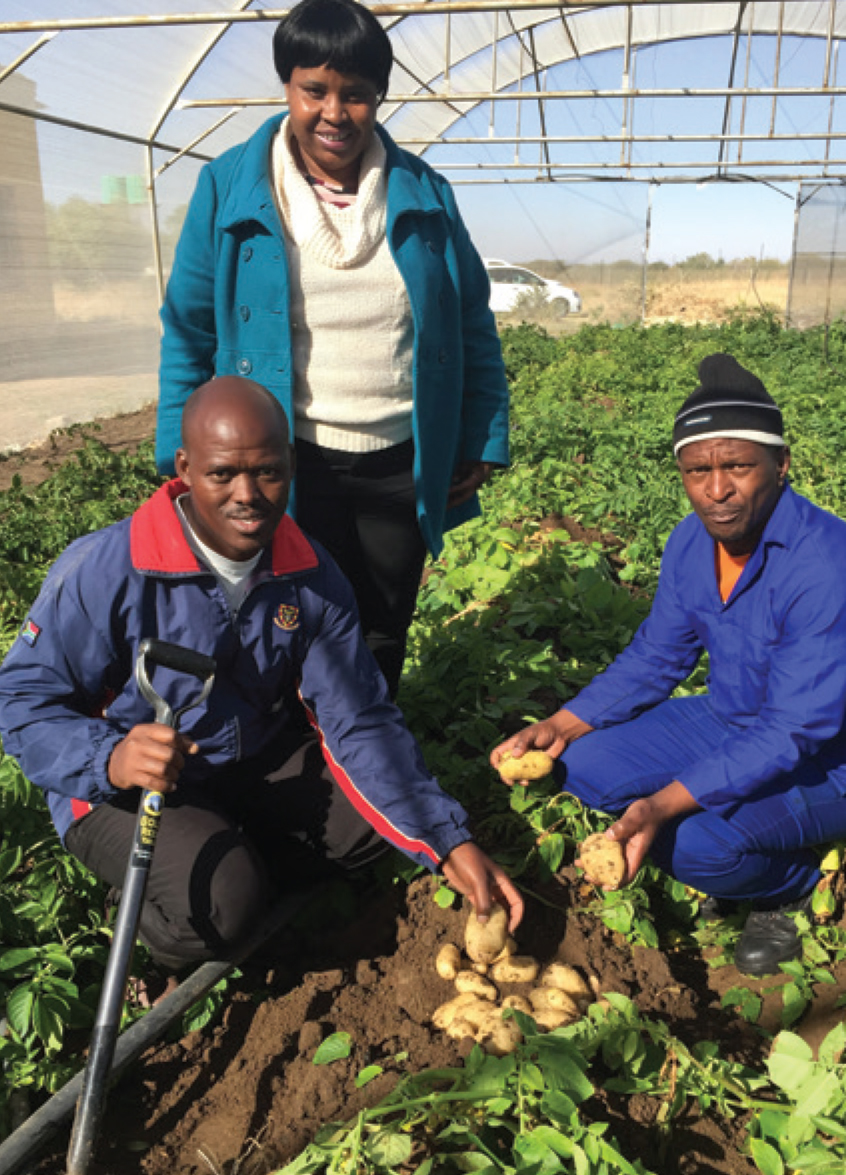
Support
- Support for potato producer groups and associations, and local entrepreneurship is lacking.
- Seed supplied by seed houses view this sector as the ‘dumping ground’ for old and poor-quality seed.
- The industry leans strongly towards seed production for commercial varieties due to their popularity and use of breeders’ rights.
Good agricultural practices
The term ‘good agricultural practices’ (GAPs) refers to principles and codes of practice that are applied to on-farm production and postproduction processes, aiming at ensuring safe and healthy food and non-food agricultural products, while considering economic, social, and environmental sustainability.
GAP concepts and principles are crucial but difficult to enforce among garden or small-scale producers. In general, this sector is less dependent on fertiliser and chemicals due to cost and availability in smaller units. The cost of enforcing it among smaller producers makes it unlikely to gain ground.
Key indicators of sustainable potato production
Biodiversity and varieties
Although South Africa has 133 potato varieties on the national variety list, 90% of all potatoes planted are from fewer than five varieties. Plant breeders’ rights on the one side ensured that only a few breeding programmes performed well in breeding good commercial varieties, while ensuring that seed from old varieties are no longer produced and available to smaller growers. Today, production relies heavily on chemical inputs that the smaller grower cannot afford and seldomly understands.
Seed production and quality
South Africa has one of the best certification systems in the world to ensure good quality material in seed production. This system also has a high price tag leading to exclusivity which makes it inaccessible to smaller producers, in turn making the availability of seed one of the main constraints. A possible answer is that the cost of rapid multiplication systems should be affordable to encourage small enterprises to produce healthy materials. Another possibility is having legislation and accreditation systems in place for seed certification adapted to local conditions of smaller producers.
Currently, the high cost of seed is forcing small-scale producers to accept downgraded seed with either a high virus status or being physiologically old and losing sprouting and growth vigour. To obtain a high-yielding crop, the seed should be at the correct physiological age and sprouting stage at planting, depending on its purpose. Due to the high price of certified seed, these producers will usually obtain farm-saved seed from non-specialised seed growers.
However, producer-based informal seed systems are generally unable to maintain seed quality or eliminate diseases such as bacterial wilt or viruses. It is therefore crucial that small-scale producers are trained in the seed system and supported by a system that will assure quality affordability.
Soil health and fertility
Potato cultivation, whether cultivated on a large or small scale, usually involves intensive soil tillage throughout the cropping period, which can lead to soil degradation, erosion, and leaching of nitrates. It has been found that conservation agriculture promotes soil health and fertility management, which enhances natural biological processes. Sustainable nutrient management involves a set of management practices designed to conserve soil resources, maintain or enhance productivity, and help reduce growers’ reliance on inorganic fertilisers.
A good example is the use of well-decomposed manure with potatoes, out of all the field crops, having shown the best response at a rate of ten tonnes/ha or more. In line with sustainable practices is the reduction of chemical use to help ensure a safe environment for the producer and farmworker, and a healthy product for the consumer.
Value addition and markets
Small-scale producers enjoy the advantage of selling their produce locally, thus determining the cost structures and eliminating the cost of transport and fees charged by a market and agents. This makes up for lower yields associated with reduced inputs.
It is important, though, that these producers are also encouraged to form producer groups that will ensure the best negotiation on pricing and purchasing power to reduce the cost of inputs. – Philip Steyn, specialist in commercialisation and enterprise development, ARC-Vegetable, Industrial and Medicinal Plants
For more information, send an email to Philip Steyn at steynp@arc.agric.za.