
Estimated reading time: 4 minutes
Eelworms are one of the oldest forms of life.
Although the oldest fossil record is 400 million years old, an expert on the prehistoric history of eelworms believes that the group probably originated (in geological terms) shortly after bacteria, fungi, and protozoa, approximately one billion years ago.
Few people are aware of the importance of eelworms (nematodes) because they are microscopically small. However, nematodes are one of the most abundant organisms on earth with more than 14,000 species. Experts have estimated that about one million nematodes of hundreds of different species can be present in an area of 1 m².
These nematodes occupy many different ecological niches. They are found in every conceivable habitat and some are parasites in plants and animals, and also in other organisms.
Nematodes can be herbivores, omnivores, or carnivores. Some of them are very specific about what they feed on while other species are common feeders, such as rootknot and lesion nematodes that have a wide host range.
Most free-living eelworms feed on bacteria, fungi, and parasitic eelworms. Eelworms play a special role in the decomposition of organic matter in soil ecosystems. They partially break down plant material so it can be further broken down by bacterial composters. The population levels of free-living (non-parasitic) eelworm in soil are used worldwide as an indicator of soil health.
Nematodes in South Africa
The nematode species composition in South Africa differs from that of other countries. The species composition of nematodes may vary in different regions and on different farms because climate and crops cultivated affect the species composition. More than 450 plant-parasitic nematode species have been recorded in South Africa, 95 of which are from potatoes or soil in which potatoes were produced.
According to the South African Plant-Parasitic Nematode Survey (SAPPNS) and National Collection of Nematodes (NCN) databases, six species of rootknot nematode (Meloidognye spp.) were recorded in 15 regions, while 12 species of lesion nematode (Pratylenchus spp.) were recorded in 15 regions. Nanidorus minor, which is the vector of TRV, was recorded in 13 regions. Note that TRV has not yet been recorded in South Africa.
Survival in soil
Eelworms have developed different strategies to ensure survival in soil:
- Immature eelworms are protected by the thick wall of eggs.
- Gelatinous envelope containing root-knot nematode eggs.
- Resistant cyst walls in which cyst nematode eggs are present.
- Ability to temporarily halt their life cycle until conditions are favourable for development.
- Physiological processes to survive extreme adverse environmental conditions. Under local conditions, anhydrobiosis is of great importance as it enables rootknot nematodes to survive under arid conditions. In this form, they are metabolically inactive, but once moisture is available, nematodes become active again. Physiological processes exist to withstand cold, heat and oxygen deficiency in various nematodes.
Damage and infestation
Nematode infestation causes direct and indirect damage. Direct root damage results in the inability to absorb water and nutrients and this can lead to yield reductions. Indirect damage may include:
- Impairment of root function leading to weakened plants that are susceptible to leaf diseases such as brown spot.
- Some species may be the vector of other diseases such as TRV.
- Wounds on roots and tubers caused by eelworms serve as a pathway for pathogens such as Verticillium dahliae, Fusarium spp. and soft-rot pathogens that are part of the early dying disease of potato.
- Symptoms of especially root-knot nematode lead to a decrease in the quality and the downgrading of table and seed potatoes.
- Juvenile eelworms feed on tissue by pushing a stylet, which is a microscopic hollow tube, into the tissue. Enzymes to digest plant cells are released into the root and plant sap is absorbed through the feeding tube of the eelworm.

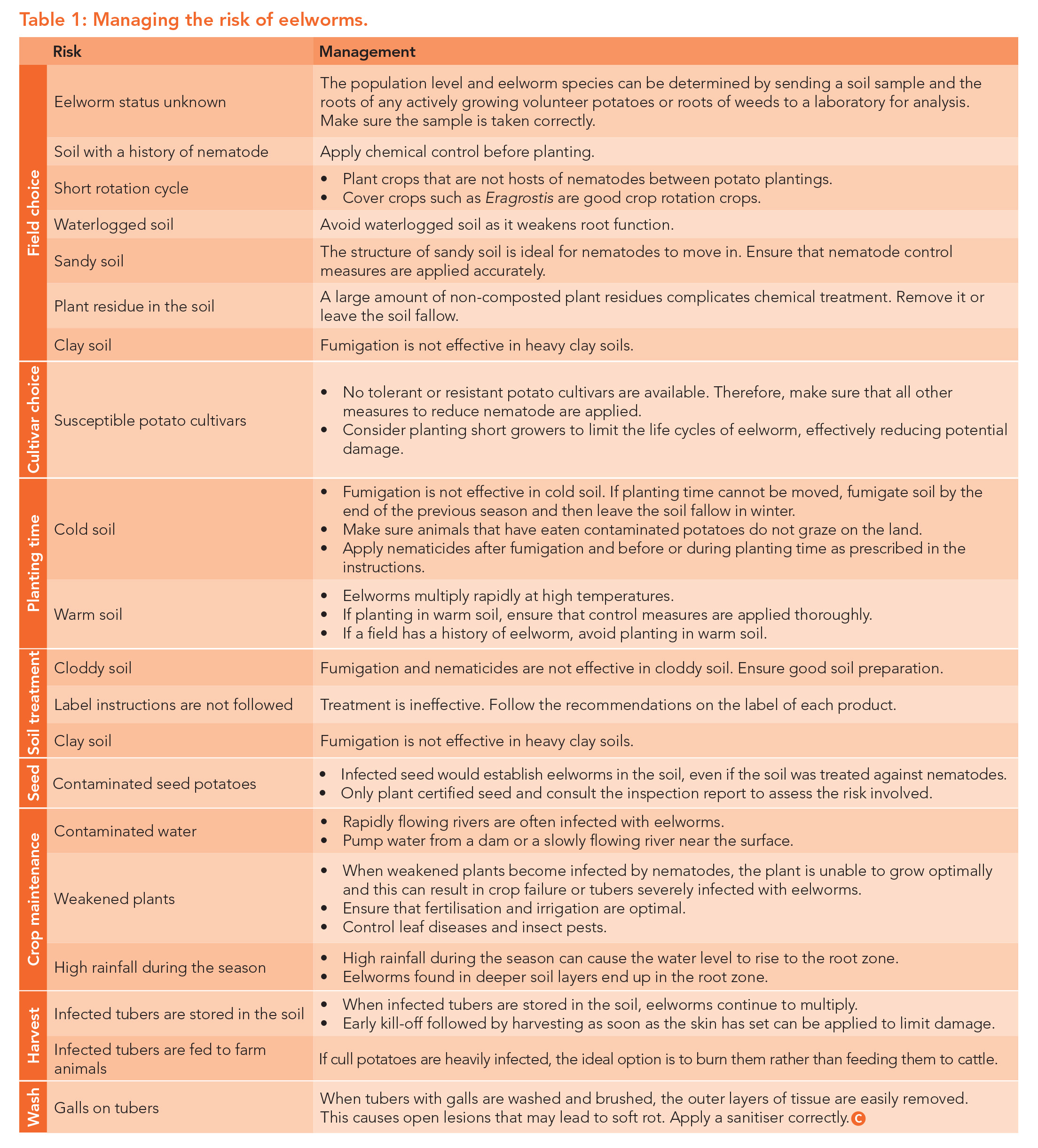
An eelworm control programme is successful if the number of nematodes in soil is kept to a minimum between potato plantings and in the potato growing season. There is no control method that can be successful in isolation to control nematodes. All possible measures should be applied to limit nematode population levels in the soil (Table 1).
This article is an abbreviated version of the Potatoes SA Fact Sheet: Eelworm pests, 2020.
To download the complete fact sheet, visit www.potatoes.co.za/fact-sheets/.