

Empowering KZN potato producers through financial literacy
Estimated reading time: 5 minutes
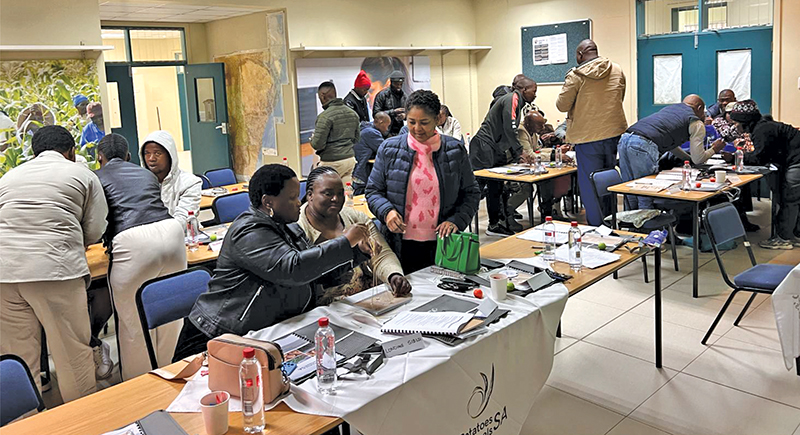
More than 25 developing potato producers from across KwaZulu-Natal (KZN) recently participated in a financial management and bookkeeping training programme hosted by Potatoes SA at Cedara in Pietermaritzburg.
The training was made possible by the KwaZulu-Natal Department of Agriculture and Rural Development, which generously provided the venue.
The initiative forms part of the support provided by Allan and Gill Gray Philanthropies to Potatoes SA’s Transformation Programme, which aims to strengthen capacity across the entire transformation value chain. The partnership recognises that sustainable transformation extends beyond production to include developing the business, financial, and management skills required to establish resilient, commercially successful enterprises. By investing in producer development through practical training and mentorship, Allan and Gill Gray Philanthropies and Potatoes SA continue to empower developing potato producers with the knowledge and confidence needed to build profitable and sustainable agricultural businesses.
The programme was facilitated by the Potatoes SA transformation team, led by me as national transformation coordinator, together with junior extension officers Takalani Sikhau and Khathu Tshikunde. The training forms part of Potatoes SA’s broader strategy of equipping developing producers with the skills required to establish and sustain commercially viable potato enterprises.
Building sustainable businesses
For many developing producers, the initial motivation for entering agriculture is to improve household food security and generate income for their families. As producers gain experience and confidence, many aspire to expand their operations and participate in the commercial agricultural sector. However, this transition requires more than good production practices; it requires sound business management.
At the start of the training, I highlighted the remarkable progress many developing potato producers have made in mastering the technical aspects of production. Through mentorship, extension support and practical experience, producers have improved their understanding of land preparation, irrigation scheduling, fertiliser application, pest and disease management, and crop husbandry.
Production remains the foundation of every successful farming enterprise. However, as producers progress in their development journey, financial management becomes equally important. Many produce quality crops but still struggle to grow their businesses due to weak financial planning, poor record-keeping, and inadequate bookkeeping systems. These are the management skills that enable a farming enterprise to become commercially sustainable.
While production, financing, and marketing are recognised as the three critical pillars of farming, effective financial management provides the link that allows these components to function together efficiently.
Practical learning scenarios
The training programme combined theory with practical exercises, allowing participants to apply financial concepts to realistic potato farming enterprises. Producers participated in practical budgeting exercises where they developed production budgets for potato farming enterprises based on realistic assumptions, production costs, and expected market conditions. These exercises highlighted the importance of accurately estimating input costs, labour requirements, expected yields, and projected income before planting.
Cash-flow planning was another key area of discussion. Producers learned that profitability alone does not guarantee business success if income and expenditure are poorly managed throughout the production cycle. Understanding when money enters and leaves the business enables producers to plan input purchases, meet financial obligations, and avoid unnecessary financial pressure during the season.
The concept of profitability was also explored, with an emphasis on reinvesting profits into the enterprise. Participants were encouraged to view farming as a long-term business in which profits should be used strategically to improve infrastructure, purchase quality inputs, increase productivity, and expand operations over time.
Developing financial responsibility
The programme also addressed responsible credit and debt management. Producers were encouraged to borrow only when necessary and to ensure that any credit obtained contributes directly to improving productivity and generating sustainable returns. Discussions highlighted the importance of planning for unforeseen circumstances by setting aside contingency funds and developing financial plans that can withstand production and market risks.
Producers were encouraged to make financial decisions based on accurate records rather than assumptions. Available agricultural funding mechanisms were also presented, providing producers with a better understanding of the opportunities available through public and private sector institutions. Participants were advised that access to finance often depends on maintaining reliable financial records, developing realistic business plans, and managing farming enterprises effectively.
Investing in transformation
As South Africa continues to transform its agricultural sector, developing commercially successful producers requires more than just production support. Building strong financial management skills equips producers to make informed business decisions, manage risk effectively, and position themselves for long-term growth.
Training initiatives such as this strengthen the capacity of developing producers to operate competitive agricultural businesses while improving their ability to access finance, expand production, and create employment opportunities within their communities.
Potatoes SA extends its sincere appreciation to the KwaZulu-Natal Department of Agriculture and Rural Development for providing the training venue and supporting initiatives that promote producer development. The organisation also acknowledges the valuable support of Allan and Gill Gray Philanthropies, whose investment in capacity building continues to strengthen the transformation value chain and contribute towards the development of resilient, profitable, and sustainable black-owned potato farming enterprises.
By combining technical production support with financial management training, Potatoes SA continues to empower developing producers to transition into successful commercial potato producers who contribute to economic growth, food security, and the transformation of South Africa’s potato industry. – Rachichi Marokane, Potatoes SA