

Fertilisation strategies for potatoes under El Niño-induced environmental stress
Estimated reading time: 5 minutes
Drought and high temperatures associated with El Niño events is widely regarded as one of the most severe environmental constraints to crop production. It not only reduces water availability, but also disrupts plant physiology, soil nutrient dynamics, and ultimately yield and quality.
A strong El Niño in South Africa, such as the one the country is currently facing, is scientifically linked to shifts in atmospheric circulation that suppress rainfall over the interior. Research identifies El Niño Southern Oscillation (ENSO) as the dominant driver of interannual climate variability.
During these events, the summer rainfall regions – including the Free State, North West, Limpopo, and Mpumalanga – typically experience below-average rainfall, more frequent dry spells, and higher temperatures.
The winter rainfall region (Western Cape) can also experience below-normal winter rainfall, increasing water supply risks. These climate anomalies translate directly into agricultural stress, as ENSO affects soil moisture, vegetation condition, and crop yields across southern Africa.
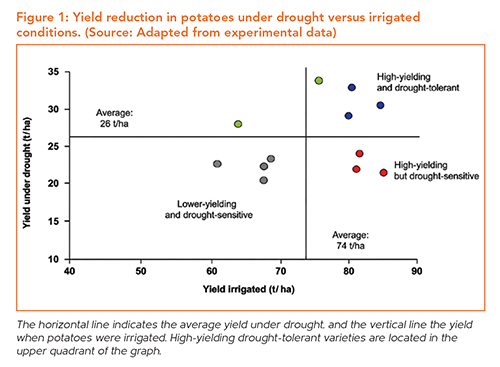
For potato production, the impact is particularly severe. Potatoes are vulnerable due to their shallow root systems and high sensitivity during tuber initiation and bulking. Reduced water availability and temperatures outside the optimal 15 to 25°C range suppress tuber initiation, bulking, final yield, and quality.
Consequently, under a strong El Niño, summer production regions face direct yield losses from drought and heat, while winter regions face indirect constraints via reduced dam recharge and irrigation availability.
This makes water management, cultivar choice, and planting timing critical risk-mitigation strategies for potato producers. Therefore, the negative impact of drought on nutritional uptake and effective fertilisation management includes:
- Reduced root hydraulic conductance.
- Lower transpiration flow.
- Reduced microbial activity and nutrient mineralisation.
- Reduced nutrient uptake from dry soil.
Plant responses to drought stress
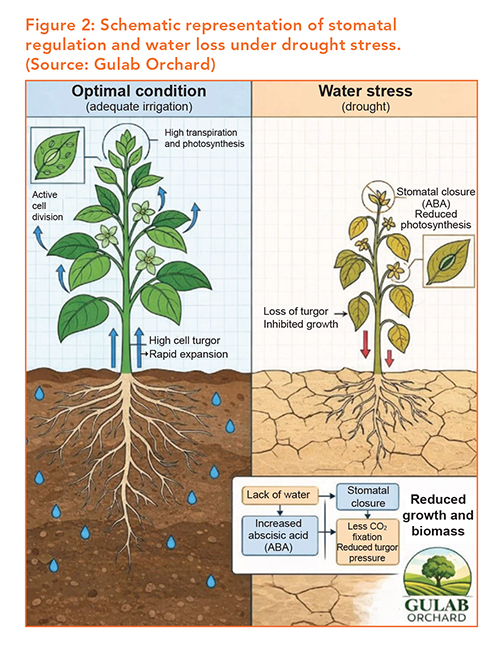
A water deficit limits plant growth primarily through reductions in turgor pressure, which refers to the outward push of water inside a plant cell against its outer wall. This pressure keeps plants upright and enables them to open stomata.
Reduced turgor results in stomata closure. Stomatal closure prevents excess water loss due to transpiration.
It also limits carbon dioxide uptake and thereby reduces photosynthesis, preserving water until conditions improve.
This cascade of cellular events decreases cell expansion and leaf area development, as cell division and leaf expansion is reduced by halted photosynthesis. Therefore, plant growth and development are ultimately negatively influenced. High temperatures reduce photosynthetic efficiency by increasing respiratory losses and impairing the plant’s ability to convert sunlight into carbohydrates. As a result, less energy is available for growth and yield formation.
Nutrient management
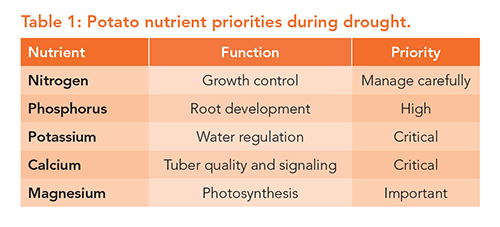
Nutrient application can be managed in a timely manner to alleviate the devastating effects of drought and high temperatures. Nitrogen stimulates vegetative growth.
However, when supplied in excess, it increases water demand, making crops more sensitive to drought conditions and potentially accelerating drought stress. In potatoes, excessive nitrogen delays tuber initiation and reduces tuber set.
Phosphorus is essential for energy transfer and root development. During limited water availability, its mobility in soil can be reduced. For this reason, placing phosphorus near roots is critical. Efficient phosphorus nutrition can improve water uptake and support root growth under stress conditions.
Potassium plays a central role in osmotic regulation and stomatal control. It improves water-use efficiency and maintains plant turgor pressure under drought conditions. It is important to note that band placement near the root zone improves availability under drought.
Calcium stabilises cell walls and membranes while acting as a key signalling element (messenger) in stress-response pathways, thereby coordinating plant responses to drought stress. In potatoes, calcium is critical for tuber quality, root growth, and reduced internal defects. The role of sufficient calcium cannot be understated, as it also plays a role in wound healing and disease resistance. In drought conditions, the impact on calcium delivery to tubers will be impaired as calcium movement depends on water flow.
Secondary nutrients and micronutrients such as magnesium, boron, zinc, sulphur, and silicon all contribute to improved stress tolerance by supporting photosynthesis, enzyme activation, and structural integrity.
Key practices for practical fertilisation management under drought conditions include:
- Split applications to improve nutrient use efficiency.
- Avoiding excessive fertiliser concentration in the root zone.
- Using foliar feeding to bypass soil limitations.
- Building nutrient reserves prior to stress periods.
- Using weather stations and reliable forecasts to anticipate stress conditions.
Conclusion
Balanced nutrition is key to improving drought resilience. Under El Niño conditions, fertilisation should focus on improving water-use efficiency, supporting root growth, and maintaining plant physiological function. – Pieter Brink, agronomist, Yara
For more information, send an email to pieter.brink@yarasupport.com