
Estimated reading time: 7 minutes
The need to include biological products in strategies for managing pests and diseases is becoming increasingly evident. To successfully include biological products, however, it is important to understand how and where they ‘work’. The purpose of this series of articles is to explain how biological products function and how they can be included in successful integrated pest management programmes.
Potatoes grow in close contact with the soil and the many microscopic organisms that live within it. The soil surrounding roots and tubers, their surfaces, and the area just inside them form a small but very active living environment that includes bacteria, fungi, nematodes, insects, viruses, and other organisms. Before we can understand how this environment affects potato plant health, we must examine the soil microbiome of potatoes.
The potato microbiome explained
The potato soil microbiome can be grouped into several areas, often referred to as ‘compartments’, each with its own conditions and mix of organisms (Figure 1).
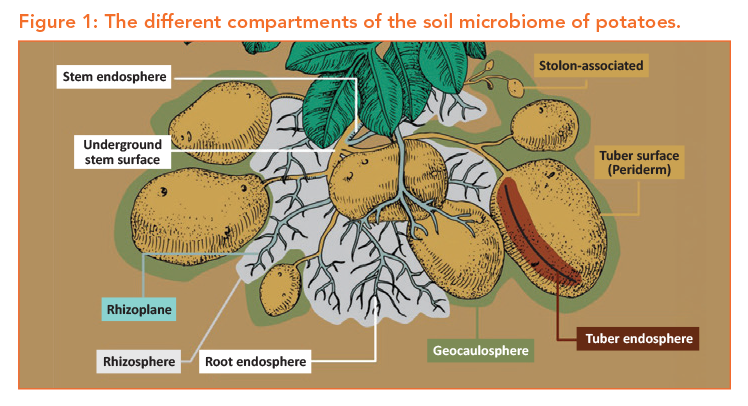
- ‘Bulk soil’ is the soil outside the direct influence of potato roots and tubers.
- Closer to the roots are root‑associated areas: The rhizosphere (soil affected by substances released by roots), rhizoplane (the root surface), and root endosphere (microbes living inside root tissue).
- Below‑ground stems and stolons form additional areas.
- Around tubers are the geocaulosphere (soil surrounding tubers), tuber periderm (the tuber skin), and tuber endosphere (microbes inside tuber tissue).
Some of these areas can be further divided into sub-compartments. For example, the rhizoplane includes the outer root surface and the thin layer of soil and natural root secretions that stick to it. As roots grow and age, these micro-environments change, and the microbiome changes with them. Because potato tubers and stolons are modified stems, the microbes associated with them differ from those found on and around roots. One reason for this is that different plant parts release distinct compounds into the surrounding soil, influencing which microbes can thrive.
Common bacterial groups found on potato tubers, roots, and nearby soil include Pseudomonas, Bacillus, Arthrobacter, and Enterobacter. Many members of these groups are known to support plant growth and help suppress disease‑causing organisms. Fungal communities also vary widely, ranging from decomposers to organisms that live inside plants (endophytes) and those that compete with or suppress pathogens.
Building a microbiome
Potato plants do not simply grow in soil; they actively influence the microbes around them. Roots release small amounts of sugars and other natural compounds into the surrounding soil. These compounds, often referred to as root exudates, provide food for some microbes and act as signals that attract certain beneficial species while discouraging others.
This interaction becomes especially important when plants are under pressure from pathogens or plant‑parasitic nematodes. In response, plants can recruit beneficial microbes to affected roots or tubers. These organisms may occupy infection sites, produce compounds that limit pathogens, and help trigger the plant’s own defence responses (systemic resistance). Together, these effects can, in some cases, reduce nematode attraction to the plant, limit root penetration and reduce reproduction, adding an important layer of protection.
The microbiome is not fixed. It is shaped by factors such as cultivar, soil type, cropping history, climate, and farming practices, meaning that it can vary considerably between production systems.
Certain microscopic organisms benefit plant health. Some bacteria and fungi help release nutrients from the soil, making them easier for the plant to absorb. While some organisms do not affect the plant directly but instead support other microbes, others can harm the plant or cause disease. When beneficial organisms are present in sufficient numbers and variety, they help keep harmful organisms under control and support healthy root and tuber development.
Benefits of a healthy microbiome
The organisms associated with roots and tubers play a key role in improving potato productivity, resilience, and sustainability. In this and upcoming articles, we will look at the factors that influence the potato soil microbiome, how adding beneficial microbes can support this community, and how these approaches may reduce pathogens and plant‑parasitic nematodes while promoting healthy plant growth.
At present, we know more about the microbes that harm potatoes than those that are harmless or beneficial. However, this is changing. Research is increasingly focussing on the soil microbiome – the community of naturally occurring microbes that live on potato roots, stolons, stems and tubers, and in the soil surrounding them.
Many common potato diseases begin on the tuber surface, on roots, or in the surrounding soil. Examples include common scab and black scurf. Beneficial microbes can help reduce these problems and limit yield losses in several ways:
- They can compete with disease-causing organisms for space and nutrients, making it more difficult for pathogens to establish and spread.
- Some beneficial microbes modify the local environment in ways that make disease development less likely.
- Many produce natural compounds that inhibit or stop the growth of harmful organisms.
Overall, soils with a diverse microbial community are more likely to be disease‑suppressive, meaning they can better resist disease even when pathogens are present.
The microbiome’s influence
Nematodes include both beneficial species and plant-parasitic species that damage roots and reduce yield. Research shows that nematode populations in a field are often linked to the types of microbes present in the soil.
Soils with more beneficial microbes often experience lower pressure from harmful nematodes. Some bacteria and fungi naturally attack nematodes, while others interfere with their ability to find roots, hatch from eggs, or reproduce. In this way, a healthy soil microbiome can help keep detrimental nematode populations under control and reduce reliance on harsh chemical treatments.
Seed tubers are the starting point of a potato crop, but they can sometimes carry fungal and bacterial pathogens and, in some cases, nematodes. These organisms may survive on or within the tuber and cause early infection and losses after planting.
The microbes naturally associated with the seed tuber, known as the seed tuber microbiome, can influence how well these pathogens survive and spread. Beneficial microbes may form protective layers on the tuber surface (biofilms), compete for nutrients during storage, and suppress pathogens by producing antagonistic compounds. As the tuber sprouts, a well‑balanced microbiome can limit pathogen establishment and reduce early disease pressure. This highlights the importance of managing not only root and tuber health in the field but also the biological quality of seed tubers.
Managing the soil microbiome
Most production practices influence the soil microbiome. Practices that generally support a more diverse and resilient community include crop rotation, often incorporating cover crops; reducing soil disturbance where possible; adding organic matter through organic amendments; and avoiding broad-spectrum soil fumigants.
Targeted tools can also be used, including seed treatments, soil conditioners designed to support microbial activity, and microbial inoculants containing selected beneficial microbes. For an introduced microbe to be effective, it must be able to establish and function alongside the microbes already present. While direct control of specific pests and diseases will always have a role, approaches that support overall microbial diversity and ecological balance are more likely to provide long-term suppression of diseases and nematodes.
The potato tuber is not merely a storage organ; it is biologically active and closely connected to the soil environment. Beneficial microbes associated with roots, tubers, and surrounding soil can help improve nutrient and water availability, suppress soil‑borne and seed‑borne diseases, and reduce pressure from plant‑parasitic nematodes.
By understanding and managing these interactions, potato growers and advisors can move toward more resilient production systems that support both profitability and sustainability. As Lukie Pieterse, editor and publisher of Potato News Today, wrote in the November 2024 issue of CHIPS: “A healthy soil ecosystem supports the growth of vigorous potato plants by enhancing nutrient availability, improving soil structure, and suppressing soil-borne diseases.”
Understanding the potato tuber microbiome can support more sustainable approaches to managing diseases and nematodes. As research continues, new tools and products are becoming available that work alongside nature rather than against it. – Wilma MacPherson, technical portfolio manager, Andermatt Madumbe
In the next article, we will explore the role of bacterial inoculants and how they can positively influence the potato soil microbiome. Send an email to support@andermatt.co.za or visit www.andermatt.co.za for more information.