
Estimated reading time: 10 minutes
Evolution, innovation, and enablement – these were the three focus areas of this year’s Potatoes SA Research and Innovation Symposium held on 23 and 24 July at the CSIR International Convention Centre in Pretoria.
The director-general of the National Department of Agriculture, Mooketsa Ramasodi, said during his opening address that one can focus so intently on new machinery and technology, that it becomes easy to forget that innovation encompasses much more – it is a mindset.
As the world changes and evolves, it is important to keep an open mind and think about the way things were done in the past. Perhaps there is a better way of doing things in the future. This is where true innovation starts. Ramasodi challenged academia and the private sector to find ways to help South Africa be more resilient and inclusive in its future growth.
“We often undervalue the role potatoes can play in driving innovation,” Ramasodi said, adding that the rising demand for potatoes is creating new opportunities. However, South Africa needs the help of consumer scientists to re-engage with consumers. Decades ago, consumers were often questioned by companies to help set the direction firms need to take, Ramasodi said.
“Consumers must play a pivotal role in food manufacturing again. Remember, although it is going well in the industry, past progress is no guarantee for future success.” However, if the industry can engage with consumers, there is a greater likelihood that the industry will be able to position itself for growth, he said.
Dr Maneshree Jugmohan-Naidu, director of agricultural biotechnology at the Department of Science and Innovation, spoke about enabling innovation in agriculture. She said much of the biotechnology present in South Africa can be found in the agricultural sector, which is something to be proud of. However, it is critical to ensure that producers get the most out of innovative technology, such as biotechnology, to optimise production in a sustainable, environmentally friendly manner and to address issues such as stunting, which is haunting South Africa’s communities.
Success celebrated with new logo
Potato Certification Services (PCS) recently turned 30 and celebrated this milestone by unveiling a new logo during a breakfast session on the first day of the symposium. The new logo is not only a symbol of the service provided by PCS but also showcases the support and collaboration between PCS, producers, and other stakeholders in the industry to ensure high standards.
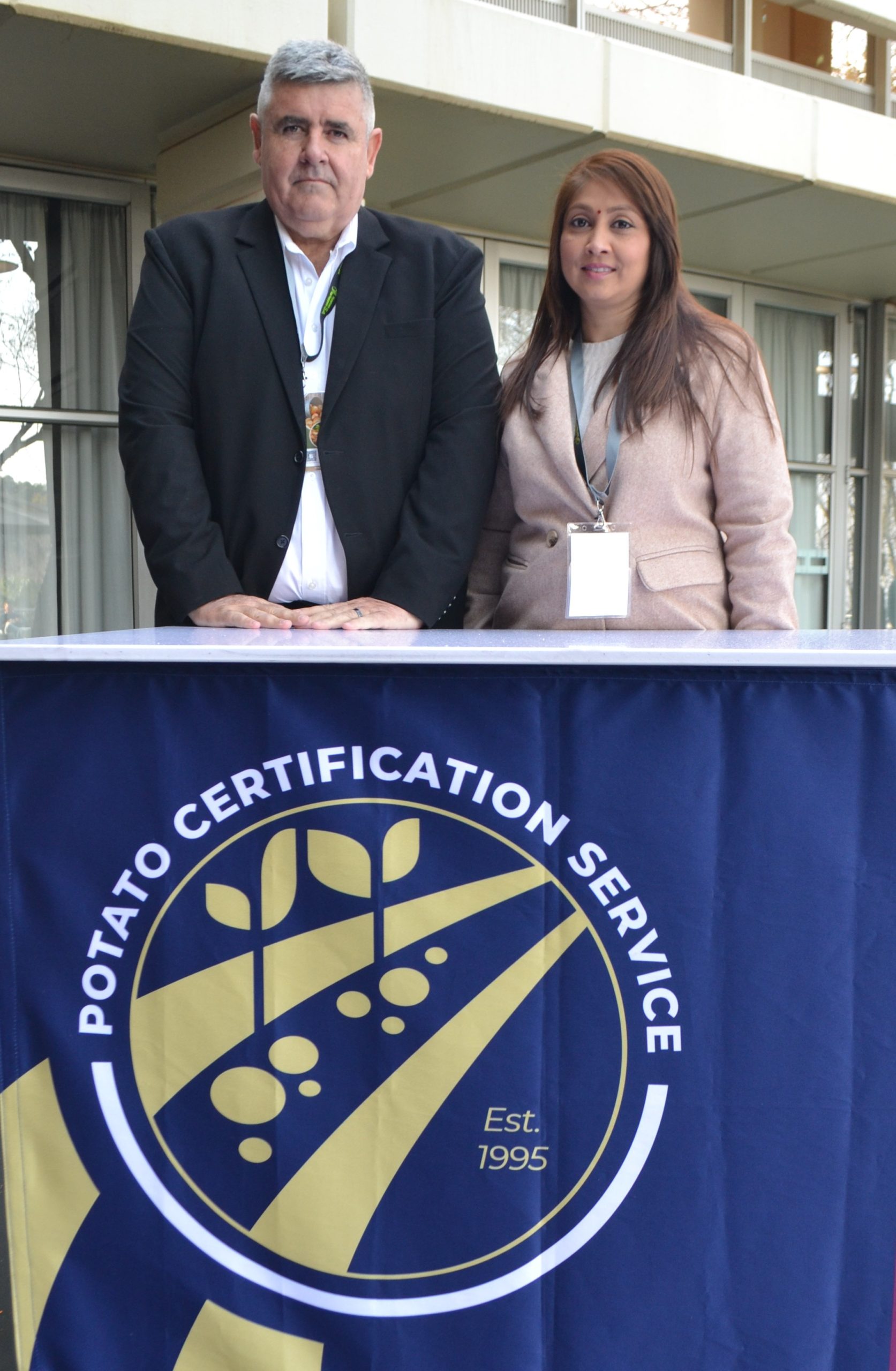
Gerhard Posthumus, chairperson of the PCS board, said during the unveiling ceremony that PCS plays a pivotal role in transforming the South African industry into a global player that enjoys international recognition. “When somebody wants to import new varieties from abroad, the first question from international companies is whether the country has a certification body that is able to handle and control large volumes of a new variety.” Thanks to PCS’s capabilities they can import new tuber varieties on a large scale.
Furthermore, Posthumus praised the work that PCS has done over the years to eradicate diseased seed potatoes that offered producers a mediocre yield. “Today, even remote communal producers have access to good, certified seed thanks in large to PCS’s efforts.”
However, although PCS’s 30th birthday is a major milestone, it does not mean the certification body’s work is complete, Posthumus said. There are still many challenges and opportunities such as climate change, changing markets, food security, and the growing African market that must be addressed in a timely manner.
Currently, PCS certifies around seven million 25kg bags of seed potatoes per annum. These tubers are exported to countries such as Zimbabwe, Botswana, Eswatini, Lesotho, Mozambique, Namibia, the Seychelles, Saint Helena, and Angola. PCS also ensures that approximately three million in vitro plants are produced every year, while also certifying ten to 11 million minitubers as Generation 0 potato tubers per annum. Certification officers carry out approximately 5 000 field inspections, take 3 700 samples, and conduct approximately 2 200 tuber inspections to ensure that the highest quality standards are met.
Pretty direction for uglies
One industry challenge received a lot of focus during the research symposium: What to do with lower-grade potatoes that are visually unappealing to consumers?
Dr Hester Vermeulen, manager for consumer analysis at the Bureau for Food and Agricultural Policy (BFAP), spoke about consumers’ willingness to accept these so-called ‘ugly’ potatoes. After all, while the produce is not visually appealing, they are still perfectly safe for human consumption.
Dr Vermeulen’s team performed a test during which they observed a group of consumers’ willingness to buy these products. While the consumers did not want to buy the uglies initially, their willingness increased once they understood that buying uglies have several financial and environmental benefits.
Tanya du Toit, a master’s student in Food Sciences at Stellenbosch University, shared her research on creating potato flour from uglies. This type of flour might not be ideal for baking when used on its own but can be used very efficiently as a thickener in dishes and products such as baby food. The benefit for consumers would be the fact that potatoes are naturally gluten free.
Lerika Potgieter, a master’s student in Consumer Sciences at the University of Pretoria (UP), discussed how uglies can be reworked into products that the market wants to buy. She focussed on creating a breakfast dish (a cheese, ham and potato breakfast tart), a ready to eat dish (potato lasagna) and a snack food (potato ice cream).
Another research team, Prof Yusuf Ahmed, an associate professor in zoology and entemology at UP, and Lerato Maupi, a master’s degree entemology student at the same university, spoke about the possibilities that uglies offer when it comes to bugs and chicken feed. Essentially, lower-grade potatoes can be used as food for meal worms, which in turn make for very nutritious chicken feed.
The consumer of tomorrow
During an expert panel discussion on changing consumer demand, it became clear that the consumers of the future will be focussed on issues such as ease of preparation, health benefits, and price.
Anthony Viljoen, agronomy director at PepsiCo South Africa, said there is a certain type of resilience that one could breed into maize to improve its ability to withstand various environmental stresses such as drought, heat, and disease while also improving its nutritional value.
However, the same principles cannot be applied to potatoes.
That is why it is crucial that producers take optimal care to improve their soil. “The stronger the soil, the stronger the plant will be,” Viljoen said, adding that efficient water use will also become more important in future.
Kobus Pienaar, Woolworths’ technical manager of regenerative agriculture, said it is always interesting to see how consumers’ preferences change from month to month. He discussed five major issues that always influence shoppers’ choices, namely food safety, nutritional value, value proposition (whether a product offers good value for money), how factory or farmworkers are treated, and whether the product is produced in an environmentally friendly manner.
The healthy stuff
Pienaar said producers need to understand that even higher income groups are price sensitive. “There is a specific price point at which we will see consumers opt for alternatives such as pasta.”
Nicki de Villiers, a dietitian with a special interest in sports nutrition, said there is still a lot of scope for product development and to promote the health benefits of potatoes among athletes. “Health-conscious consumers are moving more towards the consumption of whole foods,” De Villiers said, adding that consumers understand that potatoes are healthier as they are less processed than other starches such as pasta. “The industry should also highlight potatoes’ health benefits as they are loaded with nutrients such as potassium and vitamin C. That makes a big difference.”
She said if potato packaging could include portions or serving sizes it will be very beneficial to consumers, as this helps to take the guesswork out of shopping. From a sporting point of view, it is not always convenient for an athlete to eat a jacket potato at a sporting event, De Villiers said and suggested that the industry should consider the option of providing potatoes in a gel format.
However, she said the industry should not interfere with the product too much because changing it can negatively impact its health benefits, which is one of the biggest selling points of a potato. “Taste is very important for consumption and, unfortunately, the things that make things taste better usually are not very healthy.”
Awarding the best
During the annual Potatoes SA awards evening sponsored by UPL, three awards were presented to industry role-players.
Dr Diedrich Visser, who dedicated his career to potato insects, received the Solanum Tuberosum award. He is a lifelong champion of sustainable potato pest management. Known for his dry wit and highly engaging presentations, Dr Visser is more than just a scientist; he is a communicator and educator. His legacy includes not only his groundbreaking pest control methods but also a suite of outstanding identification guides, including the Complete Guide to Vegetable Pests as well as contributions to Insect Control in Potatoes.
Gert Bester, a potato producer from the Petrus Steyn area, also received the Solanum Tuberosum award. As a leading producer in his community, he is passionate about sustainable farming practices which utilises technology in a sensible way. Bester also, very willingly, shares his knowledge with fellow producers. He has been involved in Potatoes SA’s research committee for almost three decades and is also a former chairperson of the Potatoes SA board.
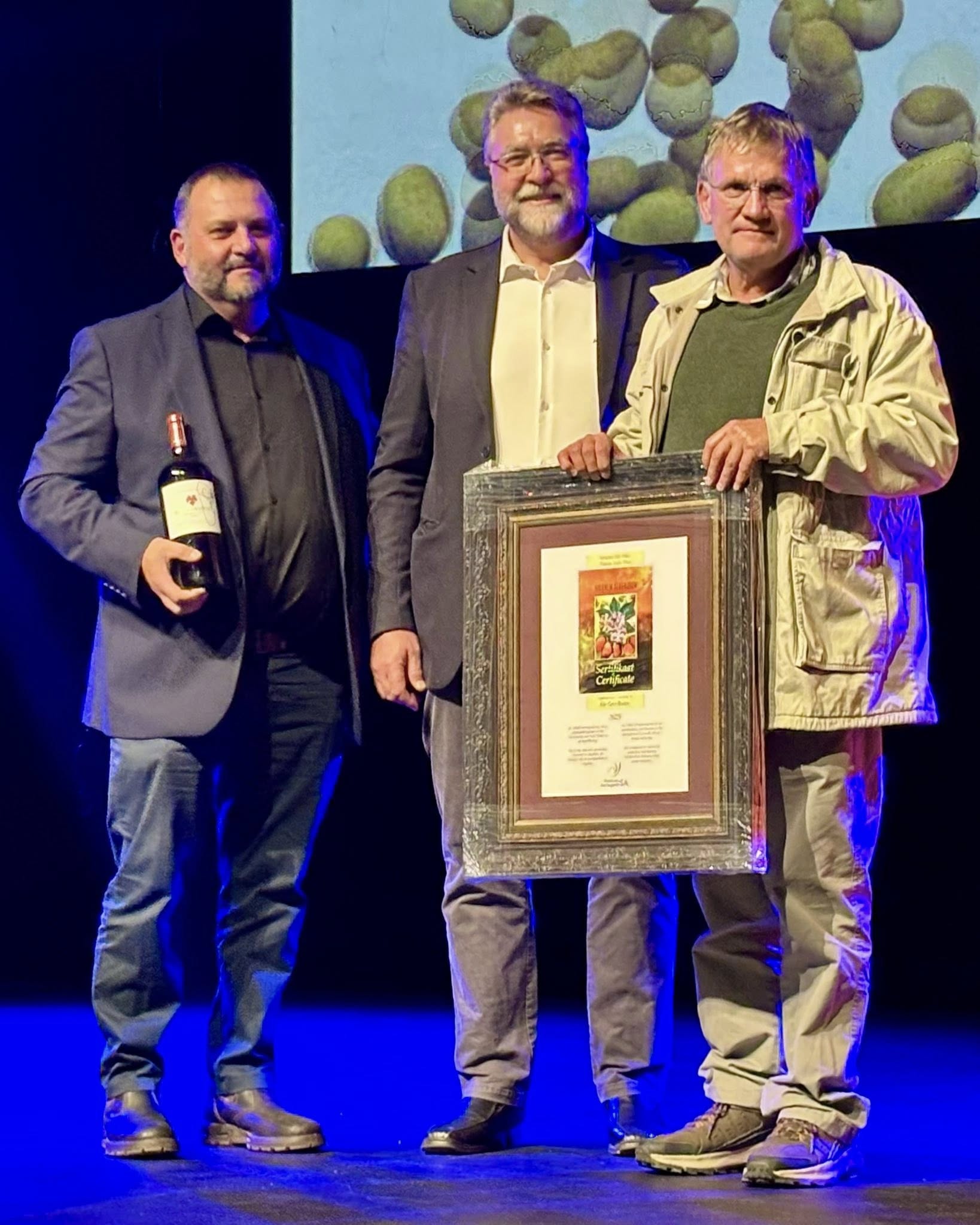
Hein Oberholzer, Potatoes SA’s finance manager, also received a Solanum Tuberosum award. He retired in August this year, after having dedicated the last 30 years of his life to the organisation and its successes. Read more about him elsewhere in this issue.
CHIPS awards
During the gala evening, Enrike Verster was honoured as CHIPS magazine’s technical writer of the year. Enrike is a regular contributor to CHIPS and it is her unenviable task to get trial data on paper and to keep it interesting for readers.
Although the trial articles follow a basic template, the responsibility of correctly presenting the data is a big task, said Lynette Louw, editor of CHIPS. “Enrike’s articles are complete and well-structured, and speak to her good relationship with the producers on whose farms the trials are conducted, as well as the other collaborators and working groups involved.”
The CHIPS advertiser of the year award went to Grimme, one of the top five advertisers in CHIPS based on spend, regular placements, as well as the quality of their advertisements. From a design point of view, their advertisements are clean, uncluttered, and provide producers with relevant facts that immediately grab their attention. A Grimme representative was not present to accept the reward, which will be handed over to them at a later date.
For more information, call Potatoes SA’s head office at 012 349 1906