
Estimated reading time: 6 minutes
Genetic variation refers to variability between the DNA sequences or genomes of individual living organisms and is the basis of the biodiversity we see around us. Even within a single species, DNA sequence variation between individuals can result in them having diverse genetic traits. Moreover, mutations (changes in DNA sequences) occur constantly which means the genetic traits of a population can evolve over time.
In agriculture, naturally occurring genetic variation has been harnessed over millennia, through conventional breeding, to combine the most desirable traits in distinct crop cultivars and livestock breeds.
Genome editing is a revolutionary scientific technique that allows scientists to make precise changes to an organism’s DNA sequences, to alter the associated genetic trait in a specific manner.
Genome editing techniques are based on naturally occurring cellular mechanisms that include the following:
- The identification of a specific DNA sequence within the genome of the target organism.
- Breaking the DNA strand in that position.
- Allowing the cell to repair the break again.
In doing so, mutations, identical to those that form the basis for natural genetic variation, may be introduced, which in turn could increase, decrease, or modify the activity of the targeted gene. Genome editing is a form of genetic engineering, however, because the character, scope, and precision of such introduced genetic change are designed and controlled, the process is also called precision breeding.
Genome editing tools
One of the most popular and effective genome editing tools is the clustered regularly interspaced short palindromic repeats (CRISPR) plus Cas system (CRISPR/Cas). Watch this easy-to-follow video for an overview at www.rb.gy/73ro2q. It is used in more than 90% of the current genome editing research and development work done in agriculture. Because of its accuracy, simplicity, and efficiency, CRISPR/Cas-like systems have reduced the technical and cost barriers associated with genetic engineering.
As a result, a wider spectrum of bio-innovators now has effective access to these technologies, and it is economically viable to improve a broader range of crops, than previously possible using older genetic modification (GM) techniques.
In addition, unlike GM which introduces novel DNA sequences that are typically derived from other species and result in the creation of a genetically modified organism (GMO), genome editing methods are rather used to alter the existing genetic material of an organism. Such targeted and precise modifications can enhance endogenous traits without introducing foreign genes.

Current potato genome editing
Genome editing in potatoes has been reported as early as 2014 (using an older technique called transcription activator-like effector nucleases [TALEN]), with a significant increase in reports from 2017 when CRISPR/Cas systems were first developed. Currently, the best source for agricultural-relevant crop genome editing data is the European Sustainable Agriculture Through Genome Editing (EUSAGE, www.eu-sage.eu) database. It only lists peer-reviewed research articles that use genome editing to develop market-oriented traits for crops. However, no information regarding the stage of development is supplied.
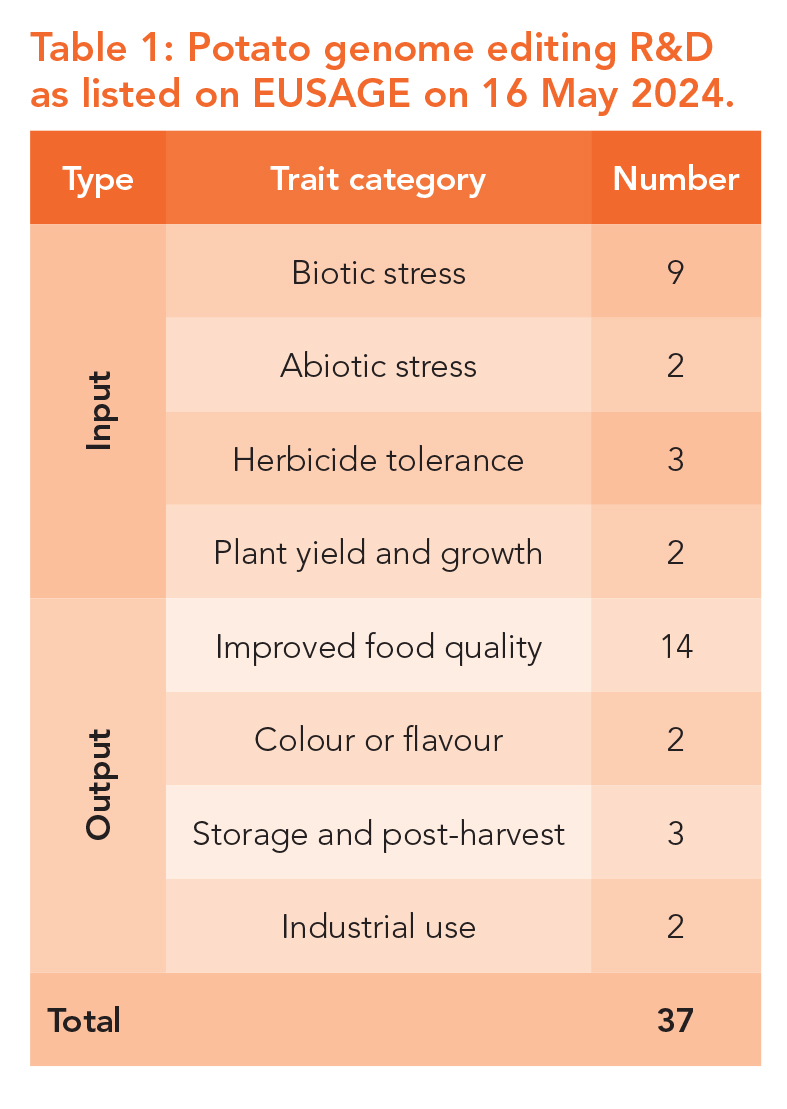
The EUSAGE database currently lists a total of 892 reports of which 37 (4%) are for potatoes, making it the seventh most genome-edited crop. Target traits can be divided into eight different categories of which half (four) represent input traits, generally important to the producer, and the other half, output traits, generally important to the consumer.
Forty-three percent (16) of the potato projects targeted input traits while 57% (21) targeted output traits. This tendency to favour output traits is typical for most crop-focussed genome editing research and development (R&D) and contrasts with historical GMO traits that are almost exclusively input traits. For example, the only three GM traits commercialised in South Africa over the past three decades, are insect resistance, herbicide and drought tolerance.
Developing genome-edited crops that offer a direct benefit to the consumer will contribute directly towards positive risk-benefit perceptions among consumers, which in turn could help ensure market acceptance of these products.
Research endeavours
Biotic stress tolerance R&D focussed on viral, fungal and bacterial resistance mechanisms, while drought and cold tolerance were the focus of the abiotic work. Yield and growth research investigated starch granule size and plant architecture. Food quality trades that have already been edited in potatoes include starch composition, anthocyanin synthesis, reduced browning, acrylamide, glycoalkaloid synthesis, and improved cold storage.
Researchers from 19 countries are represented in these publications with the United States, China, Sweden and Japan being the most prolific. To date, no directly market-orientated, agricultural genome editing R&D from South Africa has been published.
Plant genome editing techniques still require a tissue culture stage and edited genotypes must often be subjected to back-crossing to segregate the edited phenotype from the CRISPR/Cas molecular machinery. Although genetic engineering technologies for potatoes are well-established (Nahirñak et al., 2022), significant challenges remain.
Potato tissue culture protocols are notoriously genotype-dependent, and the final regeneration step is often the biggest bottleneck in the process and can also introduce undesirable somaclonal variation. Recent advances in improving the transformation efficiency of diverse potato cultivars and the development of diploid cultivars, amenable to sexual reproduction and allowing for back-crossing and segregation are set to unlock genome editing as an effective and viable precision breeding tool for potatoes.
Precision breeding for SA
The South African potato industry faces significant hurdles. Pests such as the potato tuber moth and diseases such as early blight take their toll, while postharvest wastage due to sprouting, greening, and bruising further impacts producers’ incomes. In addition, changing rainfall patterns and rising temperatures threaten wellestablished production areas. Genetics and precision breeding could provide a lifeline through:
- Pest and disease resistance: Enhancing South African cultivars’ natural defences against pests and diseases can increase resilience and reduce agricultural inputs.
- Enhanced shelf-life: Potatoes that resist sprouting and greening could dramatically cut losses during storage and transport.
- Resilient to climate stress: Potatoes bred to withstand drought or heat spells could safeguard harvests, boosting food security.
The regulatory hot potato
The potential benefits of precision breeding techniques for the South African potato industry and its consumers can only be realised if the South African regulatory framework aligns with international best practices. Most importantly this includes distinguishing precision-bred organisms, which do not contain any transgene or novel sequences, from GMOs, which do contain novel DNA sequences.
This would significantly reduce the barriers to genetics-based innovation, allowing a wider array of local innovators to develop locally relevant products. GMOs, in contrast, are difficult and expensive to develop and commercialise because of the stringent regulatory processes associated with them – born from the fact that no South African-developed GMOs have been commercialised over the past 30 years since their introduction into the country.
In conclusion, precision breeding, particularly through CRISPR/Cas technology, holds significant promise for the South African potato industry. However, realising this potential requires not only scientific and technological advancements but also a supportive and forward-looking regulatory environment. – Dr Hennie Groenewald, CEO, Biosafety
For more information, email the author at hennie@biosafety.org.za.