
Estimated reading time: 7 minutes
The advantages of crop rotation have been known for centuries and are utilised by producers to enhance soil fertility and control diseases, pests, and weeds through the inclusion of specific crops in a rotation. However, the profitability of crop production in general, particularly potato production, is continually declining.
Read this article in Afrikaans.
This can firstly be attributed to rising input costs, which have increased disproportionally compared to product prices. Secondly, productivity is trending lower due to higher disease pressure, particularly in potatoes. Previous studies revealed that selecting the correct crop rotation and cover crops, combined with optimal cultivation practices, can help reduce disease pressure. The positive effects of crop rotation on disease suppression and improved crop productivity can partly be ascribed to a more balanced soil microbial composition, improved availability of groundwater and nutrients, and reduced weed pressure.
Soil health can be defined as soil’s capacity to function within an ecosystem as a vital living system that maintains or improves plant and animal productivity, water and air quality, and promotes plant and animal health. Various tests are available to evaluate different aspects of soil health and quality. These tests include the physical, chemical and biological properties of soil.
Trial procedure
Interest in using crop rotation to enhance the profitability of dryland crop production and mitigate financial risk was recently rekindled. Virtually no research into crop rotation systems that include potatoes has previously been conducted in South Africa. Consequently, the long-term goal of this study is to evaluate and optimise crop rotation systems for potato production in the Eastern Free State to improve soil health, the physical and chemical conditions of soil, and the profitability of dryland potato production in the region.
A long-term experiment consisting of four five-year crop rotation systems was initiated during the 2014/15 summer season in the Petrus Steyn district of the Eastern Free State. The crops in each rotation system are indicated in Table 1. The 2023/24 season represented the eighth year of the trial. By the end of the first complete five-year cycle, few differences were observed between the rotation systems. The only changes over time were slight shifts in soil chemical properties.
It was subsequently decided to include a cover crop (instead of maize) starting in year seven (Rotation 1), to determine whether the organic material content of the soil could be increased (Table 1). Note the replacement of maize with a cover crop in year seven (Rotation 1), the replacement of teff with maize in year eight (Rotation 1), and the inclusion of a cover crop mixture in year nine (all rotations).
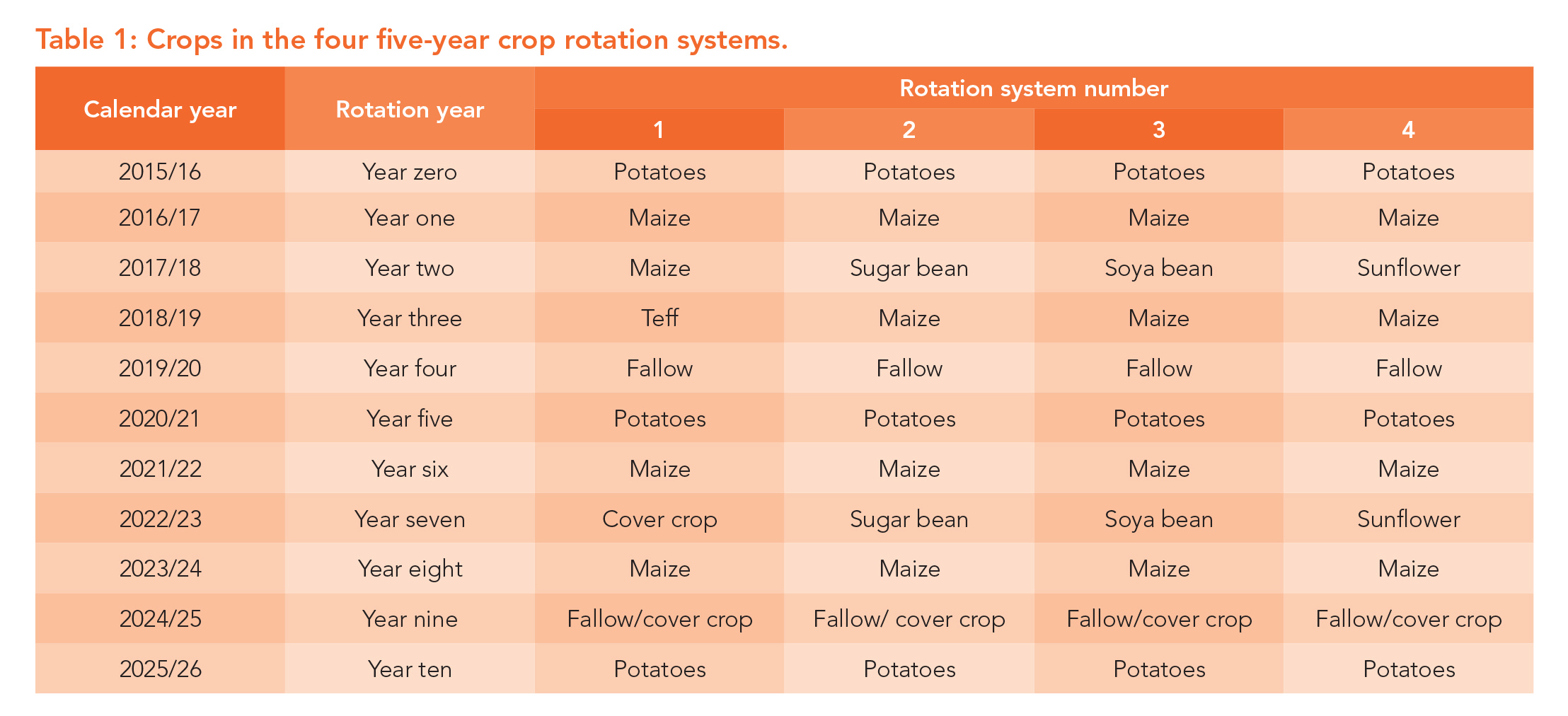
Cover crops are instrumental in promoting sustainable agricultural practices. They have the potential to control erosion, increase water infiltration, reduce nutrient leaching, suppress pests and diseases, and improve soil quality through increased microbial activity. Starting from year nine, the number of repetitions (currently eight) per rotation will be split: one half will lie fallow according to the original plan, while the other half will be planted to a mixture of summer cover crops.
Soil samples from the topsoil (depth of 0 to 25 cm) and subsoil (depth of 25 to 50 cm) are taken at the end of each growing season (May to June) for chemical analyses, which includes pH and nutrient status. Regarding soil physical properties, penetration resistance is measured to determine the presence of any compacted layers. Undisturbed soil samples are taken to determine bulk density and soil water content at the end of the season.
The assessment of soil biological properties has varied over the seasons. Since the 2022/23 season, soil microbial functionality has been determined using Biolog EcoPlates™ and microbial activity in the form of carbon dioxide release (microbial respiration) has been measured using the Cornell Soil Health Laboratory potassium hydroxide method and the Solvita CO2 Burst test method.
Results
The key soil chemical and physical results, along with maize yields recorded during the past 2023/24 season, are presented. Soil chemical results at the end of the 2023/24 maize growing season indicated no differences between treatments. The average pH (H2O) of the topsoil was 5.5, while that of the subsoil was 5.9. The levels of macro- and micro-elements in the topsoil were also within acceptable ranges.
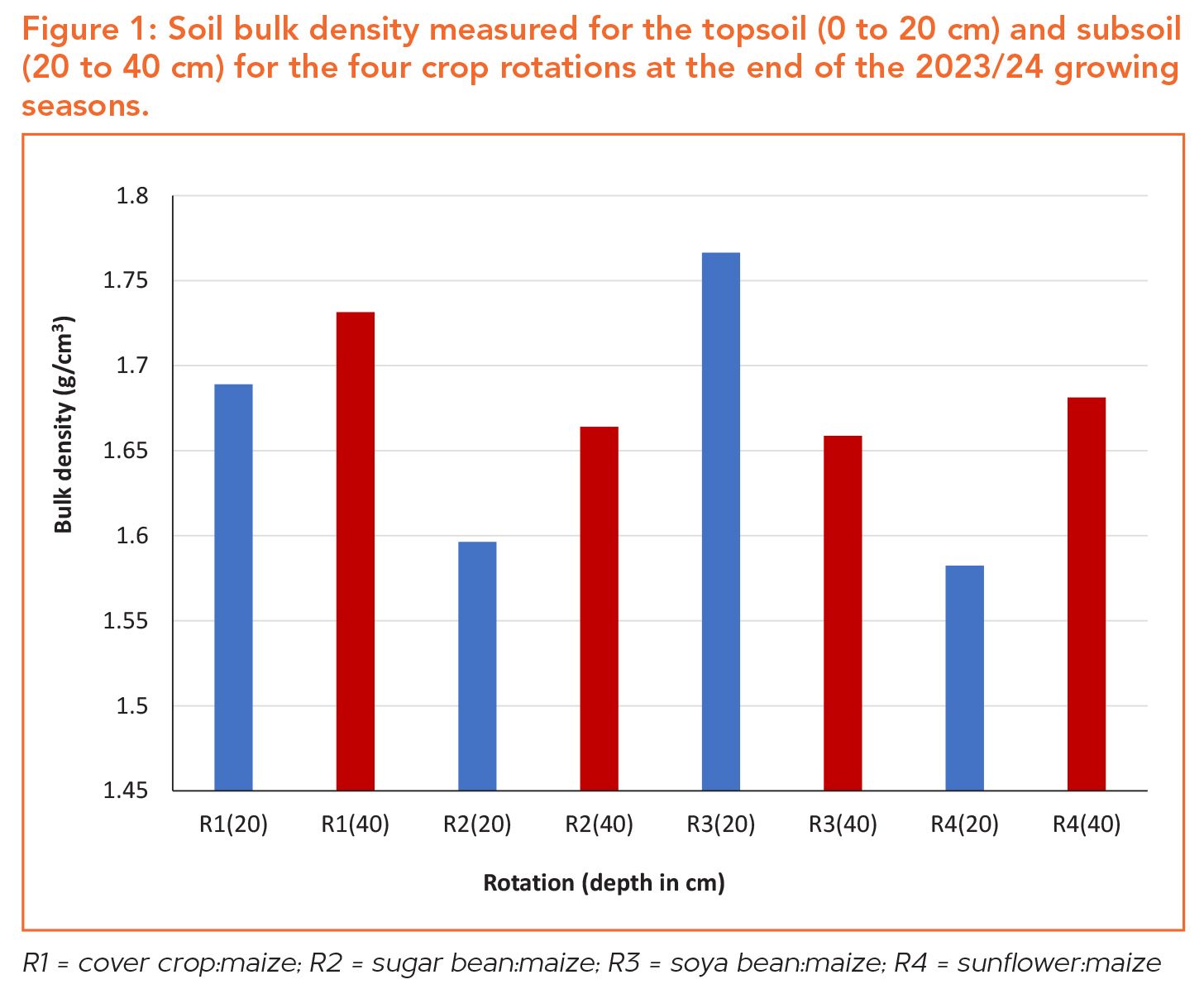
Soil bulk densities at the end of the growing season varied significantly between rotations (Figure 1). Since maize was cultivated on all plots, these differences likely carried over from the previous crops in each rotation system. The plots previously planted to cover crops (R1) and soya bean (R3) exhibited the highest average density in the topsoil (0 to 20 cm soil layer), ranging from 1.69 to 1.76 g/cm³, while R1 also had the highest density in the subsoil (20 to 40 cm), averaging 1.73 g/cm³. The other four rotations had similar subsoil densities, ranging from 1.66 to 1.68 g/cm³.
During the 2023/24 season, a mid-summer drought resulted in well below-average rainfall from February to April 2024. Clear differences in plant height and visible stress symptoms were observed during the grain-filling stage, starting in February, across the crop rotation treatments.
These differences were attributed to the legacy of the crops that preceded maize in the previous season. Maize that followed sugar beans (R2) and soya beans (R3) exhibited noticeably less drought stress and were taller than maize that followed cover crops (R1) and sunflowers (R4). The plots previously planted to cover crops still had significant amounts of crop residue from the previous season on the soil surface, and there was visible regrowth of some cover crops, particularly forage sorghum.
Grain yields
The trial produced an average grain yield of 3 950 kg/ha, which is acceptable given the dry season experienced. Maize yields (Figure 2) followed a similar trend in respect of plant height. The highest grain yields were from treatments where maize followed sugar beans (4 580 kg/ha) and soya beans (4 470 kg/ha), followed by treatments where maize followed cover crops (3 520 kg/ha). The lowest yield was recorded for the treatment where maize followed sunflower, yielding 3 240 kg/ha.
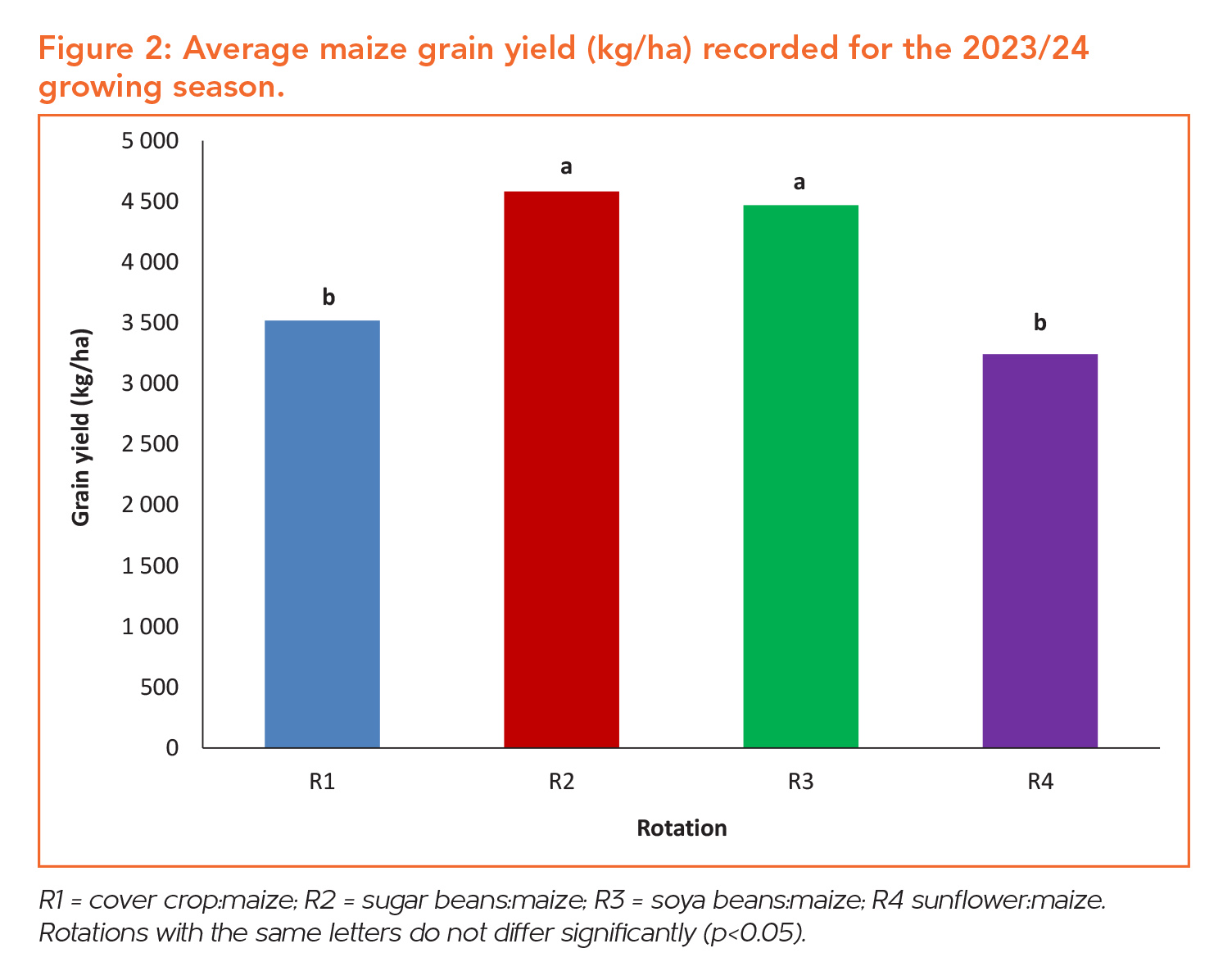
The lower maize yields in R1 (maize after cover crops) can probably be attributed to a nitrogen deficit early in the season due to the decomposition of plant residues and competition for soil moisture by cover crop residues. The reduced growth and lower yields of maize following sunflower can be linked to drier initial soil conditions (due to deeper water extraction by sunflower) and possibly higher nematode infestation at these sites. Previous observations indicated that sunflower cultivation led to increased nematode infestation in subsequent crops (such as potatoes).
An important lesson from the past two growing seasons regarding cover crop management is that summer cover crops should be terminated before the end of their growing season to prevent excessive soil drying and to allow plant residues sufficient time to decompose before establishing the next summer crop. This practice reduces competition between the cover crop and the subsequent crop while increasing soil organic matter, which benefits soil microbes.
Summary and conclusions
Distinct differences in soil physical properties and yields only started to emerge in the eighth year of this study, emphasising the fact that the benefits of crop rotation can take a long time to manifest. These preliminary results indicate that incorporating cover crops in crop rotation systems can benefit overall soil health and quality.
In addition, the inclusion of cover crops in a rotation system offers multiple benefits, such as improving soil physical and chemical properties, acting as natural pest and weed suppressants, and increasing revenue by utilising a portion of the above-ground cover crop material as animal feed.
The impact of the different crop rotation systems on soil microbial activity and functionality will be discussed further in a follow-up article in the next issue of CHIPS. – By Prof Martin Steyn, Taryn Armfield, Dr Elsie Cruywagen, and Prof Quenton Kritzinger
For more information and sources, send an email to martin.steyn@up.ac.za or armfieldtaryn@gmail.com or cruywagenem@arc.agric.za or quenton.kritzinger@up.ac.za.