
Estimated reading time: 6 minutes
Various crops have been studied for their use as green manure to combat soilborne diseases in commercial potato fields.
The implementation of green manure crops involves different mechanisms that contribute to mitigating soilborne pathogens, resulting in improved yields for commercial crops.
Biofumigation is one of the mechanisms employed. Typically, biofumigation is applied after introducing crops belonging to the Brassicaceae family, which includes plants such as mustard, broccoli, cabbage and canola as well as families from the order, Capparales.
These crops contain an ingredient known as glucosinolate. The type and quantity of glucosinolate differ across various plant species and even within individual plants.
Once these crops have been incorporated into the soil as green manure, enzymes break down glucosinolates and volatile products are released. The volatile products serve a biotoxic function. Isothiocyanate is one of the prevalent toxic volatile products. Fumigation crops can suppress diseases by directly killing the pathogen’s inoculum (microsclerotia), hindering the ability of the microsclerotia to germinate, or inhibiting the pathogen growth.
Green manure
Certain Brassicaceae crops contain low glucosinolate concentrations.
There are non-Brassicaceae green manure crops that lack glucosinolate but still effectively suppress diseases, sometimes outperforming crops with higher glucosinolate levels.
This suggests that other mechanisms are at work. Green manure can transform the microbial populations in the soil which in turn contributes to disease suppression.
The proliferation of antagonistic microbes to combat the pathogen can result in a biological control effect.
An increase in the microbial population near the rhizosphere of plants can intensify competition between microbes and pathogens, resulting in reduced pathogen infections. The impact of specific green manure types on microbial population structure is unique and varies among different green manure crops.
Green manure can also improve crop yields by altering the soil’s mineral and organic material content. One of the ways it achieves this is by breaking down residues. The resulting increase in minerals and organic material supports microbial activity, which in turn suppresses Verticillium wilt. Ultimately, this promotes growth in the potato plant.
In addition to disease control, green manure offers other benefits. Sudan grass serves as a valuable grazing crop while plants such as maize, oats, wheat and barley are commercial cash crops.
The project
The project aimed to explore the use of cover crops as green manure in managing Verticillium wilt in potatoes. Various crops were selected for the study and investigated in a greenhouse. Initially, a Verticillium dahliae silica-sand inoculum was prepared.
It was incorporated into the soil to achieve a concentration of 20 microsclerotia per gram of soil. Green manure crops were added to the soil until it reached an equivalent of 20 t/ha.
The study involved a diverse range of crops, including cowpeas, dolichos beans, faba beans, barley, grain sorghum, oats, Italian ryegrass, canola, triticale, crown vetch, lupins, maize, rye, serradella, sweet sorghum, soya bean, teff, forage sorghum, white buffalo grass and white mustard.
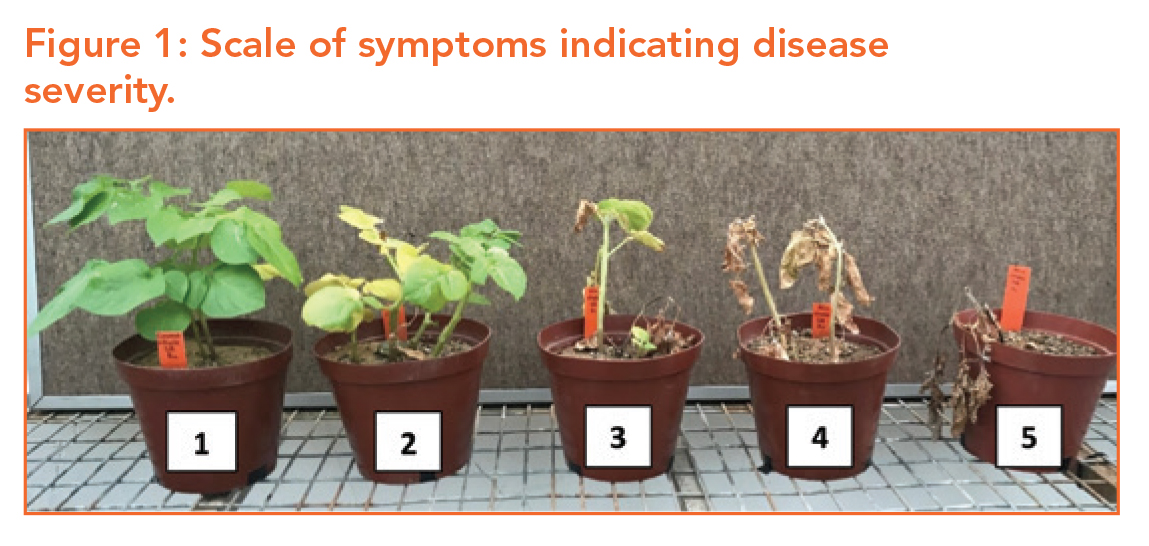
The trial concluded 12 weeks after planting. Disease severity was assessed using a scale on which symptoms ranged from 1 to 5:
- 1 – no wilting or yellowing of the plant.
- 2 – wilt and yellowing affected one-third of the plant.
- 3 – wilt and yellowing affected two-thirds of the plant.
- 4 – complete wilting and yellowing of the plant.
- 5 – the entire plant is dead (Figure 1).
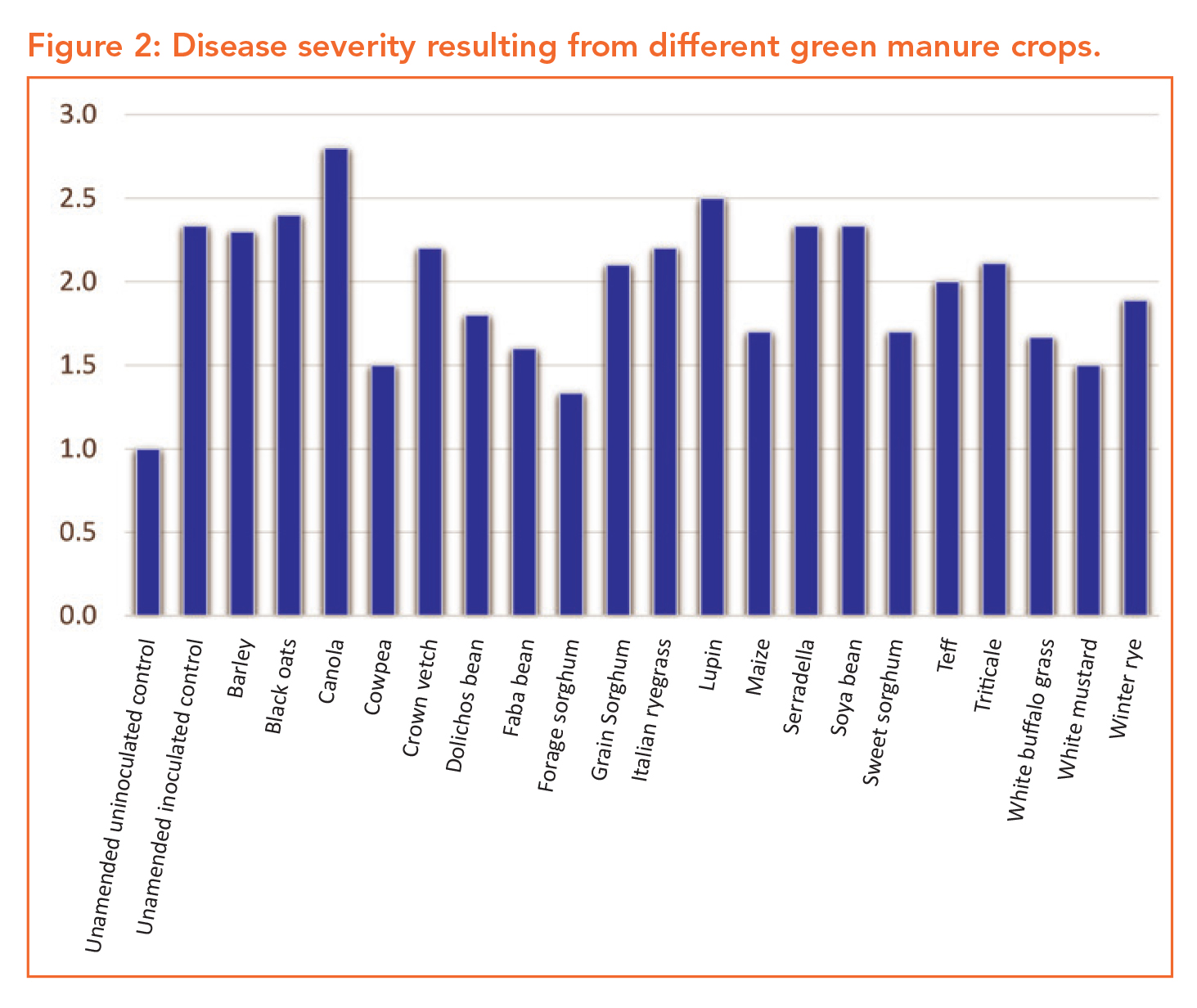
The results are presented in Figure 2.
Results and discussion
Among the green manure treatments, three treatments, namely canola, oats and lupins, led to higher disease incidence compared to the inoculated control plants, along with an increase in the wilting index. The results of the study differ from previously published literature findings which indicated that canola successfully suppressed Verticillium wilt in potatoes.
The published study found that the application of canola as green manure increased native Streptomycetes, which inhibited the pathogen. Our study outcomes differ from this study’s outcome.
This discrepancy can be attributed to the soil type, as the impact of green manure crops on microbial populations is soil dependent. The specific soil used in the greenhouse trial presumably had a different microbial population that was not positively affected by the addition of canola.
A similar scenario may apply to the application of oats and lupins, with the post-application conditions appearing to be conducive to the development of Verticillium wilt.
Wilt intensity
Implementing soya beans and serradella as green manure resulted in disease levels equivalent to the inoculated control plants. The green manure had no discernible beneficial effects. Among nine additional treatments, namely dolichos beans, barley, grain sorghum, Italian ryegrass, triticale, crown vetch, maize, rye, sweet sorghum and teff, the wilt intensity did not significantly differ from that of the inoculated control plants. It did however lead to a slight reduction in wilting intensity, but it was not statistically significant.
Green manure along with white buffalo grass significantly lowered wilt intensity, especially when compared to inoculated control plants. The crop that exhibited the most effective disease suppression was forage sorghum. Three other treatments, namely faba bean, cowpeas and white mustard also reduced wilt to a level comparable to the control plants, rendering them effective as green manure treatments.
Forage sorghum is a sorghum and Sudan grass hybrid, and is typically used as animal feed and as green manure. Other published studies have found that forage sorghum is effective against Verticillium wilt and other soilborne potato diseases when utilised as green manure.
Multiple methods contribute to the effectiveness of green manure crops. The presence of dhurrin is one potential factor. Dhurrin, a cyanogenic glycoside, can hydrolyse and release hydrogen cyanide, which is extremely toxic to several soil organisms.
Literary research results
Literature suggested that applying cowpeas to potatoes could reduce potato scab. In our study, it was proven that cowpeas can also serve effectively as green manure to combat Verticillium wilt.
Faba beans, another green manure option, can release substantial amounts of nitrogen as they decompose in the soil. In the literature, several non-Brassica crops in studies effectively reduced potato diseases.
This was achieved through mechanisms involving increased microbial biomass and activities, alterations in soil microbial population characteristics, and specific impacts on antagonistic microbe populations. These characteristics are influenced by nitrogen levels.
White mustard is recognised in the literature as an effective green manure crop to combat Verticillium wilt. It is especially effective when combined with oriental mustard.
White mustard is commonly selected as a green manure crop due to its ability to produce substantial amounts of volatile substances that are toxic to soilborne pathogens.
White buffalo grass, forage sorghum and cowpeas thrive in summer rainfall areas, while white mustard and faba beans are better suited to winter rainfall areas. The preliminary results of the study identified several crops suitable for rotation with potatoes and as green manure in both winter and summer rainfall areas in South Africa. The results of the study will be validated and/or tested in a subsequent greenhouse trial. – Dr Estianne Retief, ARC Plant Health and Protection
For more information, contact the author at retiefe@arc.agric.za.