
Estimated reading time: 10 minutes
Swayimane and Appelsbosch located in the KwaZulu-Natal Midlands are home to a considerable number of smallholder potato farmers who experience challenges that can compromise yields. Smallholder farmers tend to realise significantly lower yields, often falling below 10 t/ha, even under optimal climate conditions.
The major factors contributing to the low yield are financial constraints such as the affordability of implements and inputs, and low skills and education levels that would otherwise allow farmers to operate complex implements and apply inputs where potatoes are produced under rainfed conditions. Therefore, easy-to-apply strategies that generally translate into a high adoption rate of intervention strategies are required to improve small-scale potato yield.
Method and material
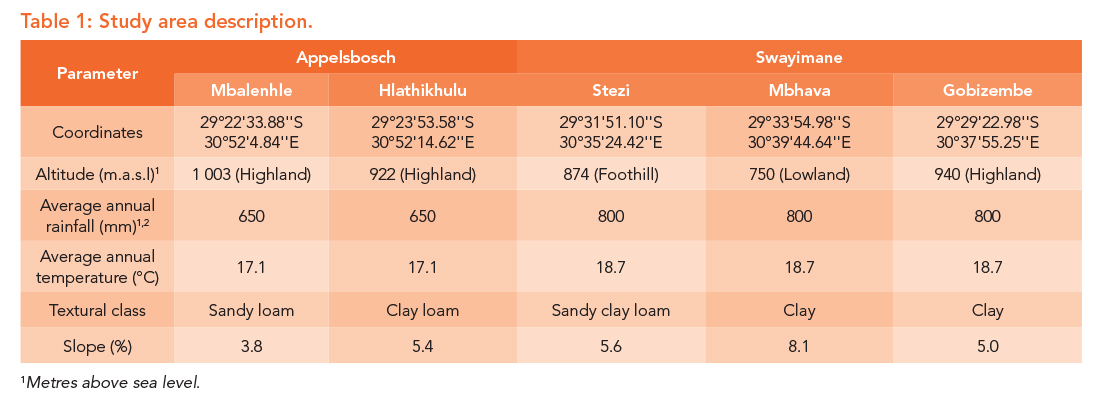
Appelsbosch has a cooler, very humid climate and low clay content soils that are sandy loam in texture. Swayimane, on the other hand, has a warmer, moderately humid climate with high clay content soils that are sandy clay in texture (Table 1). Field trials were conducted in five localities over two planting seasons in 2022/23 and 2023/24 (August to January), three of which were in Swayimane (Stezi, Gobizembe, and Mbhava) and two in Appelsbosch (Mbalenhle and Hlathikhulu). The details describing the study area are shown in Table 1.
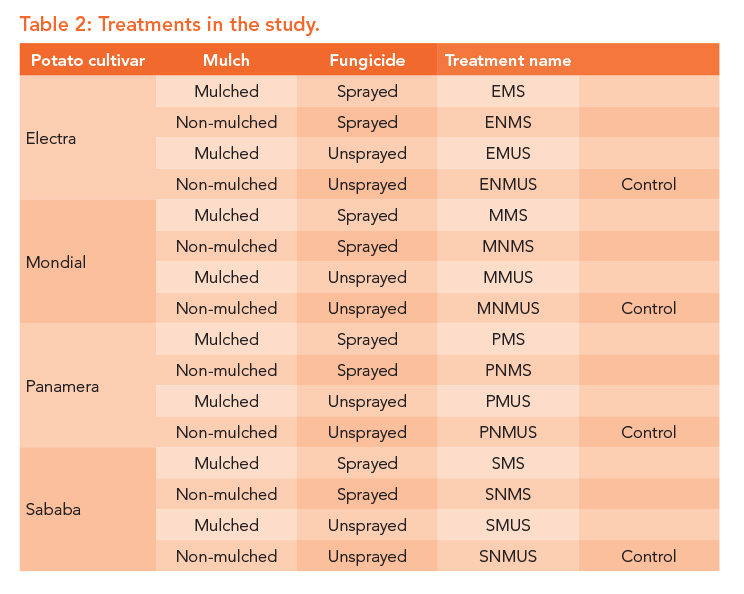
The factors tested included four cultivars (Electra, Mondial, Panamera, and Sababa) obtained from Wesgrow. Fungicides (chlorothalonil, mancozeb, and mefenoxam + mancozeb) were applied weekly in rotation and commenced when symptoms of late blight presented. Dry hay grass mulch material was applied at a rate of 1.9 kg/m2 during the crop establishment stage.
The experiment was arranged in a randomised complete block design and replicated three times. Overall, the experiment included 16 treatments (Table 2), integration of the four selected potato cultivars, two mulch application levels (non-mulched and mulched), and two fungicides levels (unsprayed and sprayed).
Plots sprayed with fungicides were separated from unsprayed plots by a 5 m wide area to reduce contamination. The plot size was 5 x 3.6 m and consisted of four rows, with seeds spaced using 30 cm intrarow spacing and 90 cm interrow spacing. The two centre rows were used for rating disease severity, and recordings were done weekly from the onset of disease until the plants reached maturity. Thereafter, yield was recorded. The percentage of disease severity (PDS) was matched to the linearised logistic, Gompertz, and monomolecular growth curves.
Climate conditions
While technical issues prevented the availability of data relating to Gobizembe and Hlathikhulu in the 2022/23 season, the 2023/24 season delivered a full data set for all localities, as shown in Table 3.
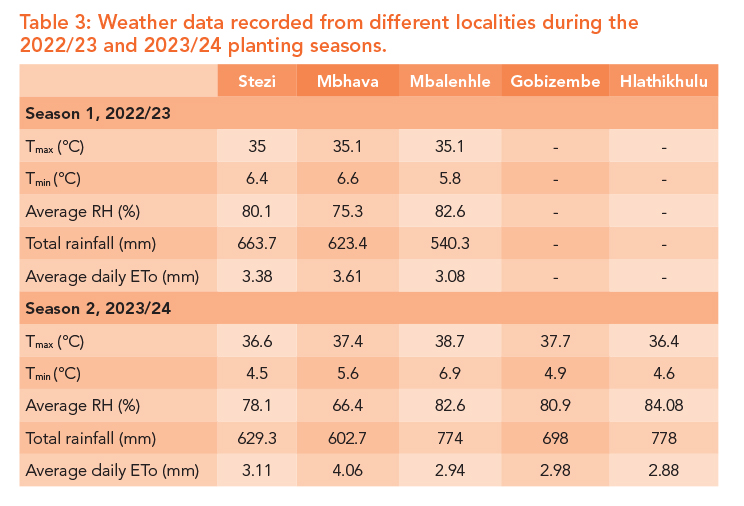
Temperatures were low at the start of the season but became warmer as the season progressed, with no observations of heat stress and maximum temperatures (Tmax) ranging from 36.4 to 38.7°C. Minimum temperatures ranged from 4.6 to 6.9°C across localities, with no cold stresses.
Both seasons received a high amount of seasonal rainfall ranging from 540 to 778 mm. Rainfall was erratic, and onset was late for both seasons. Furthermore, rainfall distribution was uneven in both seasons and as a result, critical growth stages such as tuber initiation and bulking that have a high crop coefficient (Kc), received low rainfall compared to the maturity stage. The daily average reference evapotranspiration (ETo) was high for Mbhava in both seasons with a daily average of 3.61 and 4.06 mm/day-1 compared to other localities, and a lower average relative humidity (RH) of 66.4 to 75.3%.
Disease severity
Blight outbreaks began shortly after frequent rainy days were observed at 70 to 80 days after planting (DAP) and progressed steadily, with signs of late blight on the unsprayed treatments of susceptible cultivars (Mondial and Sababa) across locations (Figures 1 to 5). Disease appeared two to three weeks later on the unsprayed treatments of Electra and Panamera.
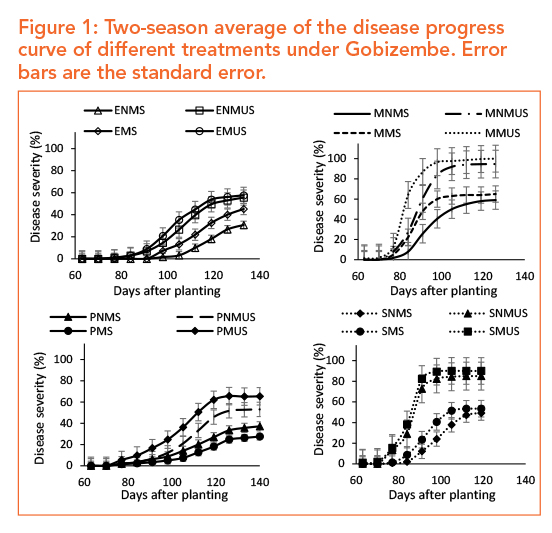
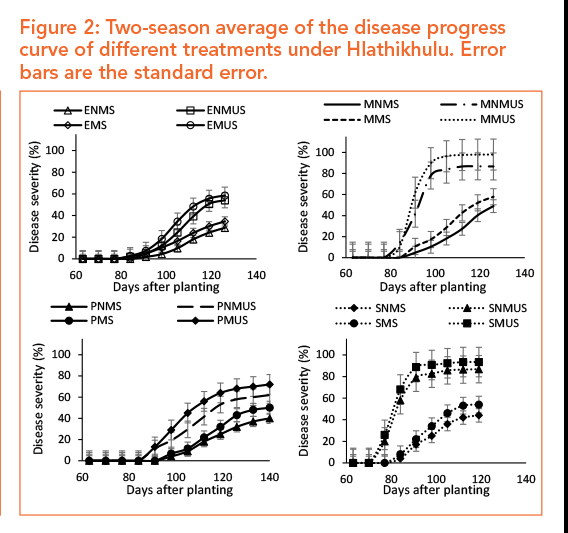
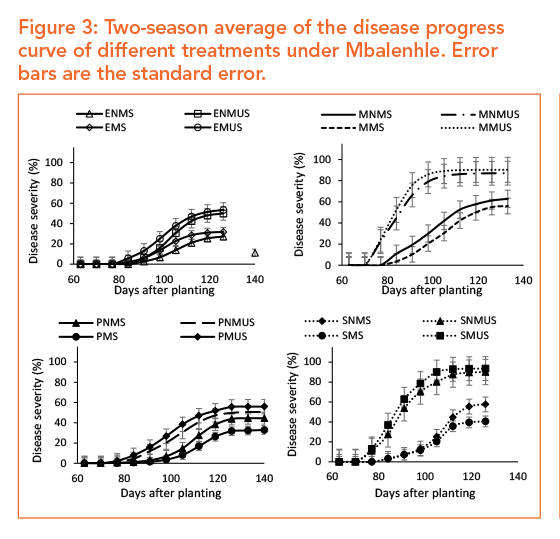
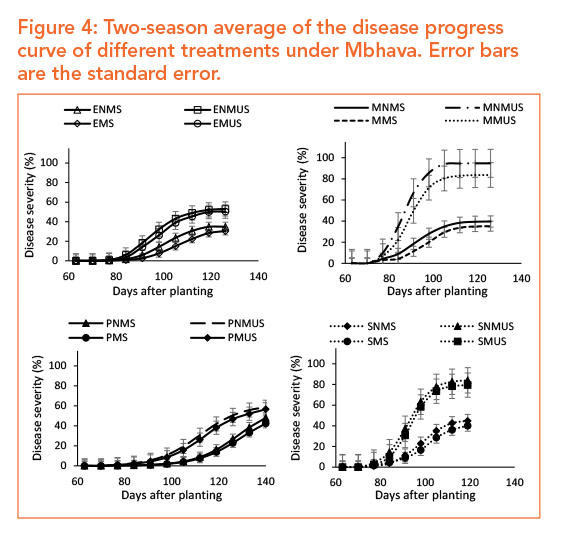
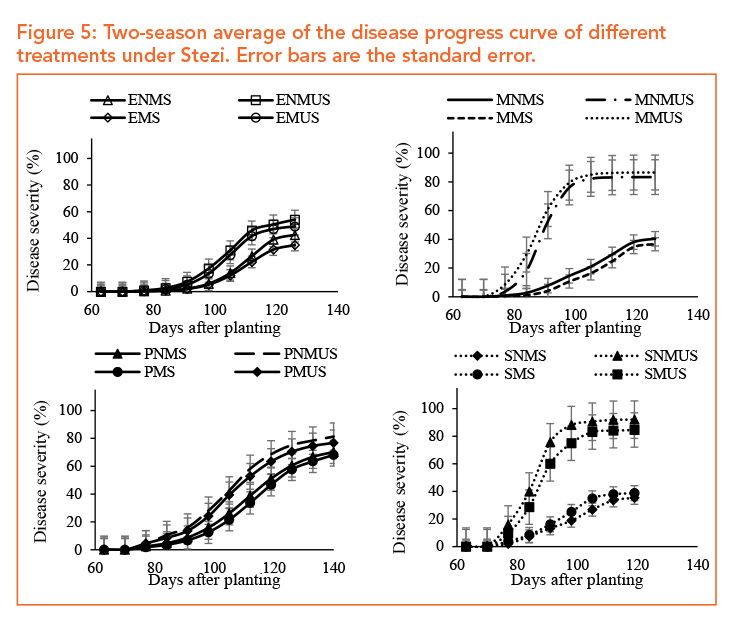
Disease severity in Sababa x mulch x unsprayed (SMUS), and Mondial x mulch x unsprayed (MMUS), was higher at the Hlathikhulu, Gobizembe, and Mbalenhle locations than in Stezi and Mbhava. At Hlathikhulu, Mbalenhle, and Gobizembe, all the cultivars with non-mulched treatments showed reduced epidemic growth compared to mulched treatments.
Conversely, treatments with mulch showed reduced epidemic growth compared to non-mulched treatments at the Mbhava location.
Overall, the results indicated that fungicide application delayed the onset of late blight epidemics, and treatment of Panamera and Electra reduced the slope of the progress curve; this was observed across localities. A comparison between cultivars showed that epidemics started to increase earlier in Mondial and Sababa than in Electra and Panamera; this was observed for both seasons across locations.
It is worth noting that non-mulched and mulched areas with Electra and Panamera that received spray treatments (ENMS, EMS, PNMS, and PMS) showed significant differences (p<0.05), while Mondial that was non-mulched and mulched, and sprayed with treatments (MNMS and MMS) showed significant differences at the early growth stage (70 to 105 days after planting). Overall, all the treatments sprayed with fungicides showed significant differences to unsprayed treatments.
Locations at high altitudes (Gobizembe, Hlathikhulu, and Mbalenhle) had prolonged high RH, high rainfall, and warm temperatures (Table 3) which led to conditions conducive to the increased spread of late blight. The longer delay observed in Electra and Panamera indicates that these two cultivars may possess traits that make them more tolerant to late blight under the integration approach.
Sababa and Mondial had shorter delays, and may require additional management practices to lower the risk of early pathogen infection. Overall, the results emphasise the value of integrating tolerant cultivars with fungicide application when implementing strategies to manage late blight effectively (Figures 1 to 5).
Number of stems
Treated Electra had the highest number of stems with an average of five to seven across localities over the two seasons (Figure 6). Treated Mondial had the lowest number of stems (two to three) across localities. The difference is attributed to high genetic variability among potato cultivars.
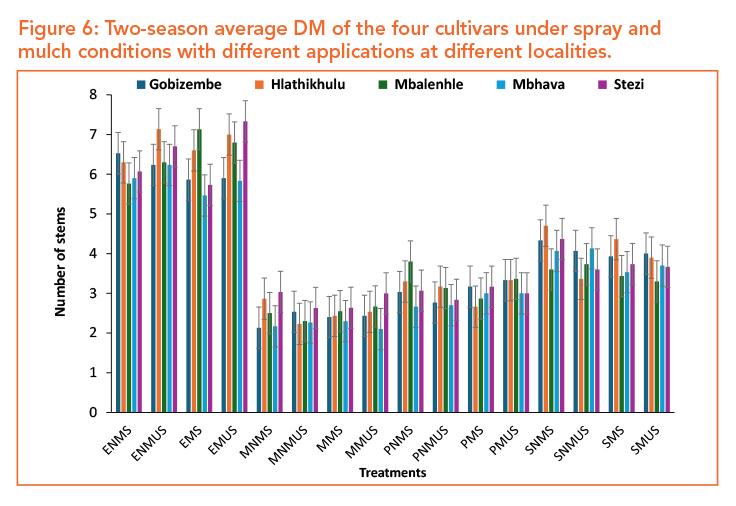
The number of stems contributes to the final yield: A higher number of stems increases foliage cover, making more leaves available for photosynthesis, and leading to the accumulation of dry matter (DM) (Mijena et al., 2022).
Potato tuber yield
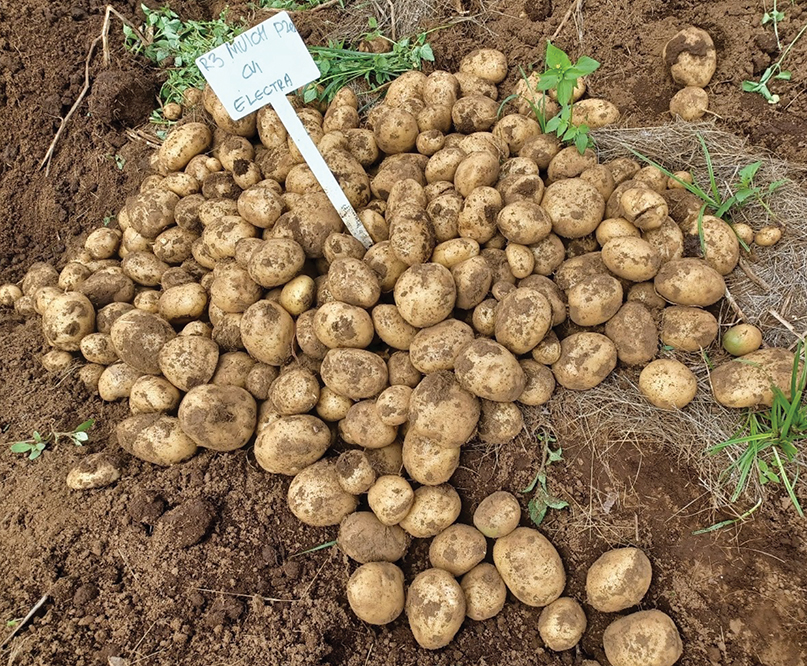
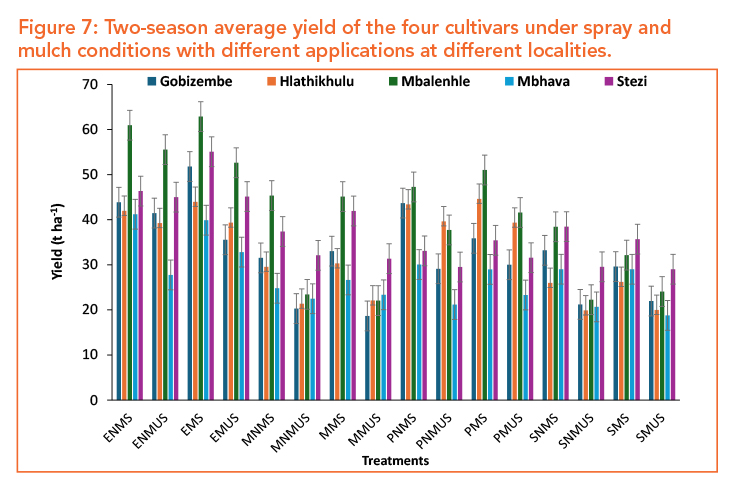
Potato tuber yield showed significant (p<0.05) differences among treatments (Figure 7). Electra x mulched x sprayed treatment resulted in a high yield over two consecutive seasons across localities with an average range of 39.90 to 62.88 t/ha-1.
Treatment that resulted in low yield was Sababa x mulched x unsprayed (SMUS) (18.79 to 29.03 t/ha-1) followed by Mondial x non-mulched x unsprayed (MNMUS), ranging from 20.30 to 32.11 t/ha-1 across localities.
Panamera and Electra under unsprayed treatments, mulched or non-mulched, showed tolerance to blight diseases although the application of fungicide enhanced these cultivars’ yield. However, the increase was minimal compared to Sababa and Mondial under the same treatments.
Furthermore, in the current study, it was observed that the efficacy of the fungicides in reducing blight epidemics had positive effects on potato yield. Low potato yield following unsprayed treatment is due to the short days to maturity (Figure 7) caused by premature foliage. It was further noted that there was a reduction in potato yield as elevation decreased; the Mbhava locations had a low yield of potatoes for all treatments compared to elevated localities. Moreover, Mbhava is dominated by clay soils which holds more water and yielded rotten tubers due to the high rainfall received.
Dry matter content
An analysis of DM content revealed insignificant (p>0.05) differences among treatment combinations (Figure 8). Treatment responded differently in different localities, although all the Panamera treatments recorded high DM content. Panamera x mulched x sprayed (PMS) had a two-season average of 24.60, 24.26, and 23.09% in Gobizembe, Mbalenhle, and Mbhava, respectively.
Meanwhile, Panamera x non-mulched x sprayed (PNMS) recorded higher two-season average DM content of 23.64 and 24.56% in Hlathikhulu and Stezi, respectively.
It was further noted in Figure 8 that Mbhava produced lower DM for most of the treatments compared to other localities. Mondial x non-mulched x unsprayed (MNMUS) and Sababa x non-mulched x unsprayed (SNMUS) recorded low DM in the Swayimane locations (15.99 to 17.07%) and Applesbosch locations (17.44 to 18.26%) respectively.
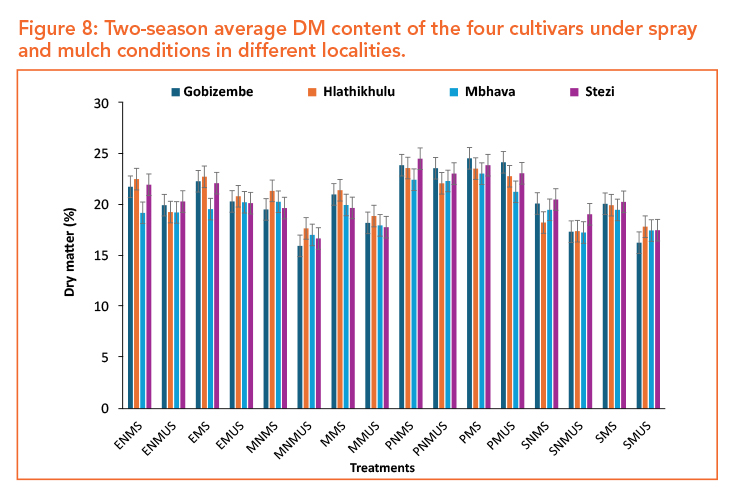
Potatoes with a DM content of 20 to 24% are preferred for French fries and > 21% are preferred for flake production. The results revealed that DM is a cultivar-specific characteristic; however, locality combined with fungicide application and climate conditions greatly affect the accumulation of DM in tubers.
Recommendations
- Electra with mulched or non-mulched, sprayed, or unsprayed treatment can be adopted at these localities to increase potato yield.
- Electra and Panamera integrated with mulch and spray treatment at the Mbhava and Stezi localities, and Electra and Panamera integrated with non-mulch and spray treatment at the Gobizembe, Hlathikhulu, and Mbalenhle locations are recommended to effectively manage late blight.
- Producers can adopt practices that deliver high DM content for production that meets market demand. Spraying with fungicides is recommended. – Nosipho Phungula, University of Johannesburg, Sandile Hadebe, University of Limpopo, Elmar Schulte-Geldermann, Bingen University of Applied Sciences, and Nomali Ngobese, North-West University
For more information, contact Nomali Ngobese at Nomali.Ngobese@nwu.ac.za.