
Estimated reading time: 6 minutes
Since 2019, METOS® SA, together with Villa Crop Protection, other crop protection and fertiliser input providers, and several public-private partners, has deployed more than 400 solar-powered METOS® weather stations across South Africa and its neighbouring countries.
This brings the total number of METOS® stations in the region to over 700. Thanks to METOS® SA’s offices and 19 service hubs nationwide, a technician is available within 150 km of almost every station in South Africa.
Each station transmits 15-minute increment data relating to temperature, rainfall, relative humidity, wind, solar radiation, and leaf wetness every hour to the FieldClimate™ cloud platform.
There, it is integrated with the Meteoblue multi-model ensemble to generate a self-learning, hyperlocalised forecast specific to the station’s exact coordinates. The system supports 80 disease models across 45 crops, including two for late blight and two for early blight in potatoes.
This is not just a weather station network; it is a dynamic decision-support engine delivering real value to various user groups: producers, independent crop consultants, irrigation companies, industry bodies, insurance companies as well as crop protection advisors. In the following section we explore the many benefits of combining near real-time climatic data with hyperlocalised forecasts, concluding with a closer look at the game-changing impact in potato farming.
Benefits for producers
- Irrigation based on actual demand. By combining on-site reference evapotranspiration (ETO) and vapour pressure deficit calculations with soil moisture probes and satellite imagery, producers can irrigate based on real-time needs. In practice, this has cut water and energy use by between 5 to 25% in pivot systems, savings already reported by METOS® clients in the Sandveld.
- Precision timing for inputs. District-level forecasts often miss localised effects such as dew pockets in low-lying areas or heat on north-facing slopes. Hyperlocalised updates (with <300 m resolution and 60-minute intervals) automatically trigger frost alarms, delay harvesting, or initiate chemigation cooldowns, reducing crop damage and bruising.
- Smarter asset planning. Five-year station archives inform decisions on hail insurance, whether to invest in variable-rate pivots or drip systems, and underpin carbon credit baselines and sustainability audits (for example Global GAP, SANS 10381).
- Peace-of-mind alerts. Producers receive SMSes or app notifications when rainfall, Delta-T, or wind gusts exceed customised thresholds, avoiding inefficient chemigation during spray season and giving managers hard data when delegating decisions.
Benefits for crop consultants
- Consultants typically serve a 30- to 50-producer spread over large areas. With a nationwide METOS® login, they can prioritise scouting routes. Dashboards highlight fields with the highest disease or water stress risks, ensuring time is spent where it is most needed.
- Benchmark practices: Comparing ETO-adjusted water use across 700+ stations can quickly reveal inefficiencies, such as leaky pivots or over-irrigated areas.
- Provide data-backed advice: Printable FieldClimate™ reports combine real weather data, forecasted spray windows, and disease risk models, giving clients and auditors solid evidence for each recommendation.
- Expand coverage: With live data feeds, one consultant can now manage a region that used to require two.
Crop advisors and retailers
South Africa enforces strict preharvest intervals and maximum residue limits. Advisors using station-based intelligence gain:
- Optimised spray windows: Real-time Delta-T, wind, and rainfall forecasts help ensure treatments are applied under ideal conditions, maximising effectiveness, and reducing re-sprays.
- Dynamic interval adjustments: Disease models automatically adjust spray schedules. When risk is low, a spray can be skipped, saving money, reducing chemical use, and improving stewardship.
- Digital compliance: Every advisory is time-stamped and linked to physical weather data, simplifying hazard analysis critical control points and SA GAP audits.
- Targeted product placement: Aggregated disease trends show where new products, such as succinate dehydrogenase inhibitor (SDHI) fungicides, will have the most impact, helping inform stocking and launch strategies.
Micro-weather and blight biology
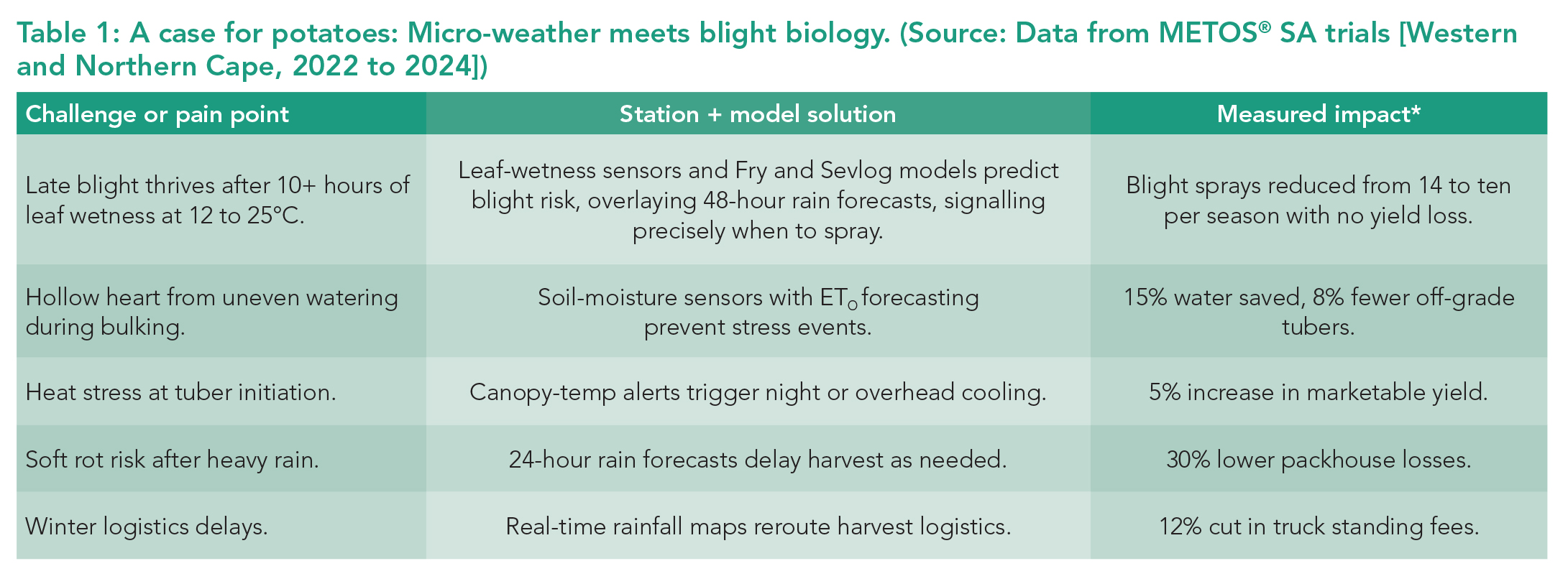
Potato farming faces thin margins, high disease pressure, and tight residue limits. METOS® stations, crop-specific disease models for Phytophthora infestans, and localised forecasts dramatically enhance management in five key areas (Table 1).
Continuous calibration tools
There is a continuous feedback loop between the actual station and the forecast. This feedback loop ‘nudges’ the forecast to become more accurate. In one location this self-learning artificial intelligence (AI)-driven capability reduced the one-day rainfall prediction error at Stellenbosch by 45%.
Sustainability benefits
- Water stewardship: Saving just 1 mm of irrigation across 50 000 ha of potatoes equates to 50 million m³, which is enough to supply a town the size of Kimberley for a year.
- Reduced pesticide use: Fewer, better-timed applications align with European Union farm-to-fork goals and can help keep South African potato production aligned with local and global sustainability goals.
- Lower carbon footprint: Less pumping and fewer truck trips mean reduced scope 1 and scope 3 emissions.
- Community upliftment: Once a station is in place, neighbouring smallholders can subscribe for a minimal fee, giving broader access to premium tools.
The road ahead
METOS® SA is piloting carbon dioxide flux sensors and AI-powered insect-trapping. With satellite normalised difference vegetation index (NDVI) integration, the platform links weather, disease, crop growth, and yield forecasts, all anchored by one of the most important arrays of sensors on the farm – a local near real-time weather station. Application programming interface (API) access to field climate, enables any third-party user of climate data to integrate data into various other platforms for specific application requirements and solutions.
Conclusion
What began in 2006 as a modest agronomic weather network has evolved into South Africa’s largest real-time climate intelligence system, built to World Meteorological Organisation (WMO) standards. Every METOS® station is compliant with WMO specifications and backed by certified technical data, with a network of 19 service hubs providing nationwide support.
For producers, these stations transform climate uncertainty into actionable insights. For consultants, they extend influence and sharpen decision-making. For crop protection advisors, they enable both regulatory compliance and enhanced application efficacy. And for potato growers, where timing is everything, this integration of sensors, disease models, and hyperlocalised forecasts has turned climatic risk into a competitive advantage, enabling data-driven decisions at critical moments.
In the face of increasing climate volatility, South Africa’s 700+ METOS® stations have become more than simply monitoring tools – they are strategic assets. By improving precision, reducing risk, and reinforcing resilience, they play a vital role in advancing food security and ensuring the long-term sustainability of South African agriculture.
Two years ago Potatoes SA launched a pilot project using a network of strategically placed METOS® weather stations in the Sandveld. Based on the success and benefits derived from the METOS® weather station network in the Sandveld, Potatoes SA is now also supporting and partnering with METOS® SA and Villa Crop Protection in the deployment of METOS® weather stations in two more potato-producing regions, namely the Eastern Cape and Limpopo. METOS® SA and Villa Crop Protection are part of the Winfield United SA group of companies. – Emile Jordaan, general manager, METOS® SA
For more information on how to benefit from the real-time weather data generated by METOS® weather stations and hyper-localised weather forecasts, visit www.metos.co.za.