
Using biostimulants to boost potato yield under heat and cold stress
Estimated reading time: 8 minutes
Temperature stress is a major limitation in potato production systems. Heat stress reduces tuber initiation, inhibits starch accumulation, and damages photosystem II, while increasing reactive oxygen species (ROS) formation. Cold stress reduces enzymatic activity, slows metabolic processes, and delays developmental progression.
Biostimulants mitigate these effects through multiple complementary mechanisms. Humic and fulvic acids improve root hydraulic conductivity and nutrient uptake, supporting metabolic stability under stress. Protein hydrolysates enhance osmotic adjustment and activate antioxidant defence systems. Plant-derived products regulate stress-responsive gene networks and maintain photosynthetic integrity under high-temperature conditions.
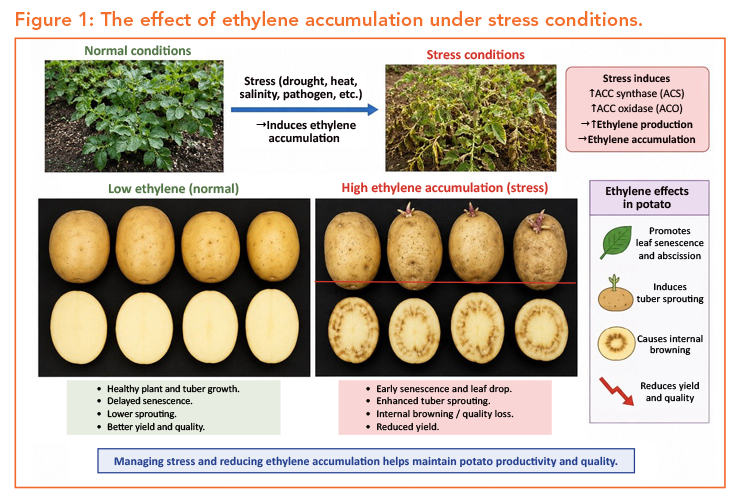
Seaweed extracts provide additional bioactive compounds, including cytokinins and auxins, that enhance stomatal regulation and stress recovery. Microbial biostimulants enhance antioxidant enzyme activity and reduce stress-induced ethylene accumulation (Figure 1), improving plant resilience. Collectively, these inputs improve physiological stability under both heat and cold stress conditions.
Shielding plants from stress
Physiological measurements and yield responses further demonstrate the importance of selecting effective biostimulant strategies under temperature stress conditions. Ten biostimulants from five different groups (seaweeds, microbials, amino acids, plant-derived, and organic acids) were tested under glasshouse conditions, where two types of temperature stress were imposed at the onset of tuber initiation.
Following the application of these biostimulants, membrane stability (Figure 2) was quantified after 48 hours using relative ion leakage as an indicator of cellular damage. Cold stress was induced by exposing the plant to −5°C for one hour, and in another set of plants, heat stress was induced by exposing the plant to 40°C for three days.
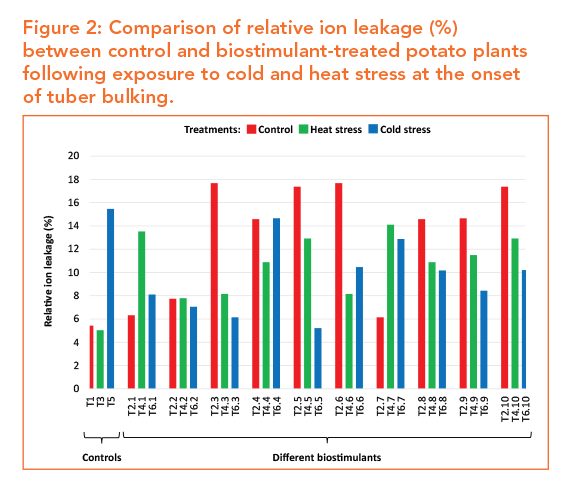
The relative ion leakage values (Figure 2) differed markedly among treatments. Lower ion leakage values indicate better membrane integrity and reduced cellular damage, whereas higher values indicate greater membrane disruption due to stress.
The control treatments under normal conditions (T1) and the control under heat stress (T3) showed relatively low ion leakage values (approximately 5%), suggesting limited membrane damage under non-stress or mild stress conditions. In contrast, the cold-stressed plant (T5) displayed a substantially higher leakage value (15.47%), indicating greater stress-induced injury.
Several treatments reduced ion leakage effectively. The biostimulants T6.5 (5.21%), T2.1 (6.32%), T6.2 (7.05%), and T6.10 (10.20%) maintained comparatively low leakage values, suggesting improved protection of cellular membranes under stress. Conversely, treatments including T2.3, T2.5, and T2.6 exhibited the highest leakage values (approximately 17.4 to 17.7%), indicating severe membrane damage and reduced stress tolerance.
Overall, the graph suggests that some biostimulant treatments improved membrane stability and stress tolerance in potato plants, while others were less effective or potentially aggravated stress effects.
Tuber quality and yield
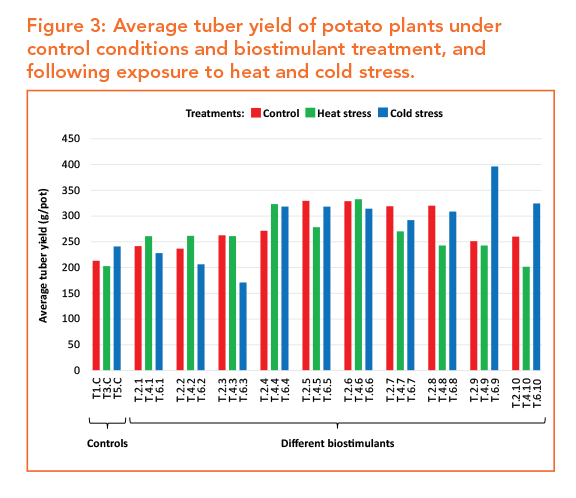
The ion leakage results demonstrate membrane stability under stress, while the tuber yield results (Figure 3) confirm that improved physiological protection translated into improved productivity. Together, the graphs suggest that certain biostimulant treatments enhanced stress mitigation sufficiently to maintain photosynthetic efficiency, membrane integrity, and assimilate partitioning during tuber development.
Under cold stress, treated plants often exhibit even lower ion leakage because the cold-induced rigidity of membranes is stabilised by biostimulants. Cold typically causes phase transitions in membrane lipids, leading to leakage. Biostimulants – especially those containing unsaturated fatty acid precursors, humic substances, or brassinosteroid-like activity – can maintain membrane fluidity and reduce chilling injury. This preserves selective permeability and lowers electrolyte loss.
Biostimulants influence both yield and tuber quality, which is particularly important for processing markets such as chips. Improved physiological balance under stress conditions results in better tuber size distribution, increased dry matter content, and enhanced starch accumulation.
Humic and fulvic acids are strongly associated with improved tuber uniformity and marketable yield through enhanced nutrient uptake, improved soil-plant interactions, and greater water retention. Seaweed-based biostimulants contain natural growth regulators, polysaccharides, amino acids, and micronutrients that stimulate root growth, maintain photosynthetic activity, and improve stress tolerance. Amino acid and protein hydrolysate products improve carbohydrate metabolism, osmotic adjustment, and antioxidant defence, thereby supporting stress recovery and consistent tuber development.
Plant-derived biostimulants, including botanical extracts and naturally derived bioactive compounds, contribute to enhanced metabolic activity, phytohormonal balance, and stress signalling. Brassinosteroids have been linked to improved assimilate partitioning and photosynthetic efficiency, and to reduced stress-related quality defects. Microbial inoculants, including beneficial bacteria and fungi, contribute indirectly by improving nutrient cycling, nutrient availability, rhizosphere activity, and root efficiency, thereby supporting more stable tuber formation under variable environmental conditions.
Yield performance under stress
Tuber yield differed substantially among treatments, demonstrating that treatments influenced potato productivity under both control and temperature-stress conditions. The control treatments under normal conditions (T1.C) and heat-stressed plants (T3.C) produced relatively low tuber yields (roughly 203 to 213 g/plant), whereas the cold-stressed plants (T5.C) showed a moderate increase in yield (241 g/plant). Several treatments markedly improved tuber yield compared with the controls.
The highest tuber yield was observed in treatment T6 (396.3 g/plant), indicating a strong positive response under the applied treatment conditions. Other high-performing treatments included T4.6 (332.6 g), T2.5 (329.6 g), T2.6 (328.9 g), T6.10 (324.5 g), T4.4 (323.1 g), and T2.8 (320.1 g). All these biostimulant treatments appear to have enhanced plant performance and productivity under stress conditions.
In contrast, treatment T6.3 produced the lowest yield (170.9 g/plant), suggesting poor stress mitigation or negative treatment effects. Some treatments, such as T4.10 (201.5 g) and T6.2 (206.2 g), also performed similarly to or worse than the controls. Collectively, the graph indicates that specific biostimulant treatments substantially improved tuber production under temperature-stress conditions, possibly by enhancing stress tolerance, improving physiological activity, and better maintaining plant growth processes.
Heat stress versus cold stress
Heat stress during early tuber initiation and early bulking typically suppresses yield by reducing canopy photosynthetic capacity and disrupting assimilate partitioning. At higher temperatures, maintenance respiration increases, leaving fewer carbohydrates available for stolon and tuber development. Heat also inhibits tuber initiation signalling (notably via reduced sucrose transport to stolons and an altered balance of gibberellins and cytokinins), leading to fewer or weaker sink sites at the critical onset of bulking. Once sink establishment is compromised, later recovery is limited even if conditions improve.
Cold stress, when moderate and not freezing, can have the opposite effect on potato tuberisation. Lower temperatures reduce shoot growth and canopy respiration more strongly than they reduce photosynthesis, increasing net carbohydrate availability for storage organs. Cold also enhances sink strength in developing tubers by promoting sucrose accumulation and favouring starch biosynthesis, while suppressing excessive vegetative growth. In many genotypes, these shifts assimilate allocation towards tubers, increasing total tuber mass during bulking.
Thus, the contrasting response is largely explained by timing and source-sink dynamics: Heat weakens sink establishment at the start of bulking, while mild cold strengthens carbon allocation to existing sinks and improves storage efficiency.
Benefits of biostimulants
Biostimulants can increase tuber size and total yield under both non-stressed and stressed conditions by enhancing physiological efficiency rather than directly supplying nutrients. Their effects are primarily expressed by source-sink regulation, stress mitigation, and improved metabolic efficiency.
Under non-stressed conditions, they often enhance photosynthetic performance and carbon assimilation efficiency. This occurs through improved chlorophyll stability, higher electron transport efficiency, and increased stomatal regulation, collectively increasing the availability of assimilates for tuber filling. In parallel, they can enhance sink activity in tubers, promoting starch biosynthesis and cellular expansion, thereby leading to larger tubers.
Under stressful conditions such as heat, drought, or cold, their effects are often stronger because they reduce the typical stress-induced limitations. This includes reduced oxidative damage (lower ROS accumulation), improved membrane stability, and the maintenance of enzymatic activity involved in carbon partitioning. As a result, the plant maintains a more functional canopy and sustained phloem transport to developing tubers.
A key mechanistic point is that many biostimulants (e.g. seaweed extracts, humic/fulvic substances, amino acid-based products, and plant-derived compounds) enhance hormonal balance, particularly increasing cytokinin-like activity relative to abscisic acid and stress-associated gibberellin shifts. This promotes tuber sink strength even when the plant is under physiological constraint.
In summary, yield increases occur because biostimulants improve both source capacity (photosynthesis and carbon fixation) and sink strength (tuber development and starch deposition), while buffering stress-induced metabolic disruption.
The tuber yield response (Figures 4 and 5) reflected a consistent physiological effect of biostimulant application under both heat and cold stress conditions. Control plants harvested at 14 weeks after planting produced fewer and smaller tubers, whereas treated plants showed an increased tuber number, larger individual tuber size, and improved uniformity.
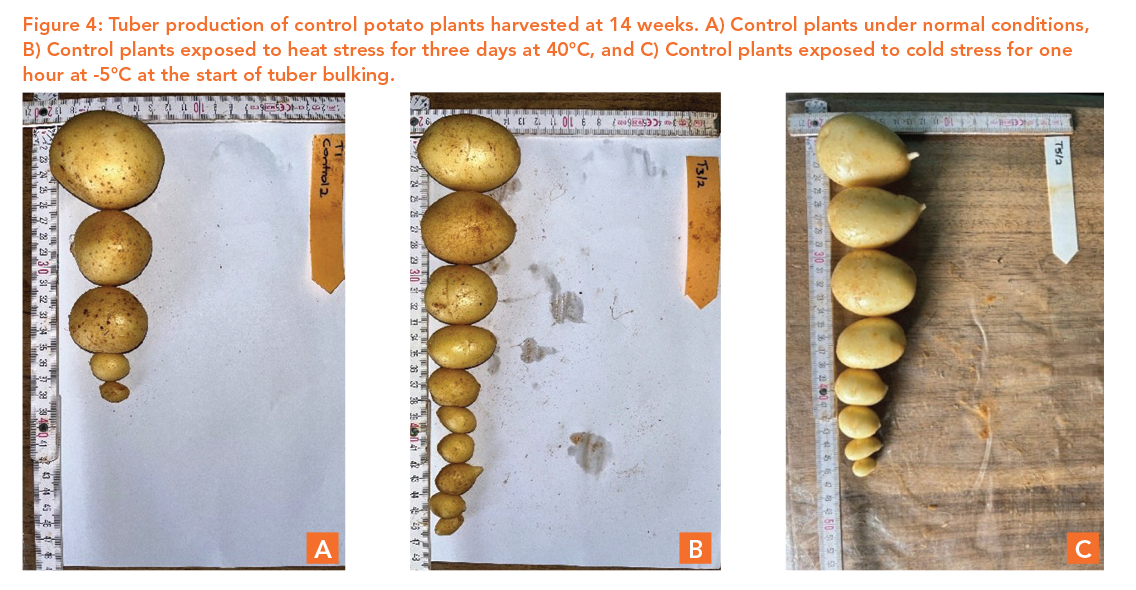
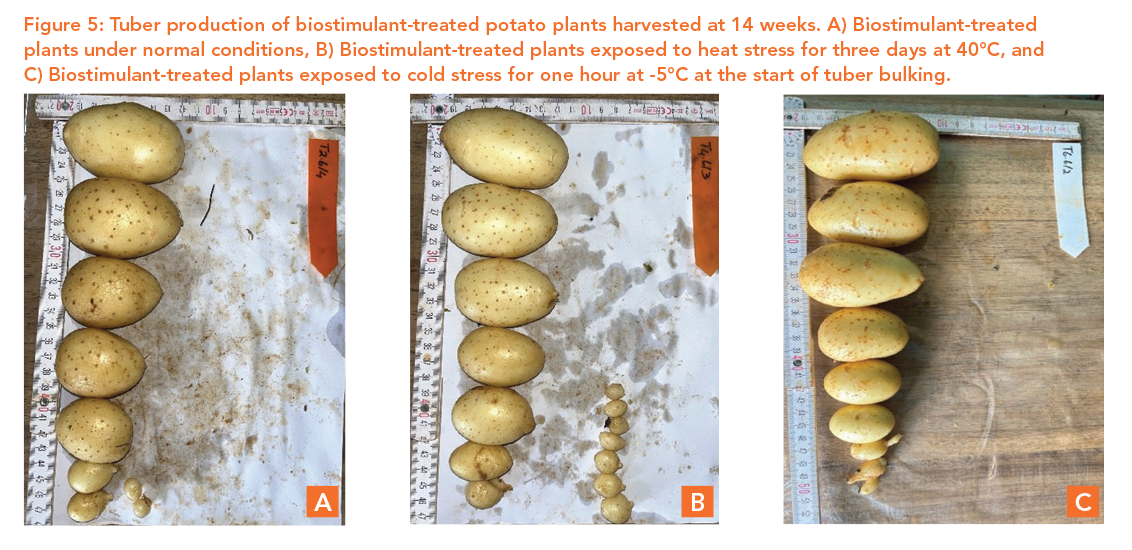
This indicates that biostimulant-mediated enhancement of assimilate partitioning and stress recovery mechanisms sustained tuber development stability following both the −5°C cold shock and the heat stress treatment applied at tuber initiation. – Dr Elmarie van der Watt and Stefan Steenekamp, University of the Free State
For more information, email Dr Elmarie van der Watt at vdwatte@ufs.ac.za or Stefan Steenekamp at 2016043446@ufs4life.ac.za