
The impact of crop rotation and cover crops on soil microbial dynamics in the Eastern Free State
Estimated reading time: 9 minutes
Traditionally, agriculture has focussed on maximising crop yield and profitability, often overlooking the long-term effects of management practices on soil health resources.
However, challenges such as climate change, water scarcity, land degradation, rising production costs, and the need to sustainably feed a growing global population have shifted attention towards more sustainable agricultural systems. Consequently, improving soil health has become a central objective of modern agricultural research and practice.
Understanding soil health
Soil health is defined as the capacity of soil to function as a vital living system that sustains plant and animal productivity, maintains or enhances water and air quality, and promotes ecosystem health. Healthy soils support sustainable crop production through improved nutrient cycling, water availability, and biological activity.
The evaluation and management of soil health have become important tools for guiding agricultural decision-making. Soil health can be assessed using physical, chemical, and biological indicators, each providing insight into different aspects of soil function. Biological assessments may focus on microbial diversity, activity, or functionality, with activity and functionality often being more practical and cost-effective measures for long-term field studies.
Among the management practices known to influence soil health, crop rotation and the inclusion of cover crops have received renewed attention. Although the benefits of crop rotation – including improved soil fertility and the suppression of diseases, pests, and weeds – have been recognised for centuries, its role in promoting soil biological health and long-term sustainability has become even more important.
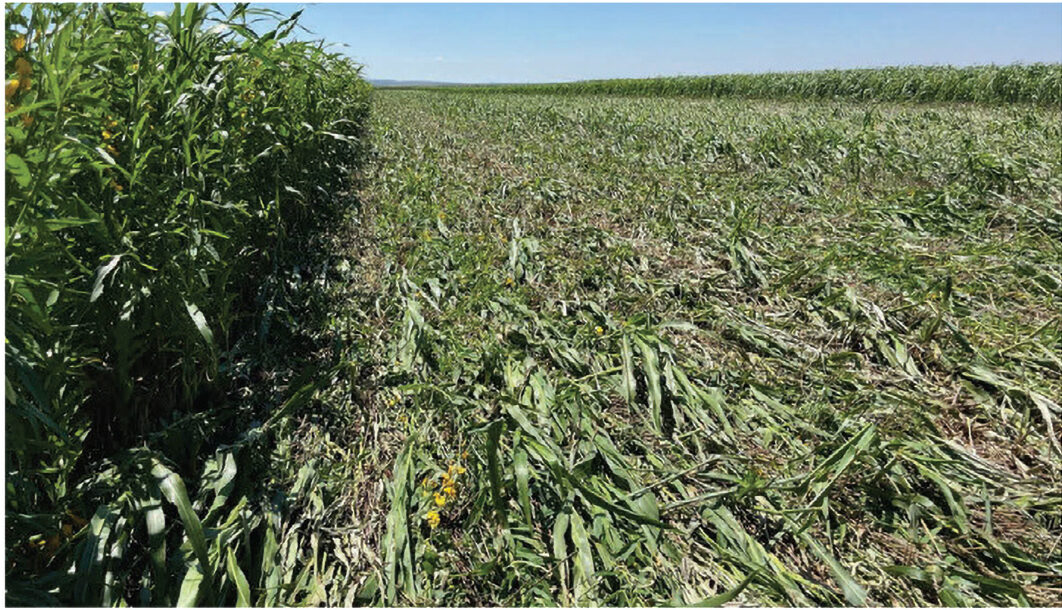
Cover crops further contribute to soil health by improving soil structure, increasing organic matter content, enhancing nutrient cycling, and supporting diverse and active soil microbial communities. Together, these practices can improve water and nutrient availability, reduce disease pressure, and ultimately increase crop productivity and system resilience.
Dryland potato production
The profitability of dryland potato production has come under pressure due to escalating input costs and rising disease incidence. Previous research has demonstrated that carefully designed crop rotations, combined with suitable cover crops and appropriate tillage practices, can reduce disease pressure while improving soil health and crop performance. Despite these potential benefits, limited research has investigated potato-inclusive crop rotation systems under South African conditions.
A long-term study is being conducted in the Eastern Free State to evaluate and optimise crop rotation systems for dryland potato production in the region. By investigating the effects of different rotation systems on soil biological, physical, and chemical properties, this research seeks to improve soil health, enhance the sustainability and profitability of potato production, and reduce the financial risks associated with dryland farming in the region. This article serves as a follow-up to previous articles published in CHIPS (November/December 2024 and January/February 2025).
Trial setup and procedures
A long-term field trial consisting of four five-year crop rotation systems with eight replicate plots each (R1 to R4) was established during the 2015/16 summer season in the Petrus Steyn district of the Eastern Free State (Table 1). By the completion of the first five-year rotation cycle, only minor differences among the rotation systems had become apparent, primarily in the form of slight changes in soil chemical properties.
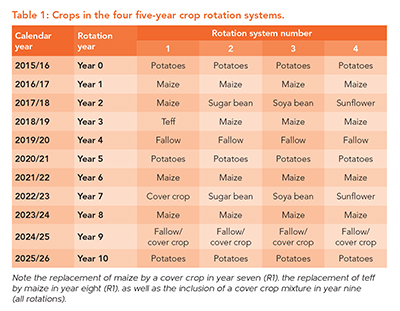
To further investigate strategies for improving soil quality, maize in R1 was replaced with a diverse cover-crop mixture in the seventh year of the trial to determine whether including cover crops could increase soil organic matter and improve soil health.
To further evaluate the effects of cover crops, the experimental design was modified from the ninth rotation year (2024/25 season). Four of the replicate plots in each rotation were maintained fallow according to the original plan (R1 to R4), while the remaining four (R5 to R8) were planted with a summer cover-crop mixture (black oats, forage sorghum, Sunn hemp, Cordoba forage radish, and white mustard).
This modification was implemented to compare the effects of fallow and cover-crop treatments on soil microbial, chemical, and physical properties, as well as on the performance of subsequent crops within each rotation system. During the tenth rotation year (2025/26 season), potatoes were planted across all rotation systems to evaluate the residual effects of the previous season’s fallow and cover crop treatments.
Soil chemical and physical properties were assessed at the end of each growing season (May to June). Soil biological assessments have been conducted since the 2022/23 growing season using rhizosphere soil samples (0 to 25 cm) collected at three stages during each season: shortly after crop emergence (October to November), mid-season (January to March), and immediately before harvest (May to June).
Soil microbial functionality was assessed using Biolog EcoPlates, which measure the ability of soil microbial communities to utilise a range of carbon substrates. Microbial functionality is expressed as average well colour development (AWCD), where greater colour development indicates higher microbial activity associated with the utilisation of specific carbon sources. Soil microbial activity was evaluated by measuring carbon dioxide (CO2) release (microbial respiration) using the Cornell Soil Health Laboratory potassium hydroxide method.
Soil microbial results
This article focusses solely on soil microbial results, while crop yields and soil chemical and physical data will be presented in a follow-up article.
Microbial functionality generally peaked mid-season, compared with the beginning and end of the season, likely due to active root growth and more favourable environmental conditions that promote microbial activity.
When comparing the seasonal average values of EcoPlate AWCD across the four rotation systems, higher microbial functionality was observed in R1 (which included cover crops) and R4 (which included sunflower) during the 2022/23 and 2023/24 growing seasons (Figure 1).
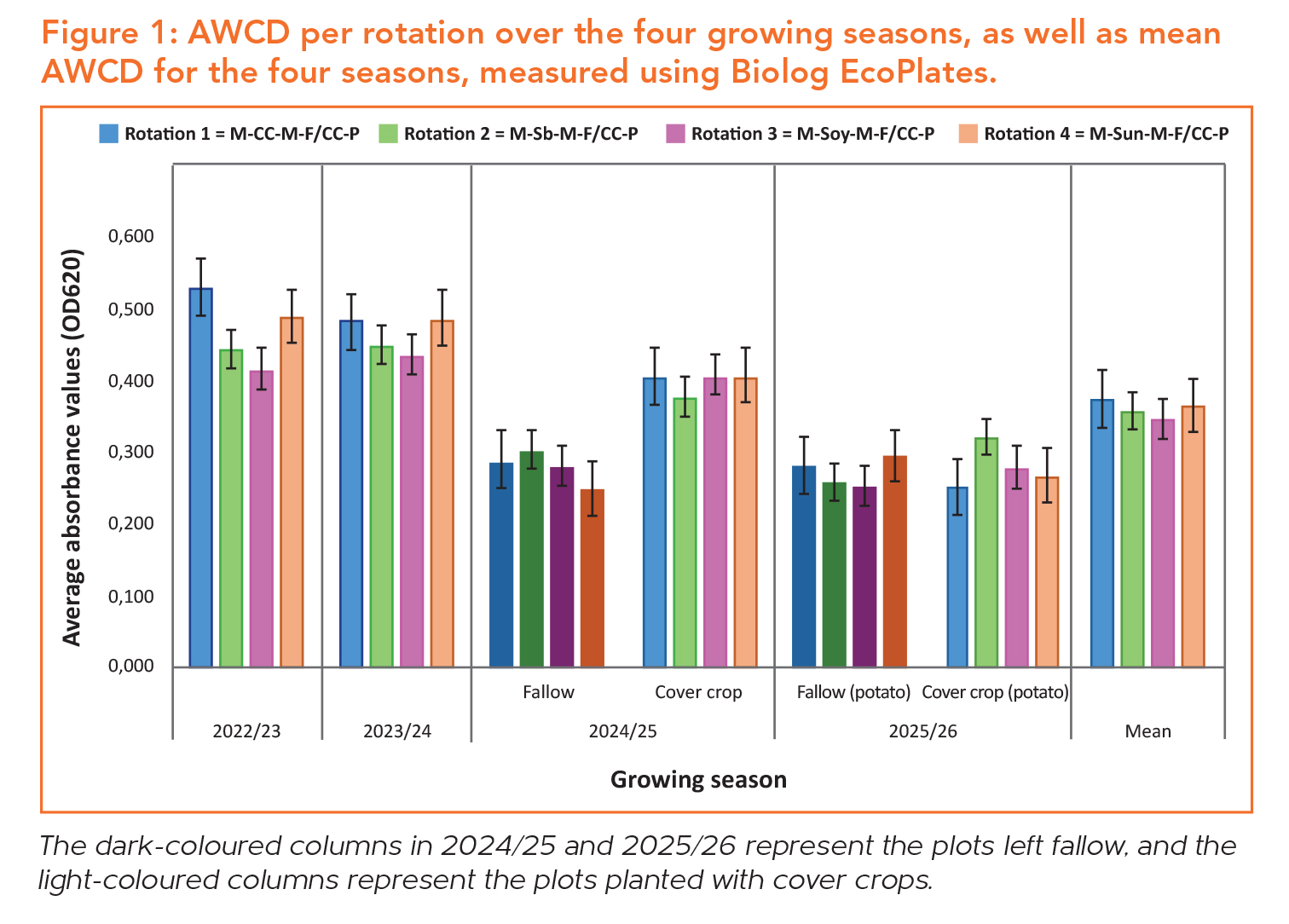
However, the 2024/25 and 2025/26 seasons exhibited greater variability between rotations than the 2022/23 and 2023/24 seasons. The increased variation observed during the 2024/25 season is likely attributable to the introduction of the fallow and cover crop treatments. During the following season (2025/26), when potatoes were planted across all rotations, microbial functionality in the plots that had remained fallow during 2024/25 largely returned to the original pattern, with higher functionality observed in R1 (originally cover crops) and R4 (originally sunflower).
In contrast, functionality remained more variable in plots that received the cover crop treatment in the 2024/25 season, suggesting that the recent incorporation of cover crops exerted a stronger short-term influence on microbial activity than the longer-term rotation effects. This was particularly evident in R7 (originally sugar bean in 2022/23 and planted to cover crops in 2024/25), which exhibited the lowest microbial functionality during 2024/25 but the highest functionality in 2025/26.
Despite increased year-to-year variation, the average microbial functionality across the four growing seasons remained consistently higher in R1 and R4 than in R2 and R3, indicating that the original cover-crop and sunflower rotations generally supported greater microbial functionality.
Microbial functionality gradually declined over the four-year monitoring period, with the lowest AWCD recorded during the 2025/26 season. Because microbial functionality reflects the metabolic activity of the soil microbial community rather than its composition alone, these changes likely represent shifts in the active microbial populations in response to crop species, residue inputs, and nutrient availability.
Although the introduction of cover crops may not substantially alter microbial diversity, it can influence which microbial groups become metabolically active. The relatively uniform management imposed during the 2024/25 season, where treatment plots were either maintained fallow or planted with the same cover crop mixture, may have reduced differences among the rotation systems by producing stronger short-term treatment effects that temporarily masked the longer-term influences of crop rotation.
Soil respiration and activity
Soil microbial activity was evaluated through measurements of soil respiration, which quantifies CO2 released by respiring soil microbes. Respiration rates were relatively variable among rotation systems during the 2022/23 season, while clearer differences emerged during the 2023/24 season when maize was grown across all rotations (Figure 2).
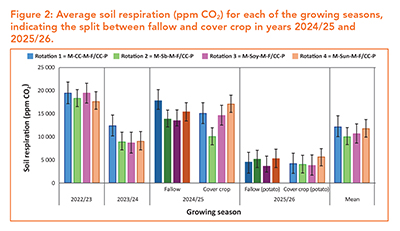
Following the implementation of the fallow and cover crop treatments in 2024/25, respiration rates were similar between the two management strategies but differed among the individual rotation systems within each treatment. Under both fallow and cover crop management, R1 and R4 exhibited the highest rates.
Respiration declined substantially during the 2025/26 season. Following the fallow treatment, R2 and R4 recorded the highest respiration rates, while R4 continued to exhibit the highest microbial respiration in plots that had previously received cover crops. When averaged across all four growing seasons, R1 and R4 consistently maintained the highest levels of soil respiration, suggesting that these rotation systems generally supported greater soil microbial activity than the remaining rotations.
The microbial analyses indicate that the inclusion of cover crops resulted in a desirable increase in soil microbial activity. However, these findings raise an important question regarding which microbial groups are responsible for the observed increase in activity.
Further investigation of soil microbial diversity, through the identification and characterisation of microbial communities within each rotation, could help explain the differences in microbial activity and respiration observed among the rotation systems and sampling time points. Such analyses would also determine whether the increased activity is associated with beneficial indigenous microbial populations stimulated by the cover crops or with potentially pathogenic microbes that are active in the soil.
Summary and conclusions
These findings demonstrate that the incorporation of cover crops can have a substantial positive influence on soil biological properties and soil health. By increasing soil microbial diversity, cover crops can enhance both microbial activity and functionality, promoting more resilient and self-regulating microbial communities.
Greater microbial diversity also contributes to the development of disease-suppressive soils by increasing competition for available resources. This allows beneficial and neutral microbes to outcompete potential soil-borne pathogens, thereby reducing disease pressure.
Beyond their effects on the soil microbiome, cover crops provide several additional agronomic benefits, including improved nutrient cycling, reduced reliance on synthetic fertilisers and pesticides, enhanced soil structure, and increased organic matter. Furthermore, the above-ground biomass produced by cover crops can be utilised as livestock forage, providing producers with an additional source of income while further improving the sustainability of the farming system. – Taryn Armfield, Prof Martin Steyn, Dr Elsie Cruywagen, and Prof Quenton Kritzinger
This project is jointly funded by Potatoes SA and Grain SA. We gratefully acknowledge the assistance and support of Gert Bester, the producer on whose farm this research is being conducted. For more information, send an email to armfieldtaryn@gmail.com, martin.steyn@up.ac.za, cruywagenem@arc.agric.za or quenton.kritzinger@up.ac.za