
World potato markets: European market recovery
Estimated reading time: 9 minutes
Global demand for European potato products has been under pressure over the last two or three years. European Union (EU) suppliers built up sales in the late 2010s on the back of much lower prices than their competitors. That advantage persisted until after the Covid-19 pandemic, when costs began to rise, as did export prices, making European shippers less competitive.
At the same time, there was a rise in processing output and exports by new players such as China, India, and Egypt. They were able to sell products at lower prices, thereby competing with more established European and North American exporters.
However, recent months have seen a reversal of that trend, with increasing demand for European produce. In May, EU frozen fry sales to markets outside the EU were 2.2% higher than in the same month last year, helping to limit the decline in 12-month sales to 4%. Meanwhile, demand within the EU has remained remarkably strong, and imports from outside the EU have been minimal – amounting to 30 000 tonnes over the past year.
While European processors will be relieved that sales appear to be recovering, there is growing concern that drought will limit potato supply and damage prospects.
South Africa
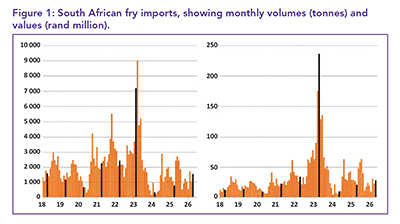
Fry imports jumped in May, driven by increased supplies from Belgium and France rather than from newcomers India and China. In fact, China has seen demand for its products fall by a third over the past year.
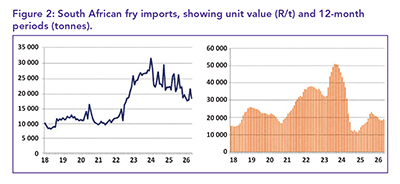
Imports continue to fluctuate, with 1 654 tonnes imported in May following 1 143 tonnes in April, 1 823 tonnes in March, and just 622 tonnes in February. The May figure was 89.9% higher than in May 2025, contributing to a 13.3% increase in annual imports to 19 218 tonnes. The average price of imports during the month was R18 382/tonne (€989; US$1 130) – 31% less than in May 2025 as Belgian and French prices fell. Belgium almost doubled its shipments to South Africa in May compared to last year at 897 tonnes, but over the year sales were down by a third amid greater pressure from France and India.
French imports jumped from two tonnes in May 2025 to 556 tonnes in May 2026 and 52 tonnes over the year to 6 238 tonnes. The average French price halved between May 2025 and May 2026 to R14 862/tonne (€800; US$914). Indian imports rose by 19 tonnes in the year ending May 2025, reaching 1 330 tonnes a year later.
South Africa’s fry exports were down 4.1% over the year to 9 846 tonnes, with May trade holding steady at 908 tonnes. The average export price in May was R29 915/tonne (€1 609; US$1 839), higher than the average import price. Namibia accounted for 37% of those annual exports, Botswana 26%, and Eswatini 13%.
South Africa exported 16 695 tonnes of fresh potatoes in May, 16.7% more than in May 2025, with annual exports rising 34.2% to 186 380 tonnes. The average price of exports during the month was R4 381/tonne (€236; US$269), 12.1% less than in May 2025. Mozambique accounted for 64% of sales, Namibia 15%, and Eswatini and Lesotho 6% each.
UK
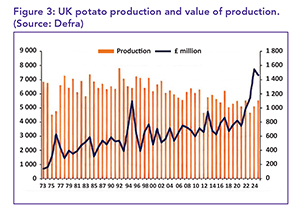
New government figures show that the value of United Kingdom (UK) potato production reached its second-highest level on record in 2025 at £1.463 billion, down 5.3% on the 2024 record, but marking the third consecutive year that it has topped £1 billion. Lower prices will likely cause a decline in value in 2026.
Sales of potatoes for human consumption fell 7.2% to £1.104 billion, while the value of seed potato sales hit a new high of £274 million (13.8% more than in 2024), according to data from the UK government’s Department for Environment, Food and Rural Affairs (Defra).
The figures also set 2025 potato production at 5.549 million tonnes, up 8.5% on the 2024 total. However, 466 000 tonnes of that total was categorised as stockfeed or waste, leaving saleable production at 5.083 million tonnes. Defra calculated the 2025 harvested potato area at 116 641 ha, a 5.4% increase on 2024 and the largest since 2022. However, many in the potato industry believe the figure to be an overestimate.
The extra potatoes produced in 2025 helped the UK reduce its reliance on imports. Defra stated that the UK produced 71.1% of its potato needs over the year, up from 67.5% in 2024 and the highest figure since 2021. However, that compares with a rate of 87.7% in 2006, and over 90% in many years throughout the 1980s and 1990s.
Despite the release of the Defra figures, our own estimates for the 2025 and 2026 planted area and total production remain unchanged. We estimate the 2025 area at 107 120 ha (4% higher than 2024) and project the 2026 area at 101 000 ha. Our 2025 production estimate stands at 4.948 million tonnes, a 5.3% increase on 2024, which is only 90 000 tonnes lower than Defra’s saleable production estimate. Average yields would deliver a 4.646 million-tonne crop, 6.1% lower than in 2025.
The Scottish seed potato area dropped by 6% in 2026 to 10 408 ha. There was an 89% increase in the Edison variety area, with doubledigit increases for other frying types including Francis, Royal, Sagitta, and Kind Russet, as well as a 19% increase in the export type Spunta.
Conversely, there was a 17% drop in the Maris Piper area, while crisping varieties Atlantic, Hermes, and Lady Rosetta saw a 20% reduction in area.
Australia
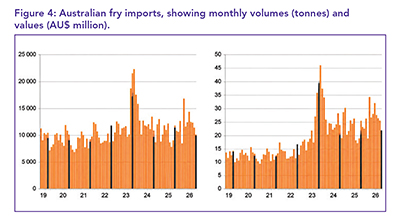
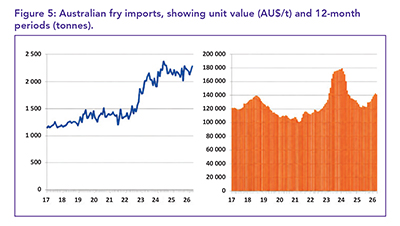
Following the annual growth in fry imports, May saw a decline in Australian demand, down 14.7% from May 2025 to 10 008 tonnes – the lowest monthly total since September 2025. Imports in the June-to-May period were up 15.6% to 142 313 tonnes.
Australia turned to Belgium for produce in June, with the country supplying over 40% of the total at 4 102 tonnes, up 26.6% from May 2025. Annual imports from Belgium rose by 12.2%, while Dutch imports grew by 9.1%, despite a 22.6% decline in May trade. The absence of German imports in June also impacted the market, whereas New Zealand held its ground after shipping 82.9% more over the year.
Established suppliers will be concerned about the growth of lower-priced entrants, including India, China, and South Africa. Indian imports jumped 173% over the year, and June trade was more than double that of May 2025. Imports from China also doubled their 12-month volume into Australia. The lowest-priced supplier in May was New Zealand at AU$1 464/tonne (€889; US$1 016), compared to an average of AU$2 275/tonne (€1 383; US$1 579). Belgium and the United States (US) vied for the highest-priced supplier at AU$2 740/tonne (€1 665; US$1 902).
Frozen fry exports were up 34% over the year to a record 20 709 tonnes, despite a 7.5% monthly decline in May trade to 1 463 tonnes. The value of that trade over the year was AU$48.106 million (€29.24 million; US$33.39 million) – AU$260.6 million (€158.36 million; US$180.84 million) less than the value of imports. The average price in May was AU$2 572/tonne (€1 563; US$1 785), which was AU$297/tonne (€180; US$206) higher than the average import price.
Poland
Wholesale prices for Polish early potatoes have dropped significantly.
New potatoes are trading at PLN0.30 to 0.80/kg (€0.07 to 0.18/kg), compared with PLN0.80 to 1.20/kg (€0.18 to 0.28/kg) at the end of June. Prices for the early variety Irga have also declined from PLN1.80 to 2.20/kg (€0.41 to 0.51/kg) to PLN0.90 to 1.30/kg (€0.21 to 0.30/kg).
In contrast, prices for potatoes from the 2025 harvest have remained virtually unchanged at very low levels, reflecting that old-crop potatoes are no longer of major importance in the current market.
Saudi Arabia
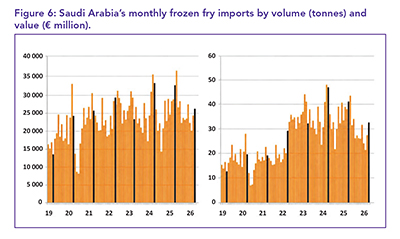
In April, frozen fry imports reached their highest monthly level since December 2025, despite the conflict in the Middle East being in its second month. However, the 25 627 tonnes imported were 20.8% less than in April 2025. Imports in the year ending April were 301 730 tonnes, up 1.9% on the previous year. Demand peaked in the year to the end of September, when volume reached nearly 329 000 tonnes.
The Netherlands was the largest supplier of fries in April, with trade up 18.3% from April 2025 to 10 371 tonnes. Dutch imports over the 12-month period were stable at 83 671 tonnes. Belgium saw April trade plunge by almost 60%, building on a 27.6% annual decline. France also struggled during the month, with trade slipping 3.4% over the year. Non-EU suppliers experienced mixed results in April. Indian imports jumped 117% to 5 400 tonnes, making India the second-largest supplier. It has now overtaken Egypt and France to become the third-largest supplier over the 12-month period, with imports up 158.5% to 43 812 tonnes. Egyptian imports have weakened over the year, falling 10.3% in April. China saw demand for its products in Saudi Arabia increase by 57.3% to 11 823 tonnes over the year, but they were down 83.7% in the month.
India and China are the lowest-priced suppliers, which has helped build sales. China offered the lowest price in April at €803/tonne, 38.2% below the average and 44.7% below the Dutch price (the most expensive among the main importing nations). The Indian price stood at €905/tonne. – Francois Strauss, Potatoes SA
Send an email to francois@potatoes.co.za for more information.