
Is charcoal rot an emerging potato disease?
Charcoal rot is caused by Macrophomina phaseolina. The pathogen was reported on sunflowers and soya beans in South Africa as early as 1969. It has a wide host range and can infect more than 500 plant species, including economically important crops such as maize, sunflowers, soya beans, green beans, and cotton. Although M. phaseolina has been reported across South Africa, reports of it affecting potatoes remain limited.
Charcoal rot – the signs
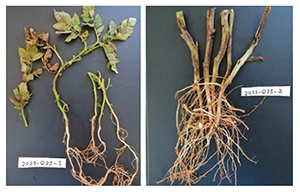
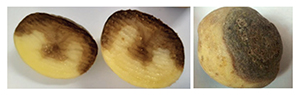
Symptoms include leaf wilting and yellowing. Infected stems develop soft, dark lesions in which small, black structures (microsclerotia) are formed. M. phaseolina can also infect tubers, causing shallow, water-soaked lesions. The tuber tissue within these lesions turns grey and eventually black as the fungus grows. In rapidly developing tuber infections, the tissue can turn from white to pink and finally black.
Stem symptoms can easily be confused with those of Verticillium wilt or blackleg in potatoes. Symptom identification is also complicated because the disease often occurs alongside other pathogens.
If producers suspect charcoal rot in potatoes, they can contact the regional Potatoes SA manager to send samples to the Agricultural Research Council (ARC) Vegetables, Industrial and Medicinal Plants campus for confirmation. A survey of the disease will help determine the risk of charcoal rot in potatoes in South Africa.
Occurrence in potatoes
During a project from 2020 to 2022 in Limpopo, which studied early dieback in potatoes, several M. phaseolina isolates were found in potato samples. All isolates obtained were tested in the laboratory and showed severe symptoms in potato tubers within seven to 14 days.
Charcoal rot occurs more commonly amid warm weather conditions when plants are stressed. Pandey and Basandrai (2021) indicated that the incidence and severity of charcoal rot will likely increase with climate change. Disease development depends on several factors, but temperature and soil moisture play a major role. According to literature, the pathogen is particularly active when soil temperatures reach 32°C or higher in crops such as maize and soya beans.
Prof Jacquie van der Waals also found that an M. phaseolina isolate can grow at 45°C (Jordaan and Van der Waals, 2015). Wokocha (2000) further reported that soya bean plants experiencing water stress are more susceptible to M. phaseolina infection. Diourte et al. (1995) found that charcoal rot in sorghum can be managed through proper irrigation scheduling.
It therefore appears that high temperatures and low soil moisture can place potato plants under severe stress and make them more susceptible to infection and disease development. However, little information is available on how temperature and moisture levels affect the development of charcoal rot in potatoes. This project will therefore focus on how temperature and moisture levels affect infection and disease development.
New studies on potatoes
M. phaseolina has a wide host range, and most of these susceptible plants are used in crop rotation with potatoes. M. phaseolina forms microsclerotia in the soil and on plant material; these structures can survive in the soil for years.
However, cross-inoculation studies are required to confirm whether isolates from maize and sunflowers can also cause disease in potatoes.
Potatoes SA’s new project on M. phaseolina will test the pathogenicity of isolates obtained from maize and sunflowers on potatoes. – Dr René Sutherland, Dr Elsie Cruywagen, Lesiba Ledwaba, Dr Juanita Engelbrecht, and Dr Mariette Truter
Send an email to Dr René Sutherland at SutherlandR@arc.agric.za for more information.