
Estimated reading time: 4 minutes
The South African fresh produce market, valued at over R53 billion annually, continues to reflect significant disparities in the representation of black producers and market agents. In December 2024, the South African Competition Commission released its final report on the fresh produce market (FPM) inquiry, highlighting critical challenges that hinder transformation within the sector.
This inquiry, launched in March 2023, sought to identify and address structural issues in the fresh produce value chain that limit competition and restrict participation by historically disadvantaged individuals.
Purpose of the inquiry
The primary objective of the inquiry was to evaluate the efficiency of the value chain, particularly regarding FPM facilities, assess key input market dynamics and their impact on producers, and identify barriers to entry and expansion for small-scale, emerging, and historically disadvantaged farmers.
The inquiry focused on staple fruits and vegetables commonly consumed in South African households, including apples, citrus fruits, bananas, pears, table grapes, potatoes, onions, carrots, cabbage, tomatoes, and spinach.
Key findings of the report
The report uncovered several critical challenges affecting transformation in the sector:
- Underrepresentation of black producers and market agents: Despite FPMs’ significant value, black producers and market agents remain disproportionately underrepresented, highlighting historical inequities and the urgent need for economic transformation.
- Barriers to entry and expansion: Small-scale and emerging farmers face systemic obstacles, such as limited access to essential inputs, inadequate infrastructure, and restricted entry into formal markets, making it difficult to compete and scale their businesses.
- High retail mark-ups: The report identified excessive mark-ups on fresh produce by retailers. Although net margins after operational costs remain low, these mark-ups suggest inefficiencies in price transmission from producers to consumers, raising concerns about fair pricing structures.
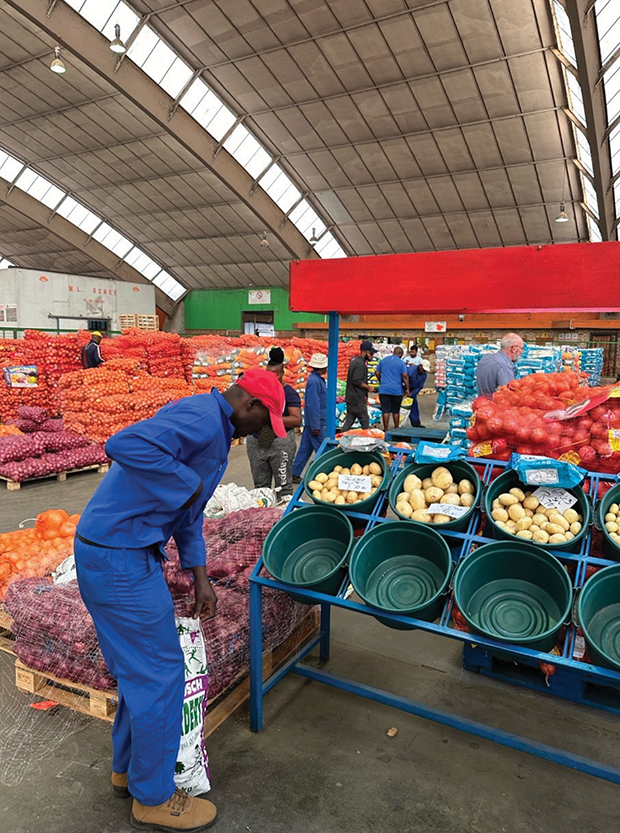
Impact on the local potato industry
The findings have significant implications for the potato industry. Currently, black potato producers account for only 3% of national FPM sales. These disparities highlight the systemic barriers faced by black participants in the industry.
However, Potatoes SA, through its transformation initiatives such as the Enterprise Development Programme (EDP) and Small-Grower Development Programme, has been at the forefront in terms of supporting black potato producers in the industry while disseminating knowledge regarding potato production.
Challenges such as limited access to quality inputs such as seeds, fertilisers, and pesticides, as well as difficulties in accessing formal markets, disproportionately affect black potato producers. These constraints limit their ability to expand operations, enhance productivity, and compete effectively in the market.
Implications for stakeholders
The report serves as a vital tool for stakeholders in the fresh produce sector, particularly black producers and market agents, by providing:
- A basis for advocacy: The detailed identification of barriers strengthens efforts to secure targeted government and industry support, including improved access to quality inputs, infrastructure enhancements, and market access programmes.
- Strategic planning insights: Understanding systemic challenges enables producers and market agents to adopt strategies such as forming co-operatives, pooling resources, investing in shared infrastructure, and exploring alternative market channels.
- Policy engagement opportunities: The report’s findings offer a foundation for engaging policymakers in advocating for reforms that promote inclusivity and fair competition at FPMs.
Key recommendations
To create more inclusive and competitive FPMs, the report outlines several key recommendations:
- Improving market access: Developing initiatives to help historically disadvantaged farmers enter formal markets, including training on market requirements and facilitating direct connections with buyers.
- Enhancing access to inputs: Implementing programmes to ensure small-scale and emerging farmers have equitable access to quality seeds, fertilisers, and other essential agricultural inputs.
- Investing in infrastructure: Strengthening storage, transportation, and processing facilities to minimise post-harvest losses and improve the marketability of fresh produce.
- Promoting fair competition: Establishing regulations to prevent excessive retail mark-ups and ensure transparent and fair pricing structures from farm to consumer.
Conclusion
The Competition Commission’s report serves as both a wake-up call and a roadmap for meaningful change and transformation. It not only provides evidence of the barriers faced by black producers and market agents, but also provides actionable steps that industry stakeholders, policymakers, and financial institutions can take to drive inclusivity.
It creates a foundation for increased investment in infrastructure, training, and support programmes that can help level the playing field.
The report also places pressure on major role-players, such as government departments, industry bodies, and large retailers, to actively work towards a more equitable market structure. Transformation in the fresh produce sector cannot happen overnight, but with the insights generated by the report, it is clear that change is both necessary and possible. – Brian Makhele, transformation specialist, Potatoes SA
For more information, send an email to the author at brian@potatoes.co.za.