
Estimated reading time: 4 minutes
Soil sodicity (swartbrakgrond) refers to a condition in which soil contains excessive levels of sodium. This condition can adversely affect soil health and crop production. The accumulation of sodium in soil, stemming from factors such as weathering of sodium-rich parent materials and human-induced salinisation, adversely affects soil structure and nutrient balance. Sodic soils are associated with poor water infiltration, aeration, surface crusting and erosion, leading to plant nutrient deficiencies, stunting and low yields. Gypsum (calcium sulphate) is a cost-effective and widely available solution for remediating sodic soils. Studies highlight the benefits of gypsum application, including reducing exchangeable sodium percentage (ESP) and soil pH, and enhancing the ease of water movement through the soil.
In South Africa, both mined geological gypsum and by-product gypsum, such as phosphogypsum from phosphoric acid production and gypsum from acid mine water treatment, offer readily available sources for agricultural use. An alternative source is flue-gas desulphurisation (FGD) gypsum which is produced in coal-burning plants and is a relatively pure by-product gypsum. Currently, FGD gypsum is produced in South Africa but is not yet available commercially. More recently, gypsum products such as liquid gypsum, a gypsum suspension, and granulated gypsum (gipskorrels) have emerged on the market.
Comparing gypsum solubility
While gypsum remains a common product in the agricultural industry, the solubility of South African gypsum sources has not been assessed. This study aimed at comparing the solubility of local gypsum sources, along with newer products such as liquid gypsum and granulated gypsum, against mined class A gypsum. Additionally, the study evaluated the effectiveness of these gypsums in comparison to granulated micro-fine calcitic lime (verpilde kalk or kalkkorrels) and calcium (Ca) nitrate for soil sodicity remediation and water movement improvement.

A soil column experiment was carried out to test the gypsum, microfine lime and Ca nitrate products. A sodic, sandy loam topsoil sample was collected for evaluation. Twelve gypsum products, two micro-fine calcitic lime products, and one commercial Ca nitrate fertiliser were tested against a control (no product added). Each treatment involved packing soil in cylindrical containers, applying the respective source on the surface, and simulating six weeks of heavy rainfall. At the end of week six, soil saturated hydraulic conductivity (how easily water moves through soil) was determined, along with soil pH, electrical conductivity, basic cations, soil acidity, ESP, and soil water dispersible clay percentage.
Findings
The findings revealed that finely textured gypsum, especially byproducts such as liquid and FGD gypsum, have faster reaction rates and outperform coarser, mined class A gypsums in mitigating soil sodicity quickly. However, all gypsum sources contributed to lowering soil ESP and soil pH compared to the control. Micro-fine lime had no effect on soil ESP or soil pH due to low solubility. Only liquid gypsum, phosphogypsum, FGD gypsum, and Ca nitrate managed to enhance soil hydraulic conductivity. While liquid gypsum proved effective, its higher cost and the need for specialised application methods due to its suspended nature should be noted.
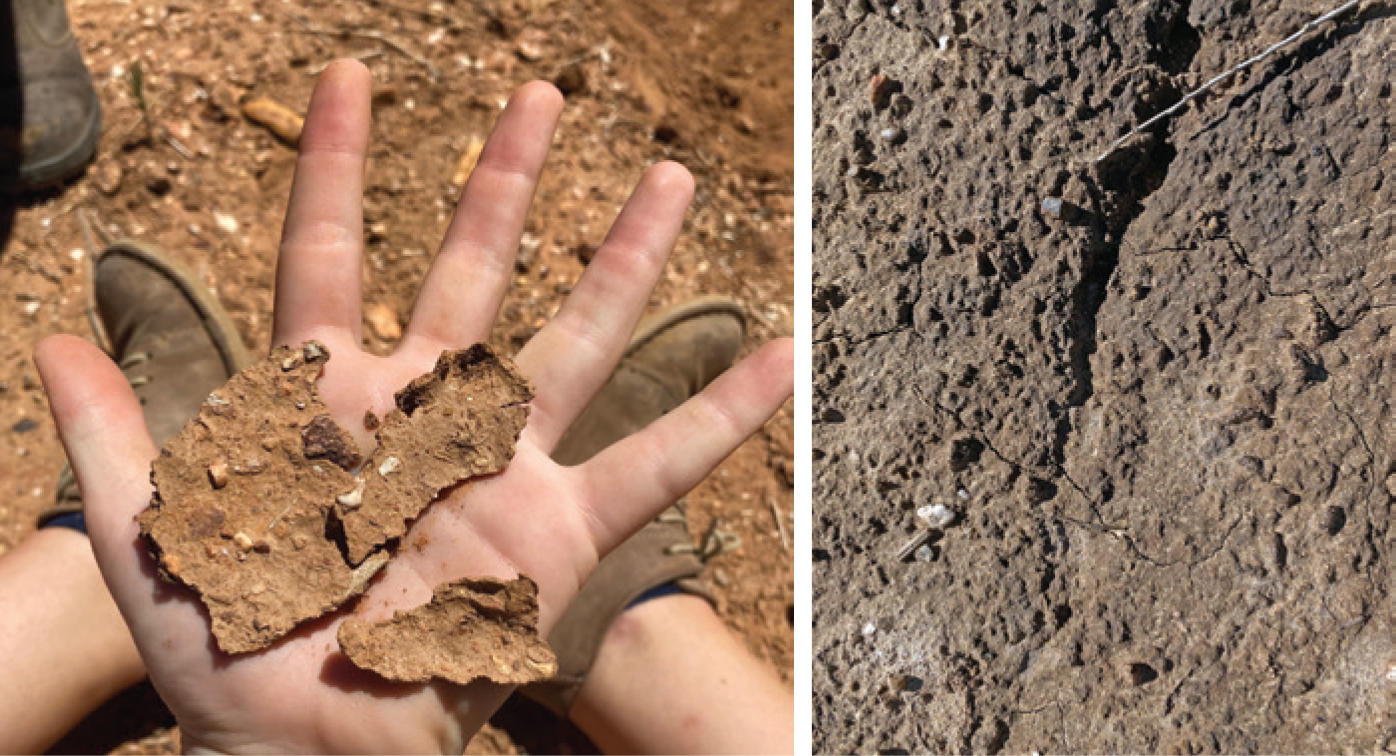
Unfortunately, FGD gypsum is showing promise, but is not yet commercially available in South Africa, and standalone Ca nitrate use is costly. Producers in South Africa currently rely on phosphogypsum, mined water treatment gypsum and mined gypsum as the primary sources. Given that the cost of gypsum in South Africa is primarily driven by transportation costs rather than mining costs, producers should choose the nearest gypsum source and calibrate the application rate based on its Ca purity.
The authors would like to thank SA Lime and Gypsum, Yara Africa Fertilizer and Stellenbosch University for funding this research. Our thanks to the Protein Research Foundation for offering the first author a bursary. This article was first published in Oilseeds Focus, Vol 10 No 1, March 2024. Examples of soil sodicity and surface crusting in the field. – Marina du Plessis and Ailsa Hardie, Department of Soil Science, and Pieter Swanepoel, Department of Agronomy, Stellenbosch University.
Read the full article in the South African Journal of Plant and Soil, vol 40 (issue 4 to 5), visit doi.org/10.1080/02571862.2023.2288192 or email aghardie@sun.ac.za.