
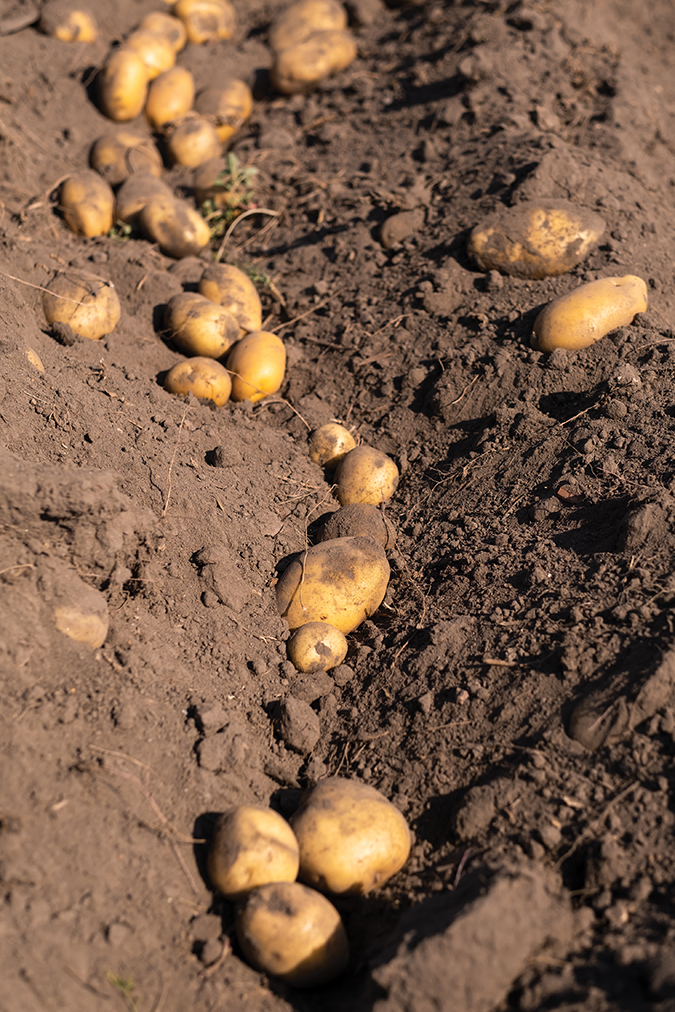
Potatoes on tired ground: The hidden cost of keeping yields high at any price
Estimated reading time: 8 minutes
World Soil Day 2025 found potato fields across major production regions quietly signalling the same message: Some soils are tired.
They still produce crops but behave increasingly like lifeless media that only respond when fed large doses of petro-derived fertilisers. For a crop as demanding as potatoes, this fatigue has been building for decades.
What is really happening?
Growers and agronomists in different regions often describe the same pattern in similar terms: more fertiliser for less response. In practice, tired or deadpan potato soils tend to show:
- Very weak or blocky structure that smears and crusts instead of crumbling.
- Poor infiltration after intense rainfall, followed by surface sealing and runoff.
- Greater volatility in nitrogen (N) response, with apparent ‘disappearance’ or leaching of N.
- Increasing issues with compaction and wet-spot disorders such as leak and pythium.
- Yields that plateau or become highly variable irrespective of high input intensity.
Long-term monitoring in many temperate production areas indicates that repeated intensive tillage, frequent hilling and harvesting, and heavy fertiliser use have contributed to declines in soil organic matter and weakened aggregation in some potato systems. While the soil still produces crops, it functions less as a resilient, biologically active sponge and more as a nutrient-holding substrate that must be constantly topped up.
In simple terms, the crop remains competitive, but the underlying soil resource is less forgiving than it was a generation or two ago.
Reshaped potato soils
The post-war expansion of synthetic N, phosphorus (P) and potassium (K) fertilisers have transformed global potato production. Manufactured nutrients allowed producers to push yields on lighter or marginal soils, feed longer storage seasons, and reliably meet the quality specifications of processors and retailers.
For potatoes in particular:
- N-rates rose to match the crop’s strong appetite for foliage and tuber growth.
- P was used liberally to support early rooting and establishment in cool soils.
- K became central to managing tuber size, skin finish, and internal quality.
These inputs delivered on their agronomic promise: more tonnes per hectare, more consistent quality, and the ability to intensify production on land that previously required longer rest periods or pasture. However, long-term data sets and soil surveys tell a parallel story in many regions.
Where synthetic N has been applied heavily and continuously, without sufficient organic inputs, soils have often become more acidic, more compacted in key horizons, and less biologically diverse. In parallel, structural changes in agriculture have reduced the flow of manure and other organic amendments back to arable land. Shorter and more specialised potato – cereal or potato – maize rotations, combined with fewer multi-year leys, mean less varied root architecture and less diverse plant residue entering the soil.
The net effect in many fields is not ‘dead’ soil, but soil that is more dependent on external nutrients, more vulnerable to structural fatigue, and less able to buffer climatic and economic shocks.
Deadpan soils
The term ‘deadpan’ is increasingly used informally for fields where potatoes simply do not respond as they once did. Typical field observations include:
- High N rates (e.g. 180 to 220 kg N/ha) that still fail to deliver robust canopy development.
- Ridges that slump or crust quickly after rain, with slow re-aeration in drying periods.
- Shallow, restricted root systems and tight clustering of tubers.
Soil assessments on these fields tend to show very low organic matter relative to soil type, elevated bulk density or distinct compaction layers, weak aggregate stability, and often excess residual nitrates below the main rooting zone.
Under these conditions, additional fertiliser can maintain crop colour and basic yields in the short term, but it does not address the core issue: The soil’s physical and biological engine is underpowered. Nutrients are supplied in large doses, yet the soil’s ability to retain, cycle and deliver them steadily has eroded.
This is the situation facing a significant share of potato hectares in 2025: technically sophisticated agronomy built on soils that have quietly lost some of their vitality.
Soil biology under pressure
More attention is being paid to how fertiliser-intensive, disturbance-heavy production affects soil life. Studies in potato and other arable crops indicate that persistent high N use, especially where it is not balanced with carbon-rich organic matter, can:
- Narrow microbial diversity and favour fast-growing, N-tolerant bacteria over more diverse fungal networks.
- Change soil pH, salinity and nutrient ratios in ways that advantage some microbial groups while suppressing others.
- Reduce the abundance and activity of organisms that build aggregates, cycle nutrients slowly, and suppress disease.
Soil organisms are not passive bystanders. They govern nutrient turnover, structure formation, and natural disease suppression around roots and tubers. When their habitat is degraded or simplified, systems typically become less efficient at cycling N and P, with higher risks of loss. These systems also tend to become more fragile structurally, with greater erosion and crusting potential.
They are also more susceptible to opportunistic pathogens as ecological ‘niches’ open up.
Petro-fertilisers are not inherently hostile to soil biology. The challenge arises when they become the predominant driver of fertility, while organic matter inputs and living root diversity are insufficient to maintain a robust soil food web. In such cases, biology is effectively placed on life support – still present, but no longer performing at its potential.
The fertiliser treadmill
Potatoes present a unique stress test for soil. They have high nutrient demand, intensive mechanical disturbance, and often short rotations.
A typical potato season involves primary tillage, secondary cultivation, bed shaping, planting, multiple passes for ridging and protection, and finally harvesting with heavy machinery. This repeated disturbance loosens and restructures the soil repeatedly, but can also leave it susceptible to compaction, erosion, and loss of fine aggregates.
Rotation and fertilisation studies consistently show that longer, more diverse rotations incorporating high-residue and deep-rooted crops tend to build soil organic matter and support more stable yields. In addition, frequent potatoes in tight rotations often require higher N rates to reach similar yield targets and may show increasing disease and quality challenges. Systems that combine organic and synthetic nutrient sources generally maintain yields while improving structural and biological indicators compared with exclusively synthetic regimes.
Growing fertility
These days, more producers and advisers are experimenting with ways to ‘grow their own fertility’. Practical strategies include:
- Cover crops and green manures between potato crops, favouring mixes that combine grasses, legumes, and deep-rooted species. These capture residual nitrates, add biomass, and improve pore continuity.
- Targeted applications of compost, manure and digestate to lower-organic-matter fields, with careful attention to nutrient balances and food safety. These materials supply nutrients and, equally importantly, restore carbon and aggregate stability.
- Diversified rotations that reintroduce perennial or multi-year forage crops, allowing time for soils to recover from intensive disturbance while rebuilding structure.
- Improved residue management, including chopping and returning haulm and other biomass where disease risk permits, often in combination with additional carbon sources.
- Biostimulants and microbial products selected to address specific constraints, such as phosphorus availability or abiotic stress, used as complements rather than replacements for sound organic and rotational strategies.
In these approaches, synthetic fertilisers remain part of the system, but the intention shifts. The soil is treated as an active partner that can carry more of the fertility load, rather than a passive medium that needs to be constantly ‘charged’ from external sources.
Using fertilisers differently
Very few commercial potato operations can transition away from synthetic fertilisers in the near term, especially on sandy or low-organic-matter soils. The realistic pathway for most is not fertiliser-free, but fertiliser-smarter.
This typically includes:
- Applying the principles of right source, right rate, right time, and right place more rigorously in potatoes, taking into account varietal demands, soil type, and market requirements.
- Shifting a portion of N from single heavy pre-plant applications to split dressings, fertigation or in-season applications that more closely match crop uptake curves.
- Increasing the use of banded or placed fertilisers within the ridge to improve nutrient access and allow for lower total rates where appropriate.
- Considering controlled-release and stabilised fertilisers in high-leaching or high-volatilisation environments, particularly when coupled with improved organic matter management, to raise N use efficiency per unit of nutrient applied.
Under such regimes, synthetic fertilisers function more like precision tools than blunt instruments. The same or lower quantities of nutrient can support both yield and soil resilience when combined with deliberate organic matter and rotation management.
Reading soil ‘vital signs’
As attention turns to tired soils, more producers and advisers are looking beyond traditional N-P-K tests to broader soil health indicators. In many areas, soil laboratories and advisory services now offer expanded panels that include organic matter and measures of active or labile carbon; aggregate stability, bulk density and infiltration characteristics; and biological indicators such as soil respiration, microbial biomass, or simple field metrics such as earthworm counts.
For potato-focussed operations, these metrics inform decisions such as which fields are most vulnerable to crusting, erosion and compaction under current management. It addresses aspects such as where cover crops, organic amendments or rotation changes are likely to yield the highest return on investment. It also indicates how rapidly soil indicators respond – positively or negatively – to changes in tillage, rotation and fertilisation over time.
New monitoring tools are also being tested, including geophysical and ‘soilsmology’ approaches that use seismic or acoustic signals to infer compaction, moisture, and biological activity within the soil profile.
As for the future, the evidence suggests that potatoes will remain an input-intensive crop. However, there is also growing evidence that soils treated as living systems – with regular additions of organic matter, diversified rotations and more precise fertiliser use – can sustain high productivity with reduced environmental risk and greater resilience. – Lukie Pieterse, editor of Potato News Today
For more information, send an email to lukie555@gmail.com or lukie@potatonewstoday.com.