
Estimated reading time: 6 minutes
We recently received the 2024 matric results and were overjoyed that learners performed so well in their final exams.
Unfortunately, hard work alone is not the only contributor to academic achievements at school. A healthy diet that supports good mental performance is critical for success.
We all know that many South African children are not privileged enough to consume a healthy diet, and therefore learners benefit from the Department of Education’s National School Nutrition Programme (NSNP). Potatoes SA has embarked on a project to better understand the so-called kasi economy as referred to by GG Alcock in his book Kasinomics (2015). Informal townships are the largest single market segment for potatoes in South Africa. The value created by potatoes in the informal township economy as a versatile ingredient of many street food dishes, such as kota, plated meals such as ama plates, and Sunday ‘seven colour’ lunches are evident.
During Potatoes SA’s visit to townships such as Thembisa and Soweto as well as informal areas in Cape Town, it was unfortunate to see that potatoes were not regularly served as part of schools’ feeding schemes. This is partially because carbohydrates such as rice and maize expand when prepared, providing the illusion that these starches fill a plate.
Potatoes, however, provide an ideal controllable portion size that will support diets for young people.
Small potatoes also offer the benefit of affordability within a manageable volume when prepared.
This provides an opportunity for the NSNP to enable learners to benefit from potatoes as an affordable, nutritional and versatile meal option, which is as nutritional as most vegetables, and provides an exceptional carbohydrate to complement any protein meal to fuel active young minds.
A versatile part of any diet
Being a nutrient-dense food packed with good carbohydrates, fibre, potassium, iron as well as vitamins B6 and C, make potatoes ideal for the diets of developing young minds, complementing any serving of food. The good quality carbohydrates in potatoes provide a great source of energy to fuel the developing brain and muscles, particularly if cooled before serving.
The fibre content of a 150 g potato serving also provides more than 10% of the daily fibre requirements of learners. This not only satisfies learners’ appetites, but also regulates blood sugar levels to ensure that learners remain alert and do not experience blood sugar spikes often associated with high starch and sugary foods.
Research by the University of Washington has shown that potatoes provide 15% of the daily potassium requirement, which is even more than that of a banana. Potassium is concentrated in potato skins and is essential for managing the risk of high blood pressure and strokes, while improving the negative effects of dietary salt on blood pressure – ultimately supporting heart health.
Vitamin C, an antioxidant found in potatoes, is reduced by cooking, but keeping the skin on can decrease this loss. This also aids in collagen production, which is important in muscle tissues while the iron in potatoes aids the haemoglobin in blood to carry oxygen to vital organs. No wonder the people of Peru, from where potatoes originate, operate well at such high levels above sea level.
Vitamin B6, also found in potatoes, contains 10% of the daily requirements that support the metabolism of carbohydrates and proteins, while aiding red blood cell development.
Nutritional properties and sizes
When preparing potatoes, its nutrient content is not as diluted as in maize and rice, providing complete nutrient loading compared to other starches. Potatoes offer the benefit of portion control compared to a full plate of, for example, rice, which often results in an excessive serving of carbohydrates. Small potatoes are also more affordable, making them a great alternative to include in the NSNP.
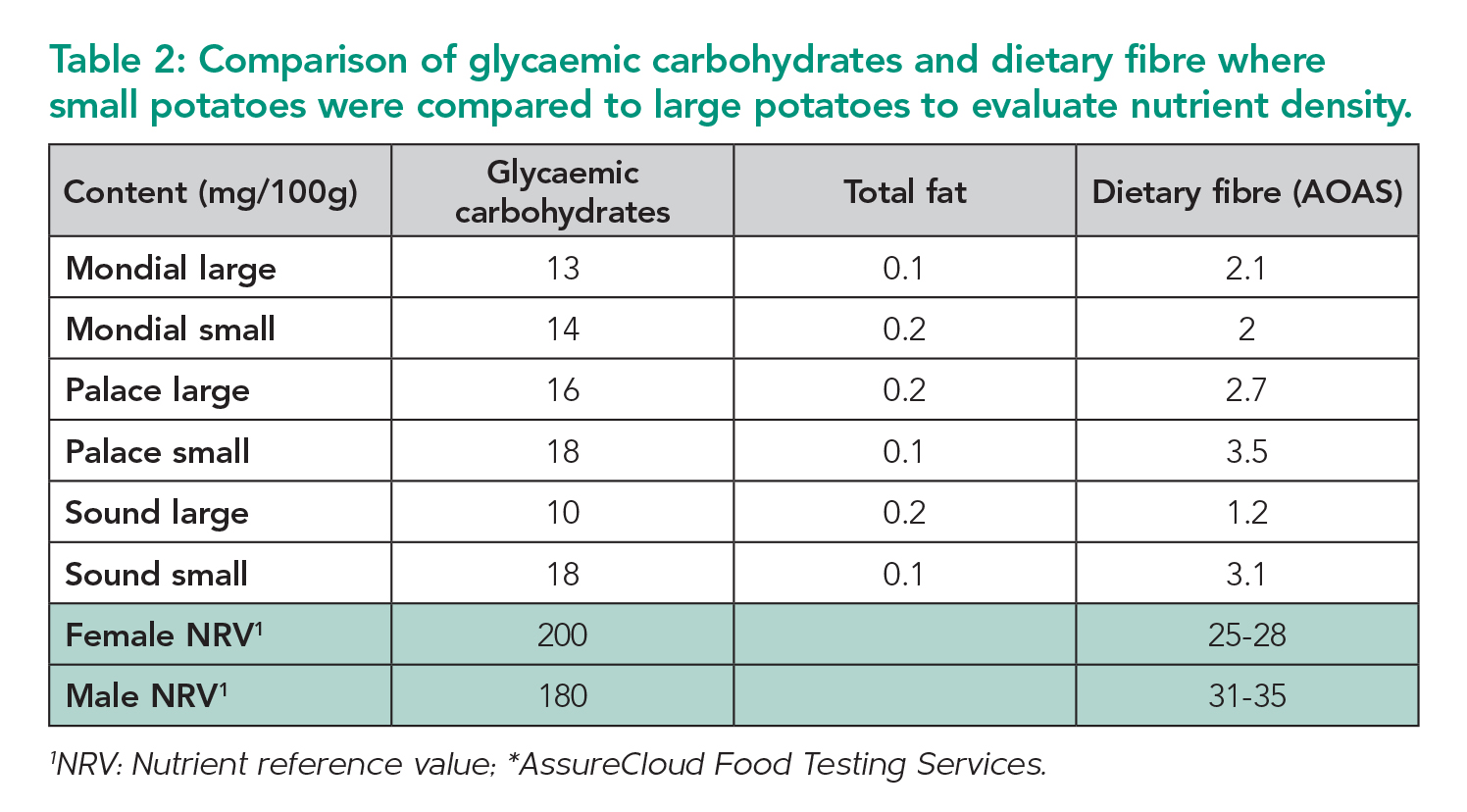
It was also suggested that the nutritional value of smaller potato sizes would differ, based on the assumption that baby and small potatoes proportionately contain more nutritional properties than large potatoes. This was evaluated in Potatoes SA’s cultivar trials at Dendron in Limpopo, where the top three yielding varieties were compared to determine whether small and large sizes were comparable in respect of their nutritional benefits (Table 1 and 2).
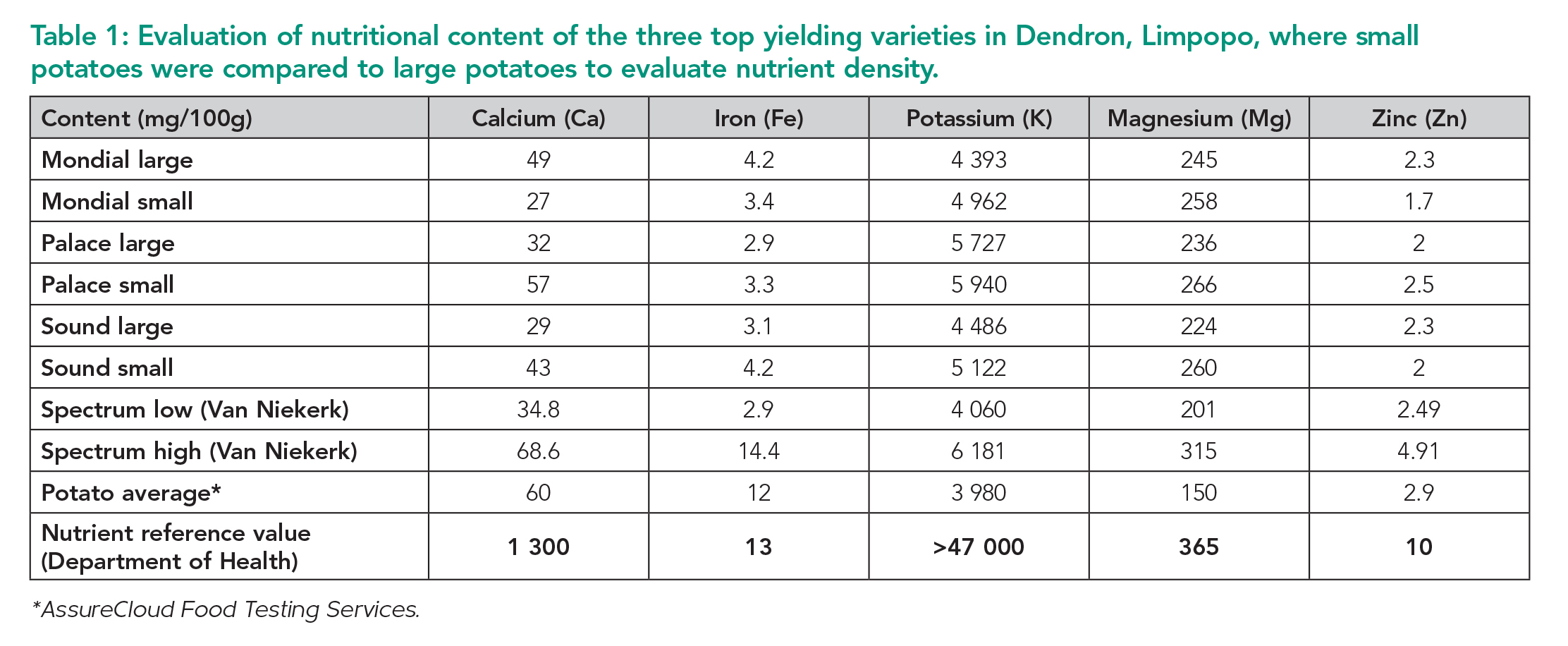
The analysis conducted by AssureCloud Food Testing Services highlighted the wide range of minerals, good carbohydrates, and fibre in potatoes. It was valuable to note that no significant differences were observed between different sized potatoes (Table 1). This comparison will be repeated in cultivar trials in other production regions.
The impact of the NSPS
The Department of Basic Education indicated that South Africa had 13.4 million learners in primary and secondary levels spread over 19 550 schools during 2023/24. Meals are served daily to most of these learners with primary school learners being the largest beneficiaries of this scheme, reaching an estimated six million learners on a daily base. If one 150 g serving is included per week in the NSPS, it will amount to 40 000 tonnes of potatoes.
The NSPS guidelines indicate that a typical school menu should include a protein such as soya, fish, eggs, milk, sour milk, beans or lentils; a fresh fruit and vegetable; and a carbohydrate/starch.
Although potatoes are included in the guidelines, they are seldom offered, as there is a perception that they take longer to prepare and do not bulk up like rice or maize. It can be debated that potatoes qualify as both a vegetable and a carbohydrate.
In the NSPS, criteria for potatoes stipulate that potatoes must:
- Have an attractive appearance.
- Be free from soil or sprouts.
- Not have damage due to mechanical causes, insects, and diseases.
- Not include a hollow heart and foreign matter.
- Not show signs of greening or sun, cold or frost damage.
- Be packed in a standard 10 or 7 kg bag.
The NSPS also allows potatoes to be supplied as a processed product, including cubed or diced products that must be supplied in a strong transparent bag.
It is our vision to ensure that potatoes are included in the NSPS, as they provide a large part of the nutritional requirements, suitable to feed a developing mind in an affordable manner. It is critical that good quality potatoes are presented in appetising ways to ensure that learners can enjoy them into adulthood. – Dirk Uys, research and innovation manager, Potatoes SA
For more information and references, send an email to Dirk Uys at dirk@potatoes.co.za.