
The A to Z of micronutrients: Copper
Copper (Cu) is one of the least visible micronutrients in crop production, and one of the easiest to underestimate. Unlike deficiencies that immediately affect colour, canopy, or biomass, Cu deficiency often stays hidden until crops reach the reproductive growth stage, by which point much of the season’s yield potential has already been established.
Cu is a constituent of enzymes involved in carbohydrate and protein metabolism and acts as a catalyst in photosynthesis and respiration. Cu is also necessary for lignin formation, which provides cell wall strength and integrity, especially in the vascular system.
It also improves the flavour and colour of vegetables and flowers, plays an active role in forming viable pollen and seeds, and increases stress resistance. Therefore, Cu’s main function is to act as a coenzyme in several enzyme systems necessary for the growth and development of different crops.
Copper deficiency
Plants absorb Cu primarily as Cu²+. In the soil, the micronutrient moves only short distances and reaches the root surface mainly by diffusion. Cool soils, dry conditions, and compaction further reduce uptake.
In plants, Cu is considered a relatively immobile nutrient: Once it is incorporated into plant tissues, it does not easily move from older to younger tissues. As a result, deficiency symptoms typically appear first in the youngest leaves and growing points.
Cu deficiency commonly occurs in sandy soils, soils with high organic matter, and soils with excess lime. Cu is antagonistic to iron, molybdenum, zinc, and phosphorus, and high levels of these elements in the soil can reduce its absorption. However, sulphur can induce or favour Cu uptake.
Cu deficiency can affect potato growth and development, especially during the reproductive phase. Cu deficiency can also increase the plant’s susceptibility to disease and reduce crop vigour. Typical symptoms of Cu deficiency include flaccid, wilted young leaves due to impaired cell wall structure and water regulation.
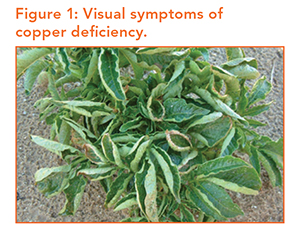
Cu deficiency causes necrosis at leaf tips, especially in younger foliage, and may reduce flowering and tuber set (Figure 1).
Cu deficiency can be addressed through several methods, including soil application, foliar sprays, and fertigation. Potato cultivars can respond differently to Cu fertiliser.
- Foliar fertilisation: Applying a Cu-containing spray allows the plant to absorb the nutrient faster than a soil application. Foliar application can be particularly effective for addressing acute deficiencies.
- Soil fertilisation: Apply dry granular NPK fertilisers containing Cu to ensure even distribution across the field. For best results, incorporate the fertiliser in the upper soil profile to make it more accessible to plant roots.
- Fertigation: Cu can also be supplied through irrigation using a soluble Cu fertiliser that dissolves easily in water.
Disease and pest management
Cu-based fungicides are widely applied, particularly in organic potato farming, to protect crops against late blight (Phytophthora infestans) and stem rot. Since Cu acts as a surface protectant, maintaining a consistent spray film on both upper and lower leaf surfaces is critical during wet weather conditions.
Toxicity
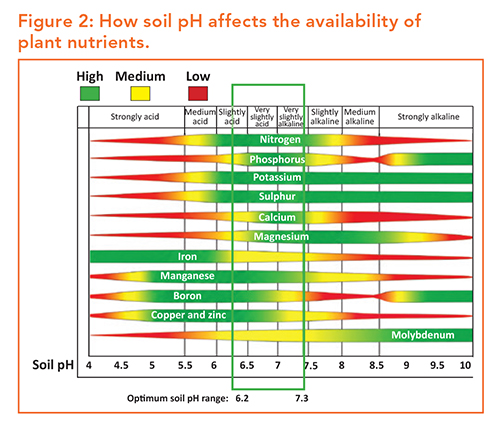
Both too much and too little Cu are detrimental to harvest optimisation. Too much Cu can affect root growth by burning root tips and causing lateral growth that is larger than normal. It can also affect the uptake of other elements such as iron and molybdenum. When the soil pH is low, Cu availability is higher, as shown in Figure 2.
Cu is an essential plant nutrient; however, the range between deficiency and toxicity is narrow. Regular soil testing is therefore important to keep Cu levels within the optimum range for healthy plant growth. – Annemarie van der Merwe, Potatoes SA
Send an email to annemarie@potatoes.co.za for more information or references.