
The best-performing potato crops during the 2025/26 season were not the best-fed, but the best-balanced. That is the central finding of a Diagnosis and Recommendation Integrated System (DRIS) analysis of 404 potato sap and leaf tissue batches.
The batches were collected from roughly 200 potato blocks across more than 30 farms in key African potato growing regions.
Rather than assessing nutrient concentrations in isolation, DRIS measured how nutrients related to one another within the plant. The study found that crop performance and quality were more closely linked to nutrient balance than to any single nutrient’s concentration.
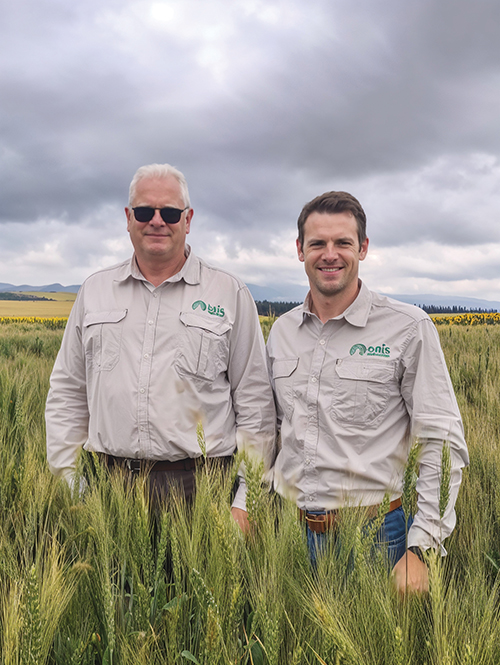
According to Charles le Roux, managing director at DRIS, the dataset’s most important finding was the relationship between nutrient balance and crop performance. “One finding that stood out is that performance and quality tracked the balance between nutrients far more closely than any individual element.
“Nitrogen made the point sharpest. High nitrate did not translate into more protein and amino acids. It acted as an antagonist to the other elements and instead drew down the plant’s energy. The crop responds to how its nutrition is balanced, not to how much of any one thing it is given.”
Understanding balance
The study challenges the assumption that higher nutrient levels automatically improve crop performance. According to the research, excessive levels of individual nutrients often coincided with greater imbalance elsewhere in the plant. Nutrients interact constantly, and elevated levels of one element can suppress the uptake, movement, or effectiveness of another.
This theme recurred throughout the dataset. At elevated levels, some nutrients acted as antagonists, influencing the balance of other nutrients critical to plant function and quality. “The data suggests that a high reading on one element often comes with more imbalance around it, because that element antagonises the others. You cannot wish an antagonism away or strip an element out once it is high,” said Le Roux.
He noted that the objective should be to build a nutrition programme that lets the crop utilise the nutrients already available to it. “The practical route is to lift the entire nutrient profile so the plant can actually use what it already has. In many cases, a lower-status, wellbalanced plant is both more productive and cheaper to manage than a highstatus, unbalanced one.”
The study repeatedly found that nutrient balance explained crop performance more clearly than nutrient concentration alone.
Calcium: A case in point
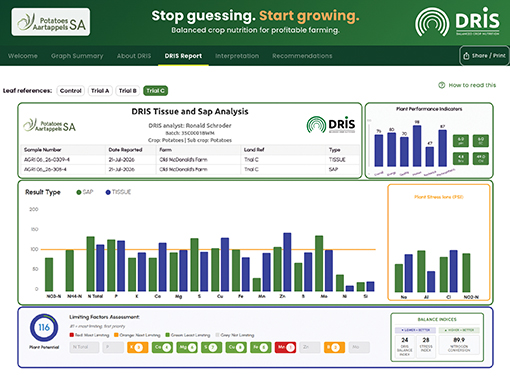
While the report focussed on balance rather than individual nutrients, calcium consistently emerged as the strongest example of how nutrient relationships influence crop performance. Across the dataset, calcium was identified as the most limiting nutrient, showing the strongest relationship to crop quality. The study found that calcium was considerably below balance in many of the potato blocks evaluated.
According to the report, calcium’s role in tuber formation, internal quality, and skin finish makes it particularly important in determining marketable quality. However, calcium also faces unique challenges within the plant.
Le Roux said calcium’s limited mobility helps explain why it featured so prominently in the findings. “Two things about calcium came through. Because calcium moves poorly inside the plant and builds slowly despite high demand, it is constantly working against its own mobility.”
The study found that antagonistic interactions with other nutrients often held calcium back, preventing it from reaching the parts of the plant where it was needed most. The calcium findings illustrate the study’s broader message:
The issue is not simply whether calcium is present in the plant, but whether the nutrient remains balanced relative to the surrounding nutrition programme.
The role of potassium
One of the clearest examples of nutrient interaction involved the relationship between potassium and calcium. The study found that as the potassium-to-calcium balance widened, crop quality declined.
Potassium frequently appeared as an elevated nutrient within the dataset and emerged as one of the strongest antagonists affecting calcium. This relationship clearly illustrates how nutrient interactions can influence crop quality.
The finding does not diminish the importance of potassium in potato production. Instead, it highlights the need to manage potassium within the broader nutrition programme. “This links straight to the calcium point,” said Le Roux. “Potassium is one of the main antagonists to calcium, and it shows up earliest in the growing cycle.”
According to the study, programmes that place heavy emphasis on potassium early in the season may unintentionally increase the risk of calcium imbalance. The potassiumcalcium relationship proves why nutrient balance, rather than individual levels, explains crop performance.
Looking beyond a single test
Another important finding was the difference between sap and tissue analysis. The report found that some nutrients can appear adequately supplied in plant tissue while remaining deficient in the plant’s active sap.
Calcium again emerged as the prime example. “While tissue reveals what the plant has stored, sap shows what it is using now. Calcium is the clearest example of why relying on only one will mislead you.”
This distinction is important because tissue reflects nutrients that have already been stored in the plant, whereas sap reflects nutrients immediately available for current growth and development.
Le Roux believes more research is needed to better understand the value of evaluating both. “Most of the available information looks at sap or tissue in isolation. When you bring the two together into one realistic view of the plant, the picture can change completely.”
The findings suggest that understanding crop nutrition may require a broader view than any single analysis can provide.
Monitoring during the season
A key recommendation from the study is ongoing monitoring. The report notes that nutrient balance shifts throughout the season as crop demand changes. A single sample therefore provides only a snapshot of the crop at a particular point in time.
According to Le Roux, growers can gain more value by monitoring the crop’s nutrient cycle rather than reacting only when limitations become visible. He added that understanding what is already working within a nutrition programme is often as important as identifying limiting factors.
“First, focus on establishing what is already working well in the programme, and why it is working, before hunting for limiting factors. Once you understand what is working, you can fine-tune around it and make it repeatable for that specific operation. That is more useful than chasing deficiencies one at a time.”
The next phase of research
While the study identified clear patterns across the 2025/26 season, future work will focus on linking those patterns to commercial outcomes. Le Roux says the next step is to connect nutrient balance directly to measured yield and packout results so that relationships can be evaluated statistically.
“I would want the full crop cycle tied to measured yield and pack-out quality, so we can see statistically which balances actually convert into marketable tubers. We have good evidence on individual farms, but not enough data to complete a statistical analysis.”
Future work could also investigate regional differences and compare the nutrient requirements of different potato varieties. “I would also make it area-specific, and I would compare varieties against each other, because a Mondial and a Sifra potato almost certainly carry different nutrient demands through the season. This is even more evident when comparing short growers with long growers. That is how you turn these patterns into something a grower can rely on.”
For now, the study’s main conclusion is clear: Potato performance is influenced not only by the nutrients available to the crop, but by how those nutrients work together. Understanding nutrient balance may be just as important as deciding how much fertiliser to apply. – Nikilene Steenkamp, Plaas Media
For more information, contact Charles Le Roux or Ronald Shroder at 066 167 4203 or info@dris.ag.