
Estimated reading time: 7 minutes
According to the Food and Agriculture Organization Statistics (FAOSTAT), a total of 359 million tonnes of potatoes were produced in 159 countries on 16.5 million hectares of land in 2021. Potatoes are the third most consumed crop in the world after wheat and rice. Many countries are often associated with their traditional potato dishes such as Poland with pierogi, Belgium with frites, and the United Kingdom with fish and chips while in Africa, the largest consumer of potatoes, Algeria, enjoys their traditional potato fritters, maakouda.
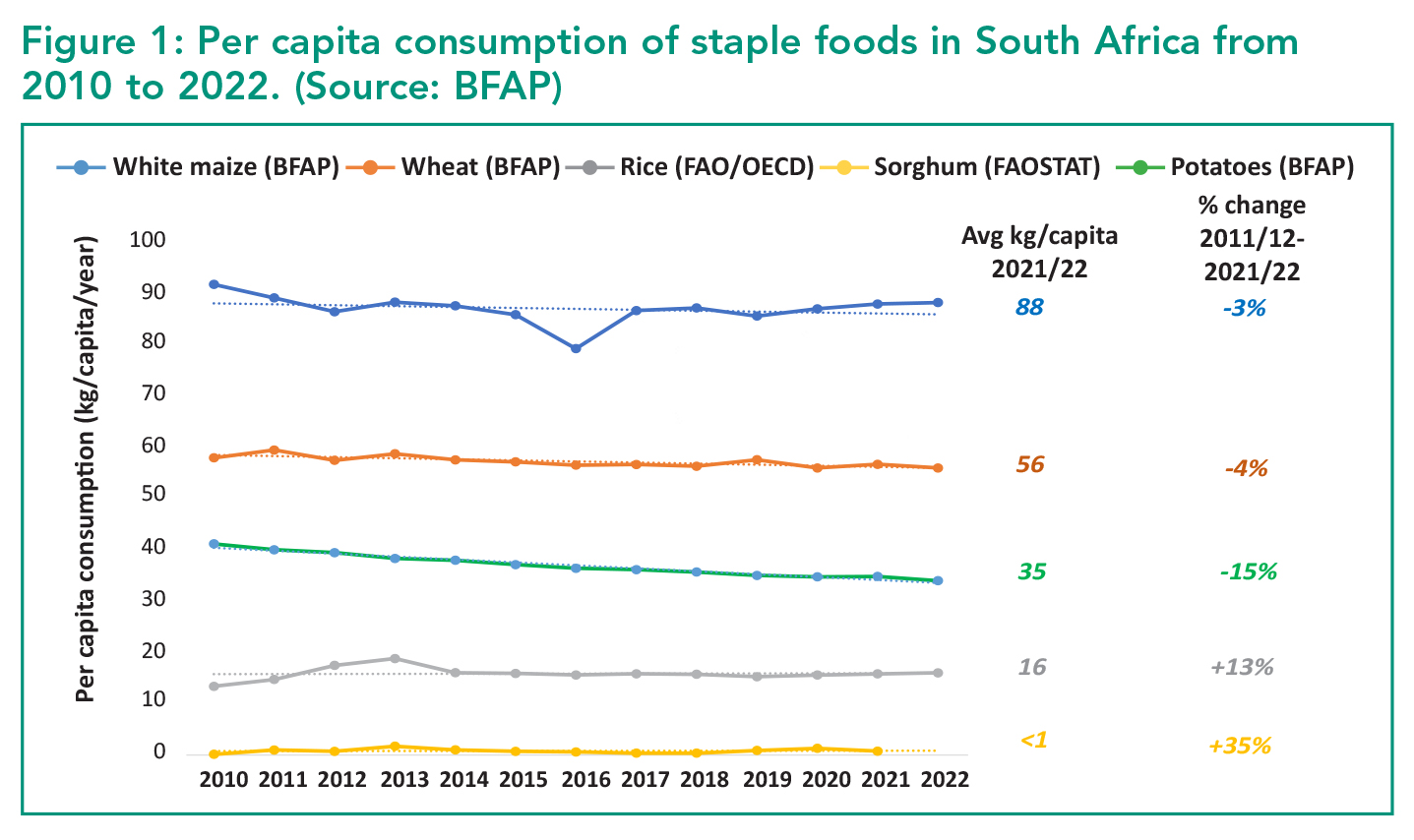
In South Africa, maize is still our main staple followed by wheat (Figure 1) but we do love our slaptjips. Just think of our local kota street feed (hollowed-out bread filled with layers of chips, cheese, meat and eggs). In short, the opportunity for growth in the potato segment lies in the fact that potatoes partner well with most meal occasions.
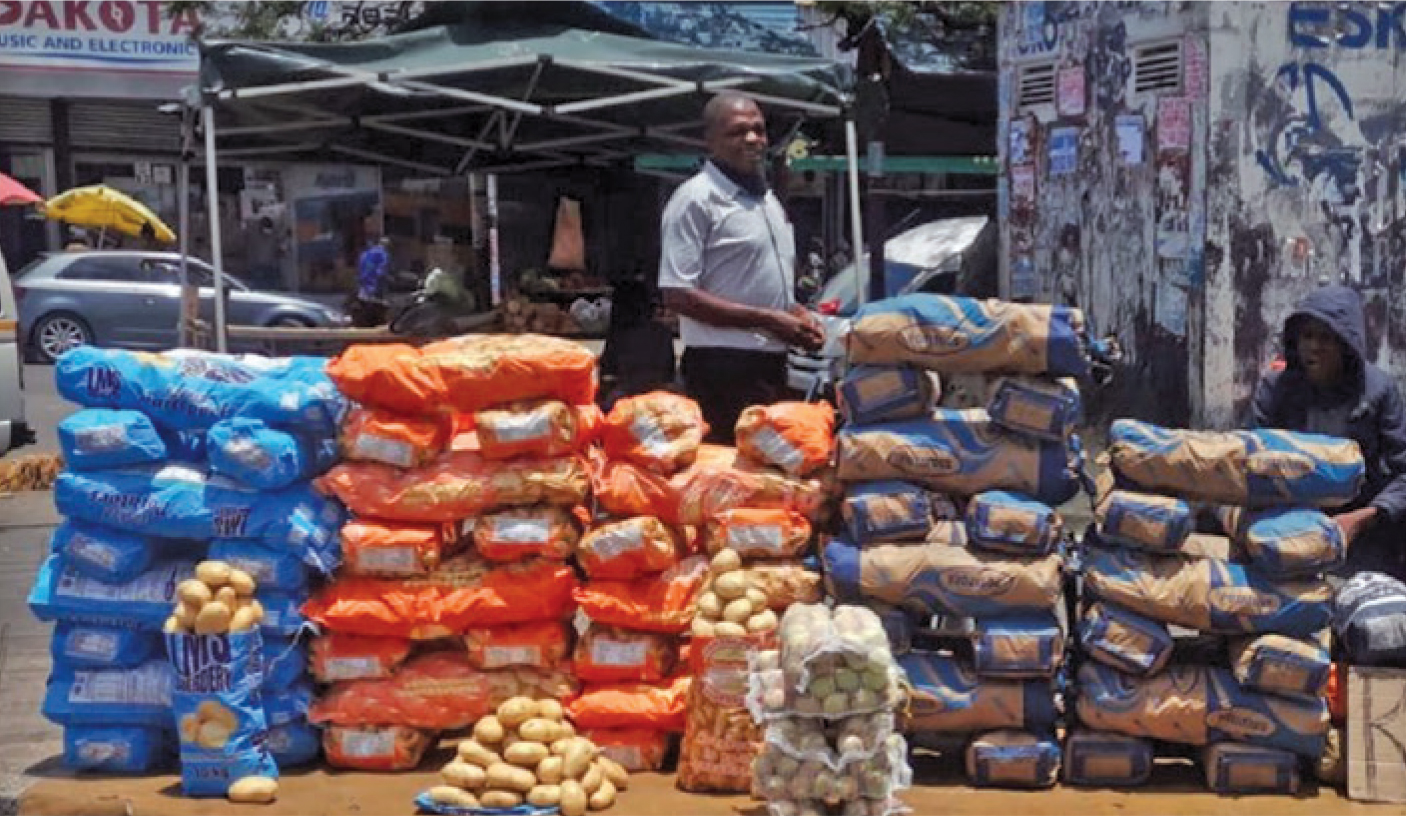
A global consumer trend review by Tastewise (2023) estimates that 51% of restaurants offer potatoes on their menus with a particular increase in the use of processed potato products and potatoes as a basis for vegan food. Locally, we have a very vibrant informal economy in which potatoes have a critical role to play. It is also here where potatoes’ opportunity for growth exists, by optimising potatoes in street foods sold through Kasi outlets and increasing potatoes as part of every home-prepared meal, including breakfast.
The local potato scene
In 2023 South Africa cultivated 51 000 ha of potatoes, producing 2.5 million tonnes of nutritious food. With our population at 62 million people, according to Stats SA, the per capita consumption of potato is only 35 kg/year. This translates to South Africans consuming slightly less than 700 g of potatoes per week which, according to the Bureau for Food and Agricultural Policy (BFAP), represents a 15% downward trend over the last decade (Figure 1).
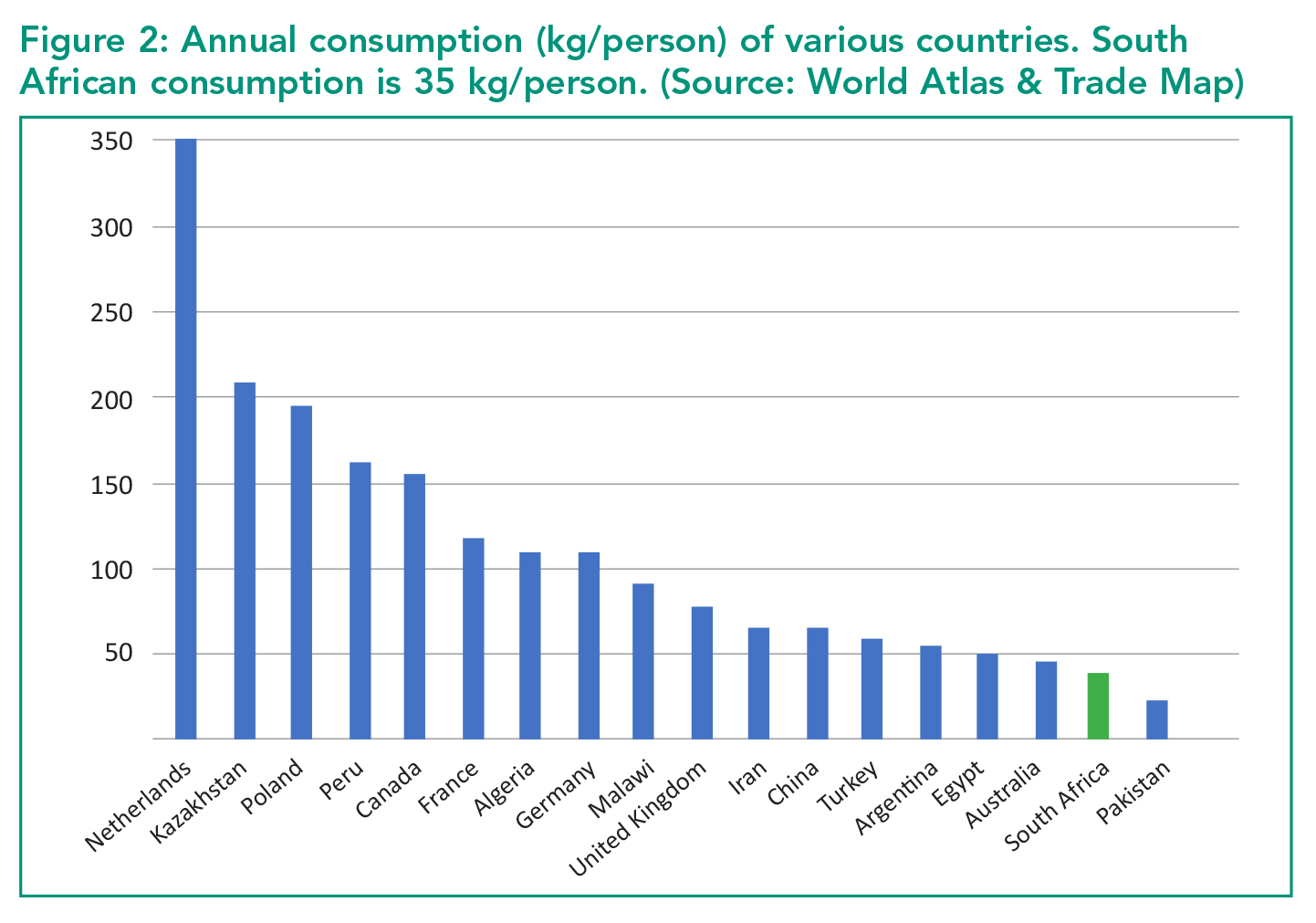
When compared to countries with similar economies, our country’s consumption is lower than that of Turkey (56 kg per capita), Argentina (53 kg) and Egypt (50 kg). In contrast, Algeria and Malawi consume 109 kg and 88 kg per person per year (Figure 2). An opportunity for growth does exist if we benchmark ourselves against economies like Argentina, Turkey, Egypt and even Malawi.
By increasing local consumption by just one potato per week and boosting exports by 15%, South African production could expand the market by 944 million tonnes per year, elevating its value from R12 billion to almost R15 billion.
World-class producers
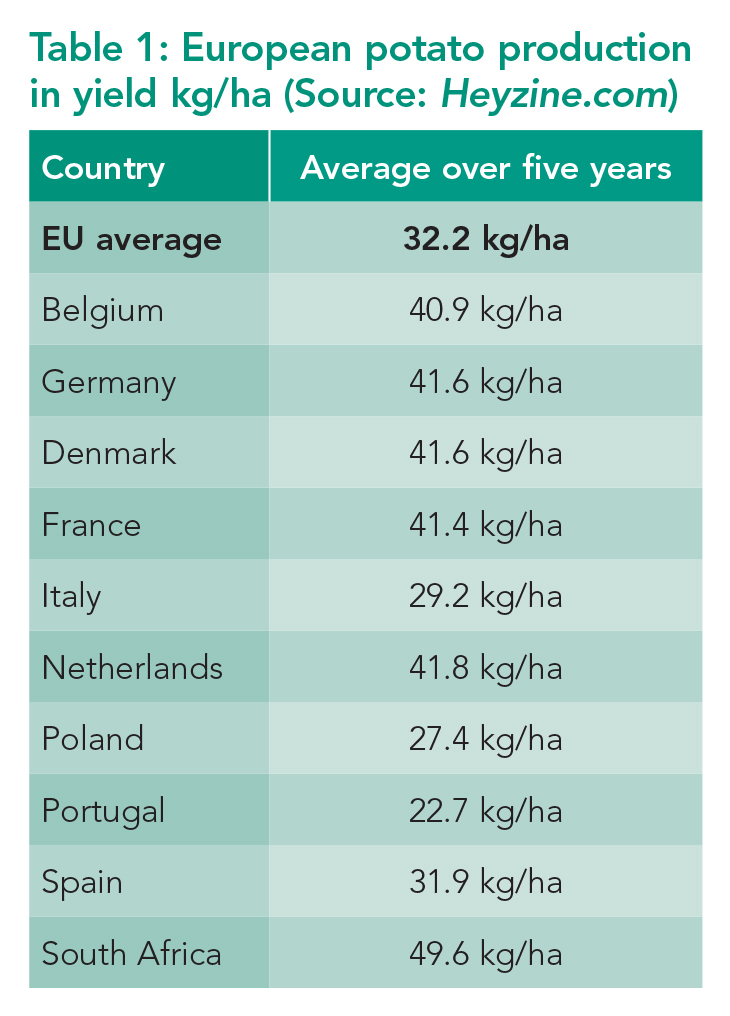
South African growers produce 49 t/ha which compares very well with European countries (Table 1). This despite a harsher environment as well as the same production challenges including regulatory pressure on crop protection, energy costs and increasing labour expenses.
Despite this, South African producers have proven their capacity to meet increased demand. Potatoes SA’s research therefore focusses on improving production by:
- Using data to make better decisions to mitigate production risks.
- Improving soil and water health to reduce pests and diseases.
- Optimising the quality of potatoes to extend shelf life.
- Exploring new applications and uses for low-grade potatoes.
Our market
The potato market has evolved over the last 50 years since Dr Van der Plank introduced his first potato varieties. In 1973, 85% of the 600 000 tonnes of potatoes produced were traded through municipal fresh produce markets (FPMs), while only 5% was processed (Hammas). Currently, less than 50% of potatoes are traded through FPMs due to a lack of infrastructure maintenance, while 20% is processed. Despite this, these markets remain our price-forming mechanism. The logistics of this market trading platform are evolving, promising improved logistical efficiencies over time.
Looking at consumption, it is estimated that 60% of all potatoes are consumed within the informal segment. This sector has captured the attention of the retail industry, with major retailers entering this segment. Potatoes, as a key ingredient of the kota, for example, have an estimated market of R10 billion (Alcock, 22 October 2018) making the informal economy an opportunity that we should not underestimate.
Potatoes value proposition
The debate is often whether potatoes are a vegetable or a category on its own. It is probably unimportant, but potatoes compare favourably with the nutritional properties of vegetables. Rich in potassium, fibre, vitamins and micronutrients, they embody the essence of ‘goodness from the earth’ (gesondheid uit die grond uit), as coined by Potatoes SA. Potatoes offer high-quality carbohydrates, often better than most grains, and do not lead to allergy problems often associated with traditional grain crops.
According to the March Household Affordability Index of the Pietermaritzburg Economic Justice and Dignity Group (PMBEJD), the household food basket for March 2024 amounted to R2 821.58 with potatoes accounting for 3.8%, while maize represented 10% and bread 13%. Potatoes have the potential to contribute a larger share of the South African food basket.
Strategic focus
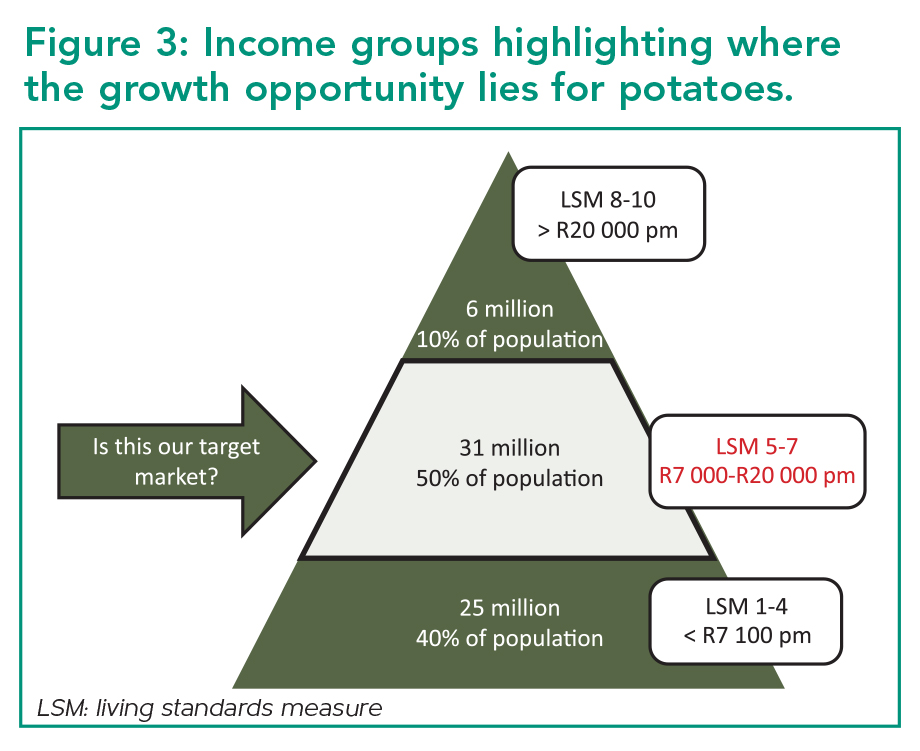
A study by Kantar reveals that many South Africans earn less than R20 000 per month (Figure 3) but this is also where the buying power lies. Potatoes offer an affordable contribution to the diet of the average South African. To capitalise on the opportunity to grow in this market, we should position potatoes as versatile partners for any home-cooked meal or ‘on the go’ option.
The future looks promising
The South African potato industry has the opportunity to grow its market by focussing on four areas:
- Locally by positioning potatoes as the partner for any meal.
- Regionally by focussing on African exports.
- Evaluation of long-term deep-sea export opportunities to countries in the northern hemisphere in their counter-season.
- Developing new uses for potatoes through processing.
Potatoes SA’s action plan
Potatoes SA has initiated a social media campaign highlighting the benefits of potatoes and this will be repositioned to reach the average South African. A study has been approved to explore potato export opportunities in the regional market and northern hemisphere countries. This will require an understanding of consumer preferences, consumption opportunities, trade barriers, market gaps, and logistical requirements.
The Potatoes SA research and innovation focus will support marketing initiatives which include optimising the quality of potatoes and developing a model to predict the shelf life of potatoes.
The Department of Science and Technology’s Innovation Agency, or TIA, is funding a project to find new uses for potatoes through processing. This includes targeting segments to address.
- Consumers with allergies.
- Develop a technique to rear insects on a potato substrate to produce insects for the animal feed industry.
- Develop new uses.
“As long as potatoes provide value to our customers there will be a market. Ideally, potatoes should partner any meal.” – Dirk Uys, Potatoes SA
For more information and references, contact Dirk Uys at dirk@potatoes.co.za.