
Estimated reading time: 6 minutes
Potatoes are one of the most efficient food crops in the world, but are highly dependent on crop protection products that are strictly regulated by various types of legislation. These include the Fertilisers, Farm Feeds, Agricultural Remedies and Stock Remedies Act, 1947 (Act 36 of 1947); the Foodstuffs, Cosmetics and Disinfectants Act, 1972 (Act of 1972); the Hazardous Substances Act, 1973 (Act 15 of 1973); the Occupational Health and Safety Act, 1993 (Act 85 of 1993); and the Labour Relations Act, 1995 (Act 66 of 1995).
Global and public pressure resulted in regulatory authorities reassessing many critical crop protection products. At the Potatoes SA Congress in Cape Town on 16 and 17 July last year, the Registrar of Act 36 emphasised that crop protection remedies must align with Section 24B of the South African Constitution. This section highlights the right to an environment that is not harmful and is protected for the benefit of future generations by securing the ecologically sustainable usage of resources.
Potato News Today editor and publisher, Lukie Pieterse, estimates the economic impact of global crop protection restrictions on the potato industry at US$20 billion per year, resulting in a 6% reduction in global potato production.
Phasing out of crop pesticides
The Registrar of Act 36, together with the Department of Health, have imposed restrictions on so-called highly hazardous pesticides (HHPs) as classified by the World Health Organization’s (WHO) Class 1B products, the Rotterdam Convention, and the Global Harmonization System of the former Department of Agriculture, Land Reform and Rural Development (now the National Department of Agriculture).
These classifications are based on the acute toxicity of pesticides that are fatal, even after short-term exposure. In addition, the Registrar of Act 36 may include products that do not meet any of the criteria, yet show a high incidence of severe or irreversible adverse effects on human health.
Many factors contribute to the discontinuation of these products, including:
- Toxicity concerns regarding a formulation and its ingredients.
- Public health risks such as potential poisoning incidents.
- Shifts in international regulations such as the European Green Deal which aims to reduce pesticide use and promote alternatives.
- The high cost of re-registration. Many crop science companies are opting out of defending existing crop protection products due to financial feasibility and regulatory complexities in maintaining registration.
Examples of restricted products are methomyl, which has been used in the illegal poisoning of wildlife, and paraquat, which is often used during suicide events.
Implications for the industry
Potatoes SA, along with other commodity organisations, and CropLife SA have highlighted the impact of these processes in respect of agricultural efficiency. The HHP crop protection products listed in Table 1 may only be purchased and administered by registered pest control operators (PCOs).
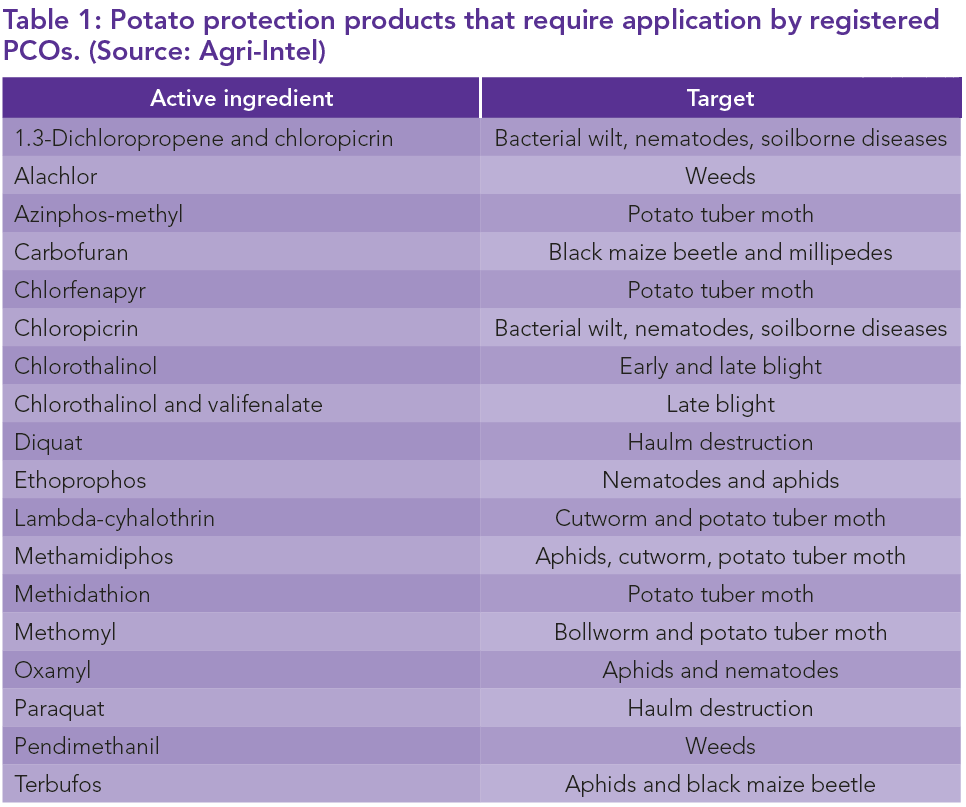
Producers are required to adhere to the certification requirements of PCOs, which means a farm must appoint a PCO who is responsible for all crop protection activities on the farm. The PCO must oversee, among others, the purchasing, record-keeping and responsible application of HHPs.
Impact on crop production
Potatoes SA has initiated research into mitigating the impact of the phasing out of these critical crop protection remedies. The focus is on crop health instead of pest control. (The organisation works closely with policymakers and research-based organisations to support alternative crop protection products.)
Current research areas include:
- Soil health management: By evaluating crop rotation systems to reduce nematode populations to support modern nematicide efficiency; management of tuber diseases such as powdery scab, black dot, Fusarium, and blackleg by utilising crop rotation systems.
- Improved pest control strategies: Understanding the triggers of potato tuber moth, and tomato and pea leaf miners for more efficient crop management; evaluating the sensitivity of key modes of action which has shown that older compounds such as pyrethroids and organophosphates have reduced sensitivity towards potato tuber moth; adapting spray programmes to support beneficial organisms (some of these products happen to be HHPs); and promoting end-of-season management systems such as irrigation and ridging to prevent infestation.
- Enhanced surveillance and disease resistance: Monitoring sensitivity shifts in potato tuber moth and early and late blight; weather modelling to optimise pesticide application; and aphid monitoring in seed production areas.
Worldwide measures
In terms of innovation and technology, current research and development are focussed on breeding potato varieties with higher yields, better disease tolerance, and enhanced nutritional properties. Precision agriculture technologies, including remote sensing, data analytics, and digital platforms all provide real-time insights to mitigate risks.
Efficient resource management includes optimising fertilisation schedules to balance input costs and avoiding over- or under-application to enhance crop health.
In terms of integrated pest management (IPM), the acceptance of biological pest control solutions hinges on an understanding of potato biology as well as pest or disease interactions. Biologicals are often met with scepticism and integrating them into control strategies will be necessary. HHPs will be phased out over time, requiring a transition to IPM to support food security or producer efficacy. Regulatory compliance and adherence to strict protocols will be essential to ensure the success of sustainable pest control initiatives.
It is important to remember that pest- and disease-tolerant potato varieties are the foundation of sustainable crop protection, and harnessing the genetic diversity of potatoes can lead to the development of resilient cultivars.
Looking ahead
By 2035, hazardous pesticides will be completely phased out, making it crucial to develop sustainable alternatives without compromising food security. Advances in breeding resistant potato varieties, IPM adoption, and precision agriculture will play a key role in ensuring the long-term viability of potato farming in South Africa.
Advocacy for the approval of new gene editing technologies as well as next generation crop health enhancers are critical. As an industry, we will have to adapt to these regulatory changes while maintaining economic and environmentally sustainable potato production.
The improvement of precision tools for early disease detection are transforming pest management.
Cutting-edge diagnostics and surveillance technologies enable the identification of pathogens before symptoms appear, preventing yield losses and reducing the need for reactive chemical applications.
By adopting eco-friendly farming techniques, leveraging technological advancements, optimising resource use, and engaging with regulatory frameworks, potato growers can secure long-term profitability and resilience.
How to become a PCO
Producers can apply for PCO certification by completing the registration application available on potatoes.co.za, paying a registration fee, providing proof of prior crop protection experience, and on completion of a medical examination. If the applicant holds an agricultural or biological qualification (diploma or degree in Agriculture), this will be accepted as proof of experience. A certified copy with details regarding subjects completed, must be included in the application.
If a producer does not possess a formal agricultural qualification, an accredited training course (NQF Level 4) can be completed, as well as practical experience under a registered PCO. This three-day course can be completed online. The following accredited institutes offer these courses: Pest Management Academy, Pest Control Industries Training Academy, and Deltatrax Projects. Potatoes SA is also in the process of developing a producer-specific training programme together with other industry organisations, pending certification. – Dirk Uys, Potatoes SA
For more information, send an email to the author at dirk@potatoes.co.za.