

Black dot: A growing challenge for South Africa’s potato industry
Healthy potato crops depend on vigorous root systems and a long, productive growing season. One fungal pathogen that is increasingly attracting attention worldwide is Colletotrichum coccodes, the causal agent of black dot of potato. Although often overlooked because its symptoms can be subtle or confused with other diseases, this pathogen can reduce plant vigour, shorten the crop’s lifespan, and ultimately affect both yield and tuber quality.
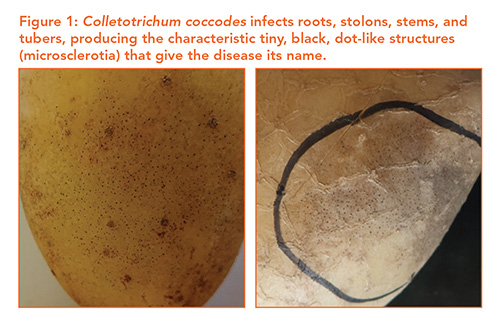
Colletotrichum coccodes infects roots, stolons, stems, and tubers, producing the characteristic tiny, black, dot-like structures (microsclerotia) that give the disease its name (Figure 1). Beyond these visible symptoms, the fungus is also associated with potato early dying – a complex condition in which plants senesce prematurely, reducing the time available for tuber bulking. Early dying often results from interactions among C. coccodes, environmental stress, and other soilborne pathogens, making its impact difficult to predict but potentially significant.
Because the pathogen survives in soil and infected crop debris for several years, it can become established in production fields and remain a persistent management challenge. The pathogen can also cause leaf spots, particularly under favourable environmental conditions. Small brown lesions on leaves and stems may reduce photosynthetic capacity, further weakening plants already under stress.
Foliar symptoms and trials
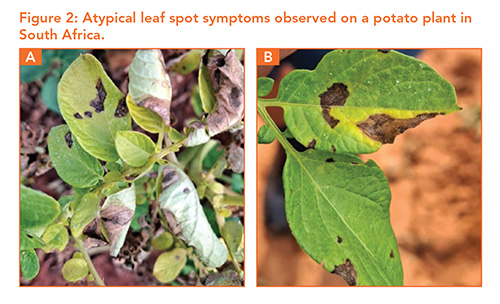
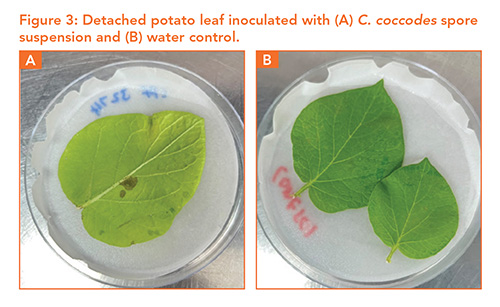
Atypical leaf spots (Figure 2) have been observed in several potato-growing regions in South Africa. Isolations from these atypical symptoms yielded only C. coccodes cultures. To confirm whether C. coccodes was the primary cause, we inoculated detached leaves and whole plants with C. coccodes spore suspensions. Spore suspensions were inoculated into the centre of detached leaves (Figure 3) and incubated for five days.
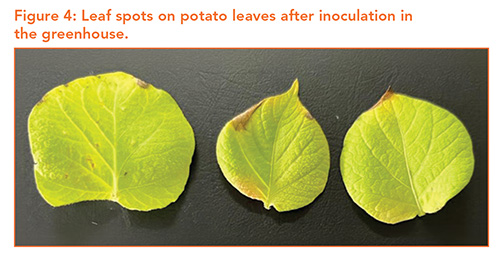
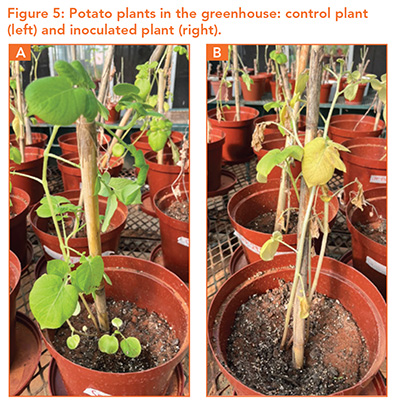
For the greenhouse trial, spore suspensions were sprayed onto five-week-old plants, which were then observed for six weeks. Isolations were performed from symptomatic leaves (Figure 4), and C. coccodes was re-isolated, confirming it as the cause of the observed atypical leaf spots.
After six weeks, the control plants in the greenhouse were still growing actively, whereas the inoculated plants showed signs of yellowing and premature senescence (Figure 5).
Looking ahead
As South African potato producers face rising pressure to optimise yields while managing changing environmental conditions, understanding black dot disease is becoming vital. Recognising the symptoms, understanding the biology of C. coccodes, and adopting integrated management strategies are key to reducing its impact and maintaining healthy, productive potato crops. – Dr Elsie Cruywagen, Dr Rene Sutherland, Tshegofatso Kgoale, and Dr Juanita Engelbrecht
Send an email to cruywagenem@arc.agric.za for more information.