
Estimated reading time: 9 minutes
Potatoes are mainly produced on intensively farmed land, which contributes to nematode-induced problems specific to the crop. Root-knot and lesion nematodes are recognised as one of the primary constraints in potato production. Lesion nematode infestations can cause severe crop losses when the crop planted before potatoes maintained a very high lesion nematode population and the follow up potato crop is invaded early in its development.
Our study therefore focussed on root-knot nematodes, specifically Meloidogyne incognita and Meloidogyne javanica, as they occur in every production region and are the most damaging. Root-knot nematodes also interact with other disease-causing organisms to develop disease complexes, including bacterial wilt and soft rot/blackleg of potatoes.
Nematode damage
Losses due to root-knot nematode parasitism and subsequent damage to tubers are common. If infestation occurs early in the growing season during tuber initiation or if mature tubers remain in the soil past their optimal lifting time, a high percentage of these tubers will be invaded and blemished (Figure 1).
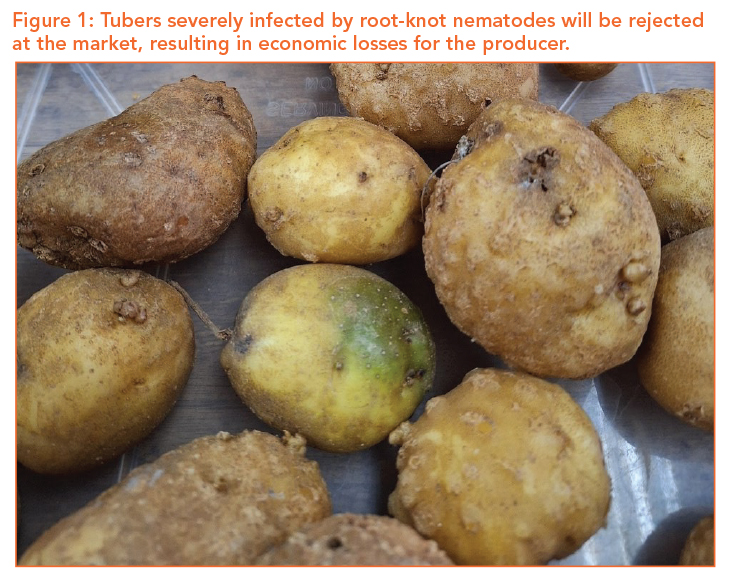
Depending on the nematode population density, infestation by root-knot nematodes may cause yield losses, and tubers showing visible nematode damage will be downgraded at fresh produce markets. Due to these challenges, many producers rely heavily on chemical control to ensure a good yield and prevent quality losses.
However, most of the nematicides currently in use are red-band and classified as toxic or highly toxic.
In some regions, potatoes are produced on fields that are fumigated before planting, in addition to being treated with follow-up nematicides.
This reliance on toxic chemicals is currently being challenged by consumer demands for safe food produced with minimal impact on the environment.
Trial background
The aim of our study was to determine whether fumigation can be excluded from the nematode control programme without impacting the return on investment for the producer.
Research has shown that, with the expansion of potato production into warmer areas, irrigation is required at planting in especially very sandy soils.
The resulting interaction of favourable temperatures, soil structure and moisture status can increase the severity of root-knot nematode infestations, leading to a dependence on chemical control practices. These favourable conditions can be replicated in a microplot facility filled with very sandy soil (Figure 2).
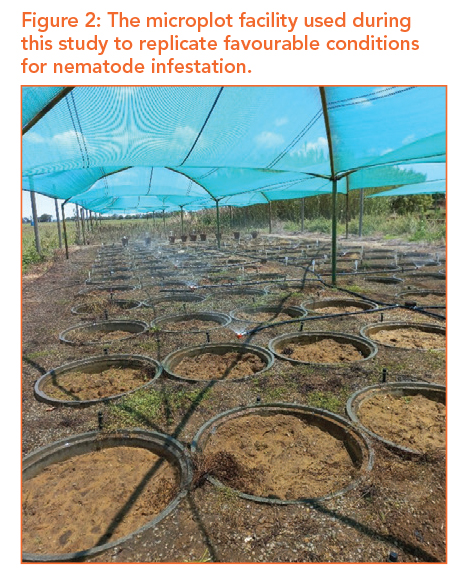
Three trials were conducted over three consecutive growing seasons, representing a worst-case scenario, since potatoes are planted in a rotation system with at least four years between plantings.
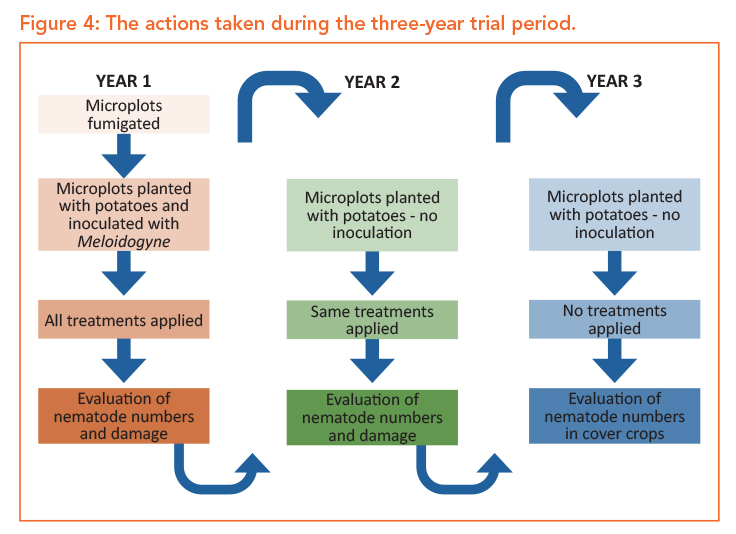
During the first growing season, the soil was fumigated before planting to ensure that no other organisms survived that could influence the data. At planting, the potatoes were inoculated with root-knot nematodes at a rate of approximately 5 000 eggs and juveniles per plant.
The microplots were not re-fumigated or inoculated in years two and three. Infestations that occurred in these two years originated from survivors remaining from the previous season. During the first two years, potatoes were cultivated using an optimum fertiliser programme recommended by a fertiliser company to ensure that data were not influenced by nutrient deficiencies.
Treatments included the old generation red-band nematicides, fenamiphos and oxamyl, and the new generation blue-band reklemel, fluensulfone and fluopyram. Five biological products were also included to serve as an alternative management tool. Two controls were included, namely an untreated control and a second control that benefitted from the fertilising programme but received no additional treatment.
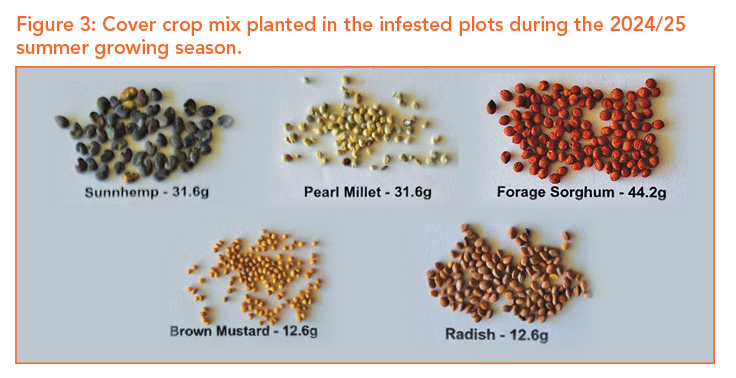
During the second year, each plot received the same nematicide or biological treatment as in the first year to determine whether nematode numbers increased or decreased for each respective chemical or biological product. In the third year, a cover crop mix tested and compiled by Dr Mieke Daneel and identified as resistant to root-knot nematodes was planted in all the plots to determine whether a relevant cover crop mix will be able to reduce root-knot nematode numbers (Figure 3). The sequence of activities undertaken during this study is provided in Figure 4.
Study results
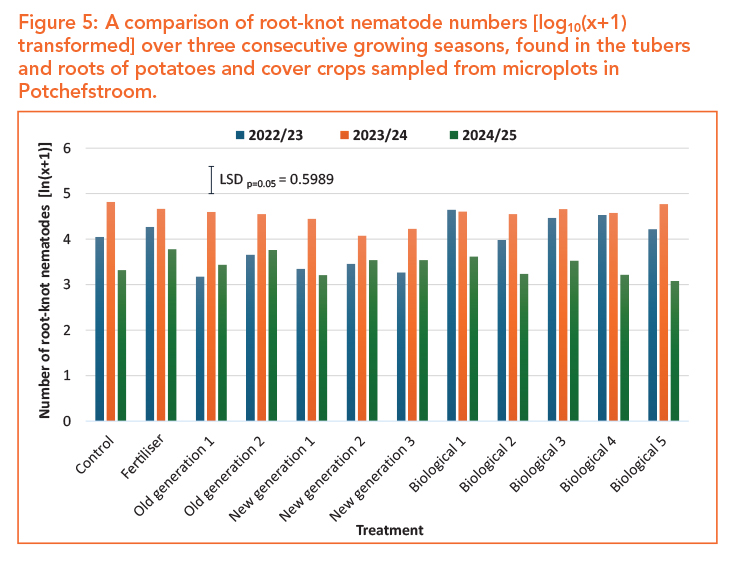
Figure 5 represents the statistical analysis of the nematode numbers (log transformed) across the three growing seasons. This allowed us to determine the behaviour of the nematode population in response to each treatment across the three seasons, as well as within individual seasons. The chemical and biological products are indicated only by numbers, as the aim of this study was to examine population fluctuations over the three seasons rather than to promote or demote products.
First growing season
Plots treated with the old generation nematicides maintained significantly lower nematode numbers compared to that of the two controls (Figure 5).
The three new generation nematicides performed well compared to the old generation products and could serve as suitable replacements.
Nematode numbers in plots treated with biological products did not differ significantly from that of the two controls and were significantly higher than those in chemically treated plots (Figure 5). This was expected, as biological products often require three to five years to show positive results. In addition, the biological organisms need to establish and multiply in the soil before control becomes possible.
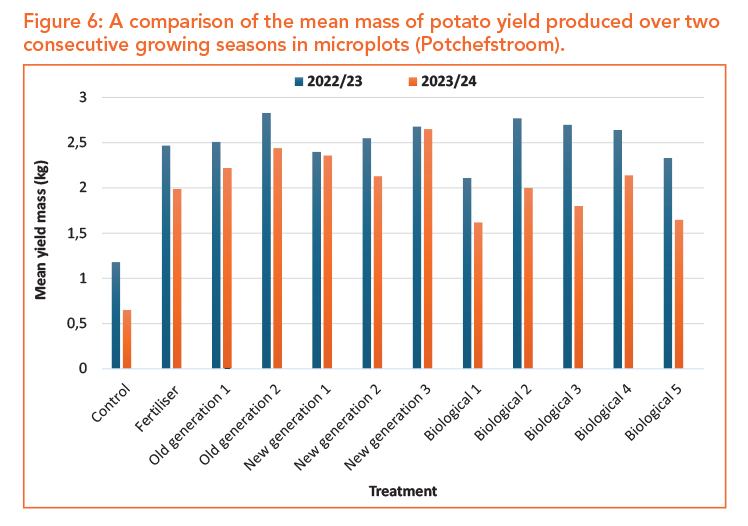
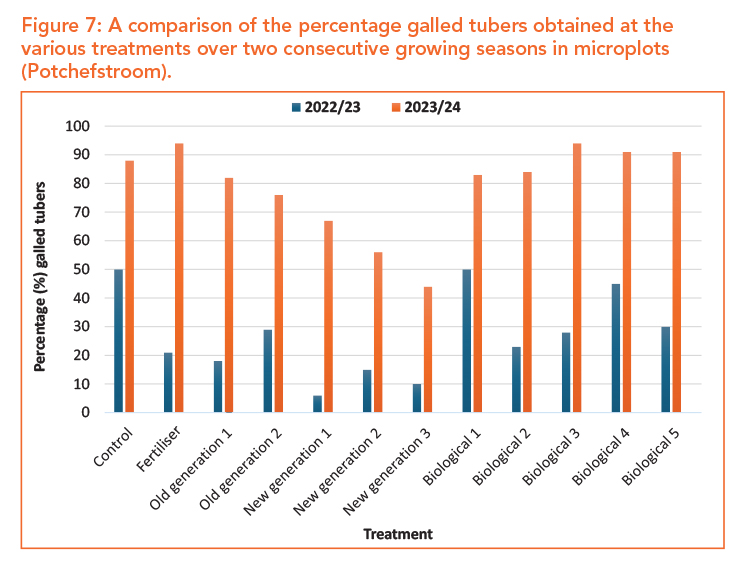
The yield produced at each treatment during this growing season served as the baseline for comparing the yield of the second growing season (Figure 6 and 7).
However, it is worth noting that during this season, the yield of the untreated control was significantly lower than that of all other treatments. The lower yield obtained from the untreated control already hinted at the influence that root-knot nematodes can have on yields of untreated, unfertilised potatoes (Figure 6).
In terms of yield quality, most chemically derived nematicides (old and new generation) showed significantly less galling and consequently higher marketability of tubers compared to that of the untreated control (Figure 7). This aligns with the significantly lower nematode numbers observed in plots treated with chemical nematicides (Figure 5).
Second growing season
Nematode numbers in plots treated with the old and new generation nematicides increased to such an extent that they did not differ significantly from either the controls or the biological products (Figure 5). The higher nematode numbers directly impacted yield, as all treatments produced significantly lower yields than the season before (Figure 6).
Only one of the new-generation nematicides was able to produce a significantly higher yield than most other treatments during this season. Despite chemical nematicides showing less galling compared to the rest of the treatments, the high number of nematodes present during the second growing season rendered these tubers also unmarketable (Figure 7).
Third growing season
Following rotation with the cover crop mix, nematode numbers declined significantly across all plots compared to the previous season (Figure 5). In some plots, nematode populations were even comparable to those observed during the first growing season.
Key study observations
Potato producers, particularly in warm regions with sandy soils under irrigation, will not be able to sustainably produce potatoes without including fumigation in their nematode management programme. Root-knot nematode development is temperature-dependent, and its life cycle can be completed in just 21 days at 26°C.
At times, root invasion may not be damaging, but as soon as tuber initiation occurs the newly hatched juveniles invade the tubers and rapidly develop and spread. This means that when infection occurs early in the plant’s growth cycle, root-knot nematodes will produce several generations during a single season.
These observations were confirmed in our study, where nematode numbers increased significantly during the second growing season where no fumigation took place.
This is because fumigants generally provide a quick kill and knockdown of an existing nematode population prior to planting. Without pre-plant fumigation, the nematode population that survived the first growing season and the winter months were thus able to invade the second growing season’s crop at an early stage of the plant’s growth cycle.
Our study further confirmed observations made in other studies that these early infections lead to a high percentage of tubers being invaded and damaged, despite the application of pre- or at-plant nematicides. This adversely affects crop quality and can lead to market rejection of the crop.
Previous studies also indicated that should nematode invasion occur despite nematicide application, higher concentrations will be needed to kill the nematodes in the roots and tubers. Corrective control is therefore not achieved at the recommended dosage on the product label.
In conclusion
The use of a fumigant remains an integral part of control by lowering the root-knot nematode numbers that survived the previous growing season, allowing follow-up nematicide treatments to be more effective. Using a suitable cover crop mix will aid in keeping these nematodes below damaging levels.
However, the combination of the cover crop mix will depend on the predominant nematode species in a field. Mixes with root-knot nematodes in mind will not necessarily be effective in a field with high levels of lesion nematodes. Producers should therefore be vigilant and aware of what is going on in their fields in terms of the specific nematode species that creates a challenge at that time. This can only be done with the assistance of a trained nematologist through analysis of soil and plant root samples.
– Dr Sonia Steenkamp, Liesl Morey and Dr Mieke Daneel, Agricultural Research Council
For more information, send an email to Dr Sonia Steenkamp at SteenkampS@arc.agric.za