
Estimated reading time: 6 minutes
Also known as continuous irrigation, low flow-rate irrigation (a form of low-rate drip irrigation) has the potential to push the limits of irrigation precision and water-use efficiency.
In certain circumstances, the adoption of low-flow irrigation technology could help producers improve their system’s water-use efficiency. The primary aim of low-flow irrigation is to supply water to the active root zone at a rate that matches the plants’ uptake.
Benefits of continuous irrigation
- Reduces water, energy and fertiliser use across a given area.
- Greater precision in placing water and nutrients within the crop root zone.
- Improves control of irrigation depth and lateral water movement, resulting in better utilisation of especially soil with lower potential, such as sandy or rocky soils.
- Efficient distribution of water and nutrients beneath each dripper, increasing the wetted area available for plant uptake.
- Limits leaching of nutrients below the root zone.
- The system’s design allows the whole farm or a group of blocks to be irrigated simultaneously.
- Increased water-use efficiency could allow producers to expand the total area irrigated with the available water, provided additional irrigable land is available.
- Automation of the irrigation system is relatively simple.
- Longer irrigation sessions lead to better hydraulic performance than conventional drip systems, which have much shorter standing times.
- Suitable for deficit irrigation.
- Enables more effective management of nutrient applications during the crop’s critical growth stages.
- Requires less fertiliser during fertigation than conventional high-flow drip systems.
- Supports sustainable crop production with fewer resources, with any increase in yield or crop quality being an added advantage.
- Reduces labour for management and operation per hectare than conventional systems.
Factors to consider
- More precision is required in the design, management and operation than conventional drip irrigation systems.
- Soil and water analyses must be carried out before the system is designed.
- More advanced filtration and backflush management is required. For example, primary filtration may use a high-capacity, self-cleaning disc or mesh filter requiring minimal maintenance, with a 100-micron filtration grade or a sand media filter with a check filter. Secondary filtration could be done with a disc or screen filter, also with a 100-micron filtration grade. Precise control of fertiliser dosing is necessary.
- The maximum dripper pipeline length should be limited to ensure that the flushing velocity at the downstream end does not fall below 0.5 m/second.
- Regular monitoring of water below the soil surface, for example weekly, is crucial for making timely adjustments to the irrigation application time.
- Hydrogen peroxide dosing will be necessary during operation at predetermined concentrations.
- More suited to higher-value crops due to higher initial infrastructure costs.
Water movement in soil
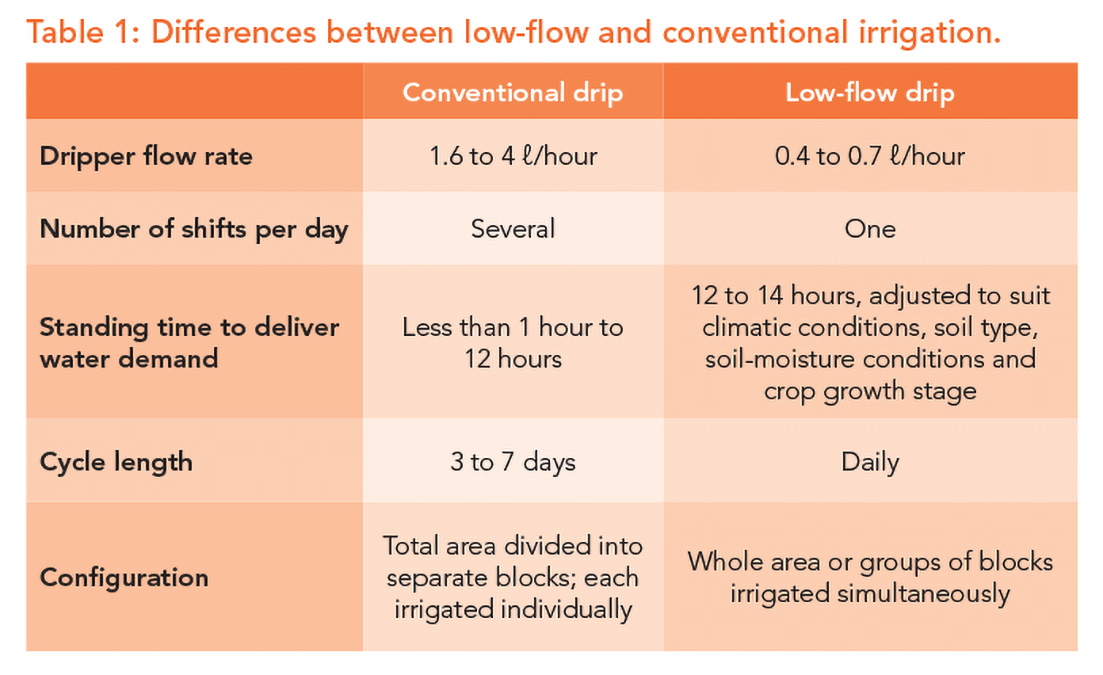
There are mainly three movements of water in the soil: vertical movement driven by gravity, horizontal (capillary) movement and surface wetness, which can lead to run-off. In conventional drip irrigation systems, where delivery rates typically range from 1.6 to 4 ℓ/hour, it can be difficult to control the depth of infiltration, since the application rate may exceed the soil’s capacity to absorb it. Run-off or surface wetting may occur, and/or some water may infiltrate deeper than the active root zone.
More frequent, shorter irrigation cycles can help mitigate this issue.
In practice, this could in some cases mean using pulsed standing time of less than one hour at a time. However, this approach carries the risk of the subsoil becoming oversaturated with water and therefore anaerobic. It is also impractical to manage such short irrigation intervals, and the hydraulic performance of the system is reduced due to losses during the time pipelines fill and drain.
Crops can experience stress when the subsoil becomes oversaturated and poorly aerated. Water that drains beyond the crop’s root zone into the subsoil carries nutrients out of reach of the roots and can also contribute to groundwater contamination.
With low-flow irrigation, it becomes much easier to control the depth to which irrigation water infiltrates the soil. It is also possible to have better control of the air-water ratio in the soil.
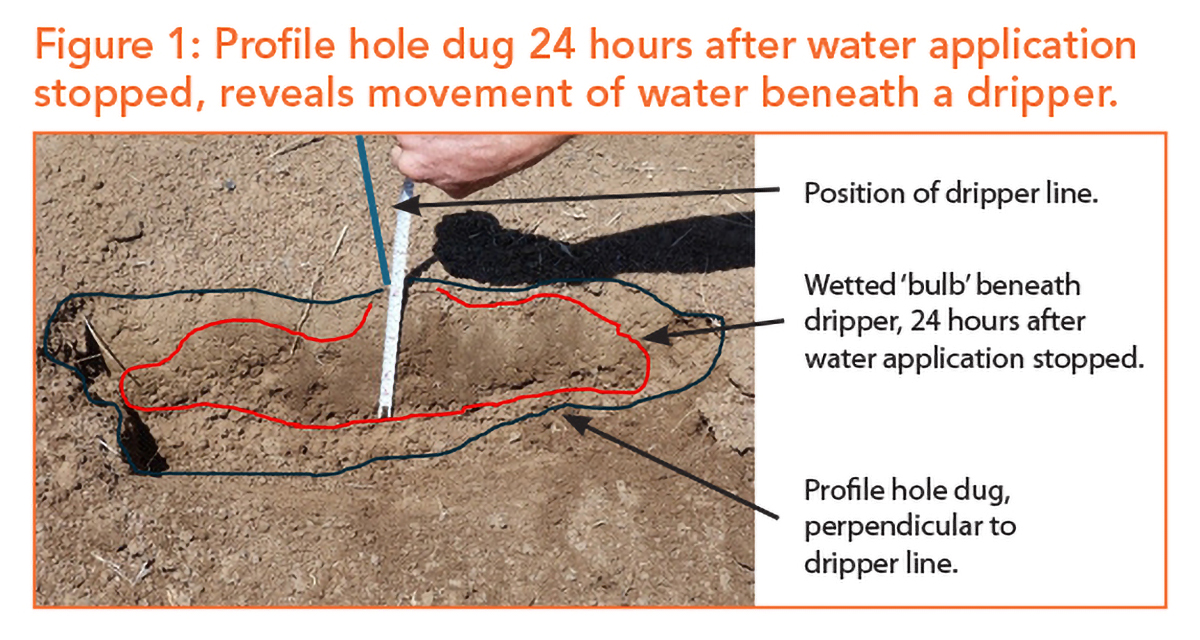
As a management tool, weekly measurements of soil moisture status at various locations within the irrigated area are essential. This should be done at least at three depths below the soil surface, providing a good indication of how irrigation should be adjusted to optimise conditions for the crop in the following week. In addition, profile holes can be dug to observe how water is spreading both horizontally and vertically beneath the drippers.
Water movement from drippers
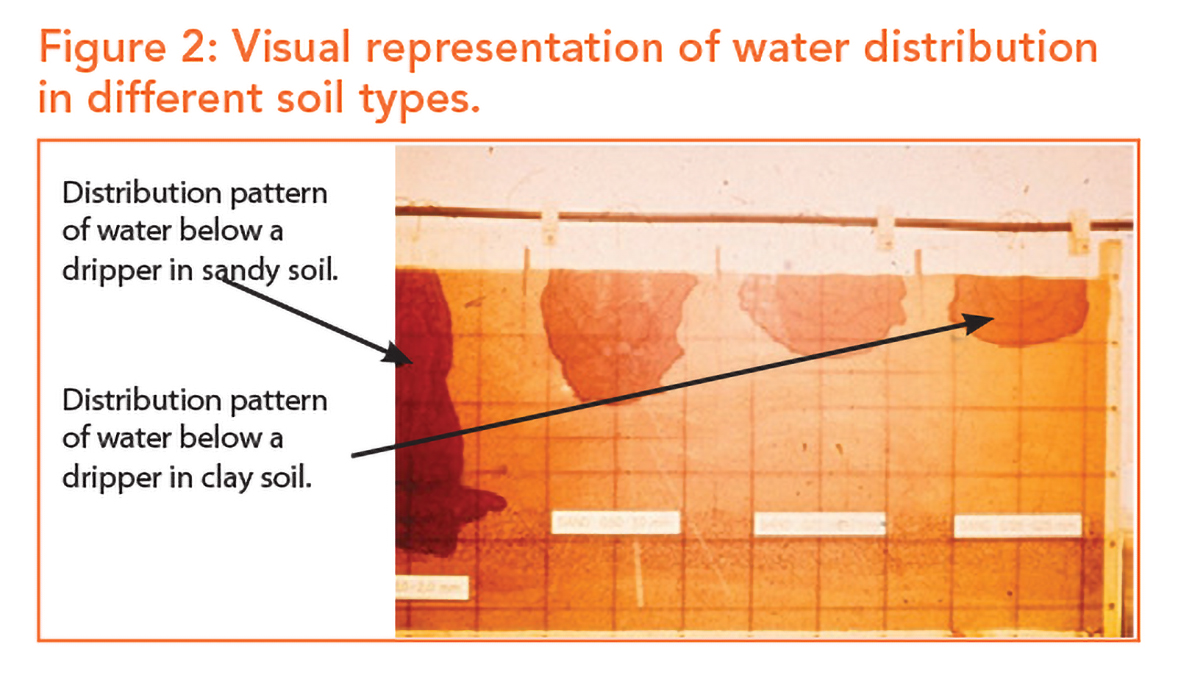
The wetted pattern beneath a dripper typically resembles an onion bulb in ideal soil conditions. The form and dimensions of this ‘bulb’ are determined by the soil characteristics and the dripper’s flow rate. The soil in Figure 1 could have a layer that restricts infiltration. Generally sandy soil has a deep, narrow wetted area, whereas clay soils result in a wider, shallower wetted zone.
Dripper flow rate plays a major role in how water moves through the soil. When the flow rate is relatively high (>1 ℓ/hour), as in conventional drippers, vertical movement beneath the dripper is dominant. With low-flow rate drippers, which deliver water at very low rates (<1 ℓ/hour), horizontal movement of water beneath the dripper is more dominant.
Water can be lost through several mechanisms, including evaporation, deep infiltration out of the crop root zone into the subsurface water table, and surface run-off. However, this does not imply the water is entirely ‘lost’. It is just being used to sustain other functions in the water cycle, even though it is no longer available for use by the irrigated plants.
Efficient crop irrigation
To improve crop water-use efficiency, losses from evaporation and deep infiltration should be addressed. It is essential that the application rate of irrigation water does not exceed the soil’s infiltration rate. Irrigation sessions should be long enough to wet the crop root zone to field capacity. The soil’s characteristics determine its water-holding capacity, and irrigation must be carefully managed to avoid the soil being saturated to the point that water-holding capacity is exceeded, which can lead to run-off or water infiltrating deeper than the root zone.
Irrigation scheduling involves managing the timing and duration of irrigation to optimise crop water-use efficiency. The optimal depletion of water that is readily available to the plant at each growth stage is determined in advance during system design. In-time soil water content is defined as the difference between the field capacity and the allowable water depletion. During each irrigation cycle, sufficient water is applied to restore the soil water status to field capacity.
Importantly, when using low-flow drip irrigation and its associated precision irrigation technology, regular measurement of soil moisture and plant water requirements must be taken into consideration for weekly irrigation planning purposes.
The depth to which irrigation water infiltrates can be controlled more accurately with low-flow irrigation. As a result, water is used more efficiently, and the soil remains better aerated. However, the success of new technologies depends on their correct application. – Fanie Vorster, ARC-Agricultural Engineering
For more information, send an email to VorsterS@arc.agric.za