
Small potatoes, big benefits: Nutritional power for school meals
Estimated reading time: 4 minutes
Following our March/April 2025 CHIPS article regarding the value of small potatoes in the diets of school-going children, Potatoes SA has undertaken a further study to emphasise the vital role small potatoes can play in improving child nutrition. Potatoes are not just a ‘side dish’, they are also a nutrient-dense, portion-controlled source of essential vitamins and minerals which is on par with other vegetables – and they complement many proteins and vegetables.
Following our initial comparison between large and small potatoes in the Potatoes SA Limpopo cultivar trial to evaluate their nutritional differences, we compared our findings with our Eastern Free State cultivar trial in Reitz.
This assessment was repeated on the same cultivars, namely Mondial, Palace, and Sound to address the question whether small potatoes, being more affordable, will offer greater nutritional benefits per serving than large potatoes.
Bridging nutritional gaps
In many rural and low-income communities, learners depend on school feeding schemes for the daily meal they receive.
These schemes rely heavily on affordable staples such as maize porridge or rice for carbohydrates, soya beans for protein, and vegetables such as cabbage or butternut.
While effective in combating hunger, meals containing maize and rice often fall short of delivering the full spectrum of nutrients children need to thrive, while potatoes provide a well-balanced alternative.
Potatoes are frequently overlooked in school feeding projects and even government hospitals, despite having the potential to fill critical nutritional gaps, especially considering their size and variety.
Nutrient highlights: Small vs large
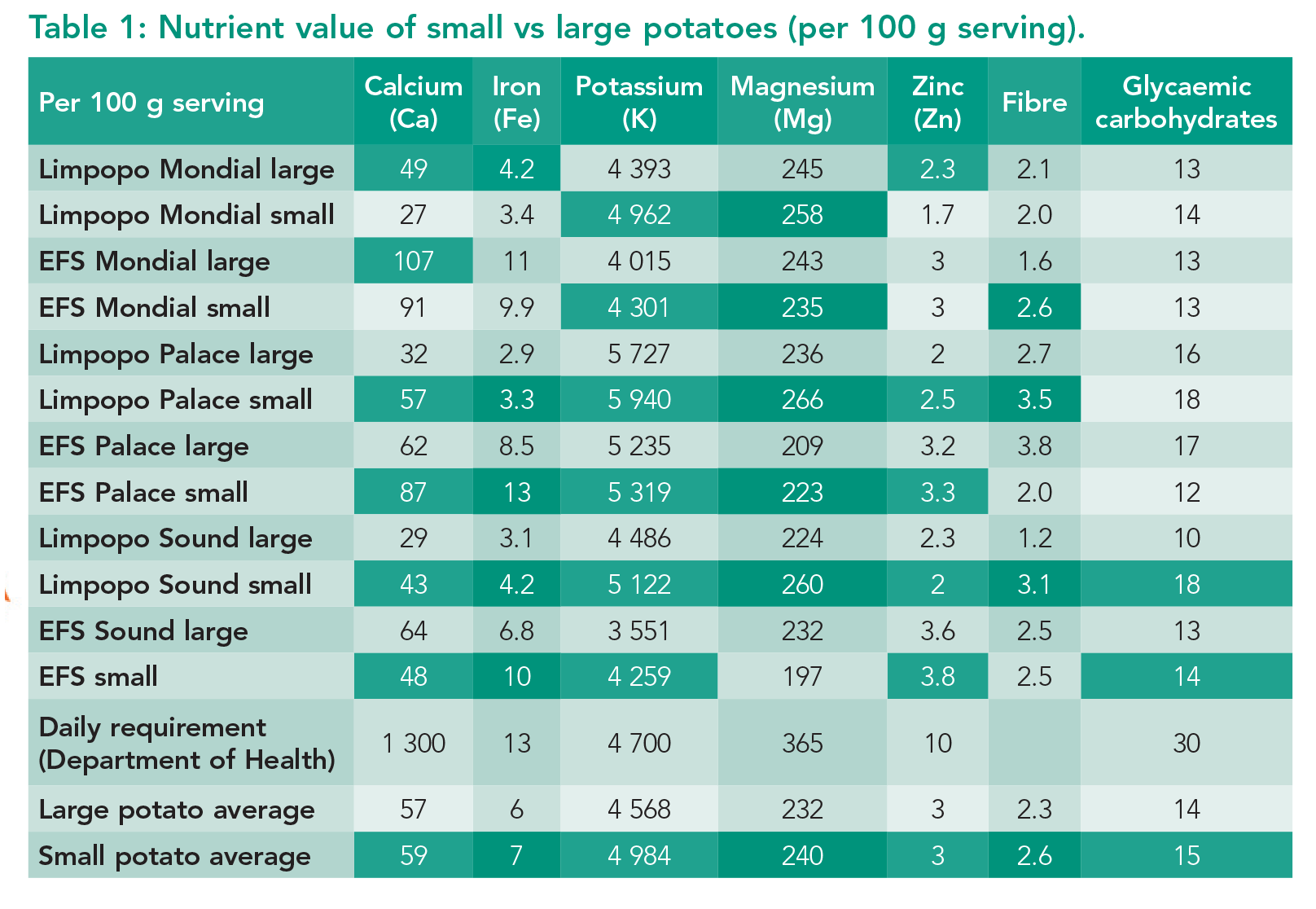
Our analyses, conducted by Assure Cloud Laboratories (Table 1), showed that small potatoes often contain equal or higher concentrations of important nutrients essential for the development of children:
- Calcium (Ca) is important for a potato’s quality and is responsible for the crop’s tolerance to diseases. In children, Ca plays a crucial role in bone development and muscle activity. The trial showed high levels in most of the small potatoes, excluding Mondial. As an example, small Palace potatoes from the Limpopo trials had the highest Ca content of 57 mg/kg, while the Ca content in the Eastern Free State trial was 87 mg/kg.
- Iron (Fe), which plays an important role in haemoglobin production, was also higher in small Sound and Palace varieties with an Fe content of 13 mg/kg in Palace, which meets the daily Fe requirements.
- Potassium (K) is crucial for muscle and nerve function and is important for good heart health. Significantly higher levels were noted in small Palace and Sound potatoes. For example, small Palace potatoes from the Eastern Free State contained 5 319 mg/kg potassium, which meets the daily requirements for K.
- Magnesium (Mg), which is important for regulating muscle and nerve function, and supporting energy production, was generally higher in small potatoes (a significant amount of 260 mg/kg). This is proportionally higher than the Mg content of large potatoes.
- Zinc (Zn), which is important for immunity and children’s growth, was present in high levels (3.8 mg/kg) in the small Sound and Palace varieties harvested in the Eastern Free State. All the averages indicated that small potatoes generally deliver more nutrients per 100 g than large potatoes. We attribute this outcome to a lower water-to-nutrient ratio than larger potatoes.
What does this mean for learners?
These evaluations underscore the powerful role that small potatoes can play in child nutrition due to:
- A high nutrient content per serving that is ideal for growing appetites.
- A higher micronutrient density that complements other meals containing protein and vegetables.
- Better fibre and energy levels that aid digestion, concentration, and learning.
- Versatility and taste, easy preparation, and effortless combination with other food groups.
Fibre and glycaemic carbohydrates
Fibre plays an important role in the digestive system, especially if potato skins are included in the meal. Smaller potatoes tend to have a reasonable fibre content. Another important observation was that small potatoes tend to have slightly higher levels of glycaemic carbohydrates, resulting in more sustained energy release.
This makes them particularly suitable for children who need a stable energy source throughout the school day.
Small Palace potatoes from Limpopo recorded 18 g/100 g glycaemic carbohydrates compared to 16 g/100 g in larger potatoes.
Small but powerful
From a practical perspective small potatoes are easier for portion management, and they cook faster.
Their nutrient-rich profile makes them a strong candidate for inclusion in national school feeding programmes, specifically in areas where food diversity is limited.
The perception that potatoes should be peeled must be overcome, as consuming the skin is healthy for young and old as it provides fibre. Small potatoes also pair well with different types of protein, vegetables and gravies, and help to build balanced, nutritious meals.
Don’t overlook them because they are small. They may very well be the most powerful ‘small’ food that developing children are able to consume daily. – Dirk Uys
For more information, send an email to Sheila Makgato at sheila@potatoes.co.za